 22 Min


Customer service principles are the small set of rules a support team uses to decide how to treat a customer when no script covers the situation. Empathy, responsiveness, transparency, consistency and accountability are the usual core. In practice, the meaning of a principle shows up in a single choice: what an agent says when the policy and the customer pull in different directions.
This guide covers 15 customer service principles, each with a worked example, the habit that breaks it and the metric that shows whether it holds. It also covers something most lists skip: which principle wins when two of them conflict.
Last updated: October 5, 2026.
Table of contents
- What Are Customer Service Principles?
- Customer Service Principles at a Glance
- 15 Customer Service Principles You Need to Know
- When Customer Service Principles Conflict, Which Wins?
- Why Are Customer Service Principles So Important?
- Customer Service Principles in the Age of AI Agents
- How to Put Customer Service Principles Into Practice
- The Role of Knowledge Management in Delivering These Principles
- Principles Hold Only When the Answers Behind Them Hold
- Frequently Asked Questions
What Are Customer Service Principles?
A principle is a decision rule. It tells an agent what to favor when the situation is new, the customer is upset and the knowledge article does not quite fit. “Tell the customer the real timeline, even when it is bad news” is a principle. So is “fix the cause before you patch the symptom.”
People often mix up three terms that sit close together, and the difference matters when you write them down for a team. The table below separates customer service principles and practices from the standards that measure them.
| Term | What it is | Example |
|---|---|---|
| Principle | A value that guides a judgment call | Give the honest timeline, even when it disappoints |
| Standard | A measurable target that tests the principle | Every delay message names a date |
| Practice | The daily routine that delivers the standard | A delay template with a mandatory date field |
They also differ from personal skills. A skill belongs to one agent; the principle is what the whole team agrees to do. Individual customer service strengths such as patience help an agent live up to a principle. Still, the principle has to hold for whoever picks up the call, including the agent who joined last Monday and has not yet met the edge cases, angry customers and policy exceptions that a five-year veteran handles without thinking.
Customer Service Principles at a Glance
Here is the full list before the detail. Every row shows what the principle looks like, what usually breaks it and which metric exposes the break.
| Principle | What it looks like | What breaks it | Metric that shows it |
|---|---|---|---|
| Empathy | Names the problem and its impact first | Repeated scripted apologies | CSAT on resolved contacts |
| Active listening | Restates the issue, asks one question | Jumping to the first likely fix | Repeat contact rate |
| Responsiveness | Fast reply plus a time for the next update | Silence while the case waits in a queue | First response time |
| Transparency | Real timelines; says when a bot answers | Optimistic dates nobody believes | Complaints about broken promises |
| Clarity | Short steps in plain words | Jargon and long articles read aloud | Repeat contacts asking what a step meant |
| Consistency | The same answer on every channel | Agents keep private notes | QA variance between agents |
| Accountability | Owns the error and states the fix | Blaming another team or the system | Escalations about the same error |
| Professionalism | Calm, courteous tone under pressure | Mirroring the customer’s anger | QA tone score |
| Personalization | Skips questions already answered | Asking for the order number twice | Average handle time on repeat customers |
| Proactivity | Warns about the next likely problem | Waiting for the second complaint | Contacts per order or account |
| Speed of resolution | Fast closure, beyond a fast reply | Fast replies that never resolve | Time to resolution |
| Omnichannel context | Chat history visible on the call | Every channel starts from zero | Transfers per contact |
| First contact resolution | Resolved in one interaction | Escalating what the agent could solve | FCR rate |
| Employee empowerment | Agents can approve small fixes themselves | Every refund needs a supervisor | Escalation rate |
| Continuous improvement | Top contact reasons fixed at the source | The same issue every month | Contact rate by reason |
15 Customer Service Principles You Need to Know
These are the key principles of customer service, in roughly the order a contact meets them, and every one comes with an example of what it sounds like on a call or how it plays out over the life of a case.
1. Empathy
Empathy means acknowledging the problem and what it costs the customer before solving it. It is one sentence, not a paragraph. “I’m sorry the router failed on the day you work from home. Let me get you a replacement today.” That names the impact and moves straight to the fix. For tested wording, see these empathy statements grouped by situation.
2. Active Listening
Active listening is hearing the full problem before answering it. Agents who do it well restate the issue and ask a single question that narrows it down: “So the app logs you out every time you switch to the camera. Does it happen on Wi-Fi as well as mobile data?” That question decides which troubleshooting path follows.
3. Responsiveness
Responsiveness is how fast the customer hears back, and whether they know when they will hear again. Expectations are short. In HubSpot’s State of Service research, 82% of service professionals said customers expect their requests resolved immediately, and the desired timeline was under three hours. A quick first reply with an honest time for the next update meets that expectation better than a perfect answer tomorrow.
4. Transparency
Transparency is telling the truth about timelines, limits and mistakes. It now includes telling customers when they are talking to software. Salesforce’s AI Connected Customer research, a 2024 survey of 15,015 consumers, found nearly 75% want to know if they are communicating with an AI agent. Also, 45% said a clear escalation path makes them more likely to use one. So disclosure is part of the principle, and so is the handoff.
5. Clarity
Clarity means the customer can act on what the agent said without calling back. Use plain words, one step per sentence and no internal codes. “Go to Settings, then Billing, then tap Update Card” is clear. A link to a long article is not.
6. Consistency
Consistency means two agents give the same answer to the same question, on any channel. It sounds basic, and it is where many teams fail. Agents keep their own notes, policies change mid-week, and the chat team and the phone team end up quoting different refund windows. Fixing it is mostly a content problem. One approved answer has to exist before anyone can repeat it.
7. Accountability
Accountability is owning a mistake and saying what happens next. “We charged you twice; that was our error. The duplicate refund goes out today and you will see it within five business days.” No blame on the billing system, no passive voice, and a date the customer can check.
8. Professionalism
Professionalism is keeping a steady, courteous tone when the customer does not. It also means knowing where the line sits: an agent can end an abusive call politely, following a policy the team has agreed in advance.
9. Personalization
Personalization uses what the company already knows to save the customer effort. “I can see you called on Tuesday about the same invoice, so let’s pick up from there” is personal. Using the customer’s first name four times is not.
10. Proactivity
Proactive service deals with the next problem before the customer meets it. Tell them the replacement device needs a firmware update before it will pair, or that a refund will appear as two separate amounts. One warning now prevents a second contact. It costs a sentence.
Give Every Agent the Same Correct Answer
11. Speed of Resolution
Speed of resolution is the time from first contact to a closed issue, which is different from how fast the first reply arrives. A team can answer chats in 30 seconds and still take nine days to fix a billing error. Track both, because customers judge the second.
12. Omnichannel Context
Omnichannel context means the conversation carries over when the customer moves from chat to phone. Customers notice when it does not. Zendesk’s CX Trends 2026 report found 74% of customers find it frustrating to tell their story over and over to different agents. Of all 15, context fails most often for technical reasons. A multichannel contact center that runs chat and phone as separate queues is where it breaks first.
13. First Contact Resolution
First contact resolution is solving the issue in one interaction, with no callback or transfer. It depends on two things: the agent can find the correct answer during the contact, and the agent is allowed to act on it. More on improving first contact resolution covers the measurement in detail.
14. Employee Empowerment
Empowered agents can approve small fixes without asking a supervisor, within limits written down in advance. For example, a resolution matrix might let agents waive one late fee per year, issue a refund up to an agreed amount and escalate anything above it.
15. Continuous Improvement
Continuous improvement means fixing the reason customers contact you. Getting faster at answering the same complaint every month does not count. So once a month, take the top five contact reasons. Ask which one a product, policy or content change could remove for good, and give that change an owner and a date.
When Customer Service Principles Conflict, Which Wins?
Two principles collide on almost every hard contact. A list that never says which one wins leaves each agent to decide alone, and that is how consistency breaks. The order below is an argument, and a team can disagree with it, but it should agree on some order and write it down.
- Accuracy over speed. A fast wrong answer creates a second contact and usually a complaint. If the agent is unsure, a short hold to check beats a guess.
- Honesty over reassurance. “Five to seven days” disappoints once. “Probably tomorrow” disappoints twice.
- Same policy, personal delivery. Personalize the words, never the outcome. Two customers with the same problem should get the same result, explained differently.
- Resolution over handle time. A call that runs four minutes long and closes the issue costs less than two short calls that do not.
The one exception is safety and compliance. In banking, insurance and healthcare, a regulated step wins over every principle above, including speed and empathy, and agents should hear that said plainly.
Why Are Customer Service Principles So Important?
The principles matter because they decide what happens in the contacts nobody planned for. Those are the contacts customers remember, and recent surveys agree on what customers want from them.
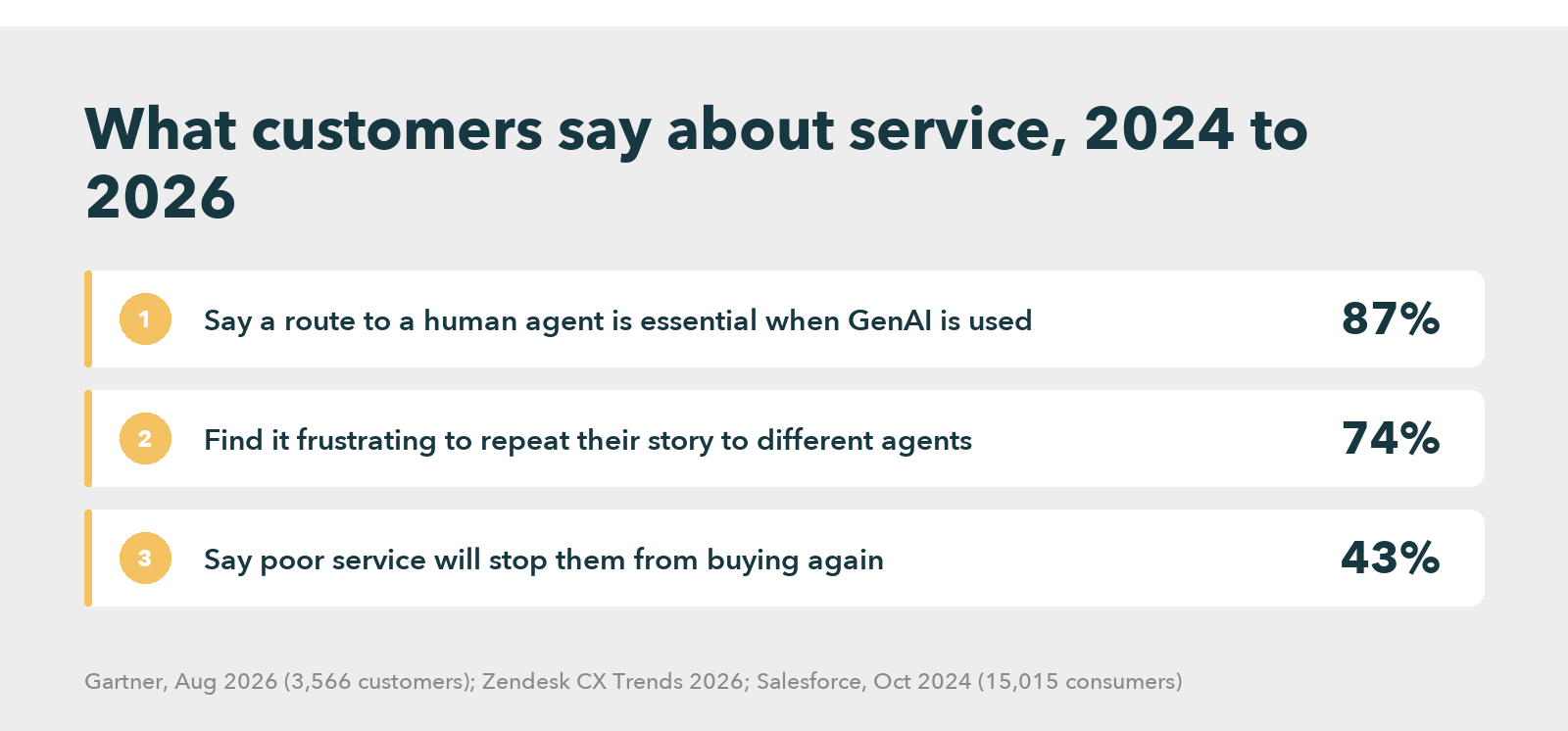
The cost side is direct. In the same Salesforce consumer study, 43% of consumers said a poor customer service experience will stop them from making a repeat purchase. And the principles in this guide that customers notice most, such as context, honesty and first contact resolution, are exactly the ones that break when agents cannot find a current answer.
There is a second reason, which is less obvious. A written set of principles lets a team scale without writing a rule for everything. A 40-agent team can lean on a supervisor’s judgment. Once the team reaches 400 agents across three sites, nobody can escalate every judgment call, and the principles become the supervisor.
Customer Service Principles in the Age of AI Agents
AI has not replaced the principles of good customer service. It has made a few of them harder to keep. In an August 2026 survey of 3,566 customers, Gartner found 87% say it is essential to offer a way to reach a human agent when a company uses GenAI for service.
Three principles change shape as a result. Transparency now covers disclosure that a bot is answering. Context covers the handoff, since a bot that collects the account details and then passes the customer to an agent who asks again breaks the principle twice. And consistency covers the bot as well as the people, because a chatbot and an agent drawing on different content will give different answers.
Self-service makes the same point. In a Gartner self-service survey of 5,728 customers published in 2024, only 14% of customer service issues were fully resolved in self-service, and 43% of failures came from customers not finding relevant content. Clarity and consistency apply to help articles as much as to agents.
How to Put Customer Service Principles Into Practice
A principle document that lives in a shared drive changes nothing. These five steps turn the basics of customer service into habits, for a small desk or a large contact center.
- Pick five principles, not 15. Choose the five that match your largest QA and complaint gaps. A telecom with many repeat contacts might pick active listening, first contact resolution, clarity, consistency and accountability.
- Write each one as a behavior with a script line. “Accountability” alone is vague. “When we made the error, say so in the first sentence: ‘That charge was our mistake'” is a behavior a QA analyst can score.
- Rank them for conflicts. Publish the order from the section above, or your own, so an agent knows that accuracy beats speed before the hard call arrives.
- Put the approved answer where the agent works. A call center knowledge base that agents search during the contact is what makes consistency possible. For example, if the refund window changes on Tuesday, every channel should quote the new window by Tuesday afternoon.
- Measure one metric per principle for six weeks. Use the metric column in the table above. If first contact resolution climbs steadily over the six weeks, keep the change. If it does not move, look at the content before blaming the agents.
Customer Service Principles in BPO Operations
For customer service principles in BPO operations, add one step. A BPO agent may handle two or three client processes in a single shift, each with its own policies. The principles stay the same across clients, but the approved answers must be separated by client, or consistency breaks the moment an agent switches process.
What Principles Cannot Fix
Here is the concession. Neither principles nor better tools fix a hiring or culture problem. A team that does not care about customers will not start caring because a poster says “empathy”, and buying software to solve a coaching problem wastes money. The reverse also holds, though: no amount of coaching makes an agent consistent when the right answer cannot be found.
See How Findable Knowledge Changed Agent Results at Scale
The Role of Knowledge Management in Delivering These Principles
Look back at the table and count how many principles fail for the same reason. Six of them, namely consistency, clarity, transparency, first contact resolution, omnichannel context and speed of resolution, all break when the agent, or the bot, is working from outdated or scattered information.
That is the job of a knowledge layer: one approved answer per question, updated once and served to the agent desktop, the chatbot and the help center at the same time. Guided troubleshooting flows help with clarity and speed, because the agent follows the same steps every time instead of improvising.
Knowmax is one option built for this in contact centers. In a telecom case study, an Indian mobile network operator reported better first contact resolution after moving its agents onto a single knowledge source with guided flows. A Fortune 500 retailer reported shorter handling times and fewer agent errors after a similar change, which is the case study offered above. Neither case was about writing new principles; both were about making the right answer easier to find.
Other approaches work as well. A small team with a stable product can keep consistent answers in a well-run help desk macro library. The case for a dedicated knowledge management platform grows with the number of agents, channels and policy changes per month.
Principles Hold Only When the Answers Behind Them Hold
Most teams already agree on the principles of excellent customer service. Very few rank them, measure them or check whether agents can actually find the answer each one depends on. Choose five, write the order they win in, give each a metric, and then look hard at whether your agents can find a current answer while the customer is still talking.
Turn Your Service Principles Into Answers Agents Can Find
Frequently Asked Questions
Seven principles recur on most published lists: empathy, active listening, responsiveness, transparency, consistency, accountability and first contact resolution. Other lists swap in product knowledge, accessibility or proactivity. The exact seven matter less than agreeing which ones your team uses and which wins when they conflict.
The golden rule of customer service is to treat customers the way you would want to be treated. In practice that means honest timelines, owning mistakes and never making a customer repeat their story. It works as a tiebreaker when a written policy does not cover the situation.
No, the principles of customer care and customer service principles describe nearly the same thing. Care usually describes the long-term relationship, and service the individual contact. In India, and in BPO job descriptions especially, the two terms are used interchangeably, so the same principles apply to both.
Consistency matters most at scale, because every other principle depends on agents giving the same correct answer. A smaller team can rely on individual judgment, but once several shifts and channels are involved, inconsistent answers cause more repeat contacts and complaints than any single tone or speed problem.


 Word Document)
 Excel File)


