 21 Min



Updated October 2026
AI powered knowledge management is a knowledge system where an AI model answers questions, but only from content that has an owner, a review date, an approval and a permission rule attached. The model supplies the language. The governed record decides what it may say.
That split is where pilots tend to succeed or fail. A model can read anything you point it at. But whether it should is a content decision. Somebody has to make it before launch, because the alternative is making it after the first wrong answer reaches a customer.
This guide stays on one question: what must be true of knowledge before an AI may use it? It lists the fields that make knowledge governed, shows what the AI does when a field fails, and summarizes what Knowmax’s own published pages say about those checks, because buyers hear plenty of vendor claims and need a way to test them. Teams that search for an AI knowledge management system, or for governed knowledge AI, will know the design.
Table of contents
- What AI powered knowledge management reads: the governed record
- How governed AI answers behave when a check fails
- One question, traced through the governed record
- Why AI powered knowledge management fails without governed knowledge
- What research says about AI powered knowledge management readiness
- Where AI powered knowledge management sits in the wider system
- How do you stop AI from hallucinating? Start with the knowledge source
- How Knowmax applies AI powered knowledge management to governed content
- Knowmax view: governed knowledge AI starts before the model
- What to check before you buy an AI knowledge management system
- When this approach is the wrong one
- Frequently asked questions
What AI powered knowledge management reads: the governed record
Every article in the store carries a small record next to its text. The text says what to do. The record says whether the AI may repeat it, to whom, and for how long. Six fields matter most. The table lists what each one controls at answer time.
| Field | What it holds | What the AI does with it |
|---|---|---|
| Owner | One named person or role accountable for the article | Sends a flagged answer to someone who can fix it |
| Review date | The day the article must be checked again | Drops the article from answers once the date passes |
| Approval status | Draft, in review or approved | Reads approved articles only |
| Approved source | The policy, system or document the content came from | Shows where the answer came from, so a reader can check |
| Permission | Which audiences may see the article | Keeps internal notes out of customer answers |
| Audit trail | Who changed what, and when | Lets a team see why an answer read as it did |
However, none of these fields is new. Good knowledge teams kept most of them long before language models existed. What changed is the cost of leaving one blank. A person who finds a stale article usually notices that something is off, but a model repeats it in fluent prose, and the smooth wording hides the problem from anyone who reads the answer without checking where it came from.
How governed AI answers behave when a check fails
At the moment a check fails, a governed system differs from an ungoverned one. Ask to see the cases below, because a demo that shows only passing checks proves little.
| Article state | Ungoverned behavior | Governed behavior |
|---|---|---|
| Review date passed last month | Answers from it with full confidence | Excludes it, or flags it for the owner and answers from current content |
| Still in draft | May be retrieved because it exists | Never retrieved |
| Internal only, customer asks | Can leak into a customer answer | Not eligible for that audience |
| Two articles disagree | Picks one, often the longer | Surfaces the conflict to an owner before it ships |
| No article covers the question | Writes a plausible guess | Declines and logs the gap |
The last row deserves the most attention. A refusal feels like failure in a demo, yet it is the only honest answer when nothing approved exists. Buyers who punish a refusal get the guesser. The logged gap is the most useful output, because it tells owners what to write next.
The knowledge governance guide covers the principles behind these rules in depth, such as approval workflows and expiry dates.
One question, traced through the governed record
Take an agent who asks, “Can I waive a late fee for a customer who is two days past due?” Here is what a governed system does with it, step by step, from the moment the question arrives to the moment the answer appears.
First it finds candidate articles. It then drops any article that fails a check: unapproved, past its review date, or restricted to another audience. Say one article remains, a fee waiver policy owned by the billing operations lead. The model drafts an answer from that article alone and shows the source. If the agent doubts the answer, a flag reaches the named owner, and the system logs the change.
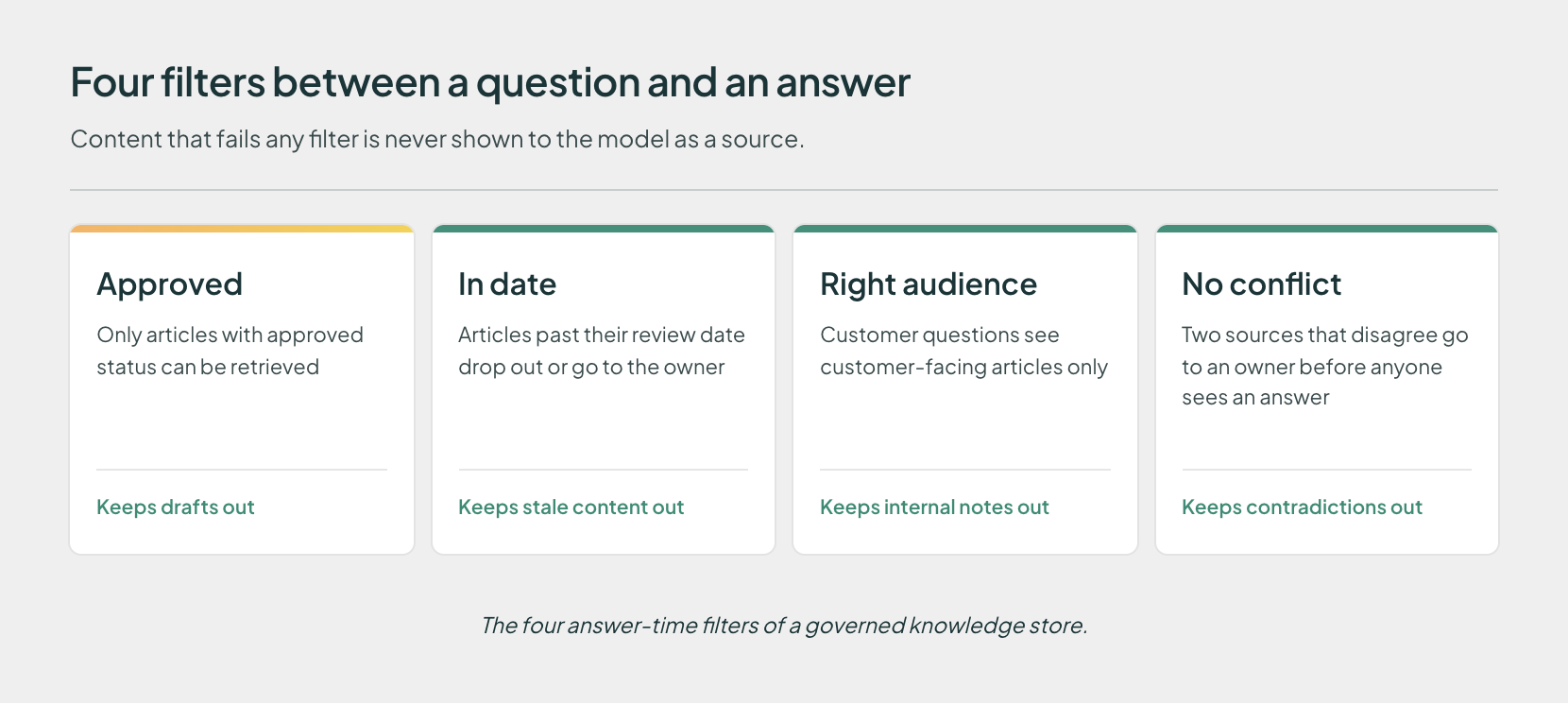
The same mechanics apply in contact center knowledge management, where agents act within seconds.
Why AI powered knowledge management fails without governed knowledge
A team buys or builds the AI layer first and connects it to whatever content exists. Launch follows. Early demos look good because someone picked the questions. Nobody picked the awkward ones. But real traffic finds the gaps.
Three causes recur:
- Stale content stays eligible. Nobody removed the old pricing page, and the model has no way to know it expired.
- Ownership is vague. An article belongs to a team, then to nobody. When someone flags it, no one acts.
- One pool serves every audience. Internal and customer-facing material share a retrieval index.
The supply side, the quality of what gets found, becomes the limit once search works. The 2020 paper by Lewis and colleagues, which introduced retrieval-augmented generation, framed the idea as pairing a model with an external, updatable knowledge source. That source is a managed asset. The model reads from it and does not replace it.
Start With the Beginner’s Guide to Knowledge Management
What research says about AI powered knowledge management readiness
Several Gartner studies point at the same weak spot. It is preparation. In a July 2024 survey of 1,203 data management leaders, 63% said their organizations lack, or are unsure they have, the right data management practices for AI. That is from Gartner’s AI-ready data release. Gartner also predicts that through 2026, organizations will abandon 60% of AI projects unsupported by AI-ready data. Knowledge articles are data that an assistant reads, so applying this to them is our inference.
The oldest figure here dates from 2012. A McKinsey Global Institute report estimated that interaction workers spend nearly 20 percent of the workweek looking for internal information or tracking down colleagues. It also estimated that a searchable record of knowledge can reduce search time by as much as 35 percent. The finding sits in McKinsey’s social economy report, which predates generative AI and speaks only to search time.
Where AI powered knowledge management sits in the wider system
Governed content is one layer. Retrieval, generation and delivery sit on top of it, and the source layer sets the ceiling for the rest.
This is why a knowledge management system matters more in an AI project than the model does, because the system is where teams assign owners, track review dates and record approvals, while a standalone chatbot has none of that to read from and so has nothing approved to answer with.
Read the Guide on Leveraging Knowledge for AI
How do you stop AI from hallucinating? Start with the knowledge source
Advice on how to stop AI from hallucinating usually covers prompts and model settings, and those help a little, but the larger lever sits earlier, because a model cannot repeat an error that is outside the content it may read. Governance shrinks that content to articles somebody owns, dates and approves.
It will not remove every error, since a model can still misread an approved article. What changes is the trail: a wrong answer points at one article and one person.
Meanwhile, formal guidance treats this as a management task. NIST published its Generative AI Profile in 2024 as a companion to the voluntary AI Risk Management Framework. It aims to help organizations build trustworthiness into the design, development, use and evaluation of AI systems. The full text is on the NIST Generative AI Profile page.
At the organizational level, ISO published ISO/IEC 42001 in December 2023. It specifies requirements for establishing, maintaining and improving an AI management system, and ISO calls it the world’s first AI management system standard. See the ISO/IEC 42001 standard page. In our reading, article-level checks sit inside that frame.
How Knowmax applies AI powered knowledge management to governed content
Knowmax describes its product as an AI-powered knowledge management platform that helps CX teams. Its content verification guide calls it purpose-built for contact center knowledge management. Because every capability below comes from Knowmax’s own published pages, treat each one as a vendor claim and test it in a trial.
What Knowmax’s pages say it does
The Knowmax guide to the agentic AI knowledge base says the platform consolidates knowledge scattered across CRMs, wikis, shared drives and agent handbooks into one governed repository. It also adds automated content freshness scoring, ownership assignment and review cycle management.
The content verification guide gives three specifics. Reviewers receive automated assignments with defined completion windows. An article with no assigned reviewer cannot be published in verified status. An “AI-ready content” status holds articles cleared for AI retrieval to a higher standard than general agent content. The same guide says Knowmax links CSAT scores and escalation patterns back to specific articles, which it calls a closed-loop verification signal.
Governance at answer time is the third piece. The knowledge governance guide says controls operate at the retrieval layer, so AI agents surface only verified, in-date content that has passed the approval workflow. On the knowledge management system pillar page, Knowmax’s AI is described as answering only from approved content. Its home page lists a Google-like search engine, SOPs turned into interactive workflows, and ready APIs to CRMs, helpdesks and ticketing systems.
Use This Guide to Choose a Knowledge Management System
Two limits to test before you rely on it
None of this removes the work of writing and owning articles. A platform can assign an owner, but it cannot give that person the time. Time is the hidden cost. And a vendor’s description of a control does not prove the control fits your approval process. So ask to watch a failed check in a trial with your own content.
Knowmax view: governed knowledge AI starts before the model
These four positions are Knowmax’s view, each tied to a named source.
Answer quality is a governance problem before it is a model problem. A Gartner readiness survey covered more than 200 service and support leaders, from December 2024 to January 2025. Leaders effective at organizational readiness saw a 300% increase in the likelihood of reaching technology goals, while leaders effective at vendor and product evaluation saw 50%. The survey covers service technology broadly, so it supports the view without proving it.
A model should not answer from content nobody owns. The AI-ready data guidance from Gartner says that if the data has issues, the data is not ready for AI. But an article with no owner, review date or approval has an issue by that standard. So it should stay out of answers.
A logged refusal beats a confident guess. In a Gartner chatbot survey published in September 2026, only 27% of customers said they would try a chatbot again after a negative experience. A declined answer, in contrast, tells an owner what to write next. The Knowmax system guide makes the same point: ask what the AI does when approved content lacks the answer, because the right response is “I do not know”.
Shared ownership is no ownership. The content verification guide from Knowmax lists a missing ownership model first among six common failure points. It also says each article needs a named reviewer. That is a vendor’s view of its own market, so test it against your own backlog.
Plan the Rollout With the Implementation Guide
What to check before you buy an AI knowledge management system
There is no single best AI knowledge management system, because the right one depends on your content, your approvals and your channels, so a short test is the fairest way to separate systems that govern from systems that only answer.
- Failed checks on screen. The vendor should show an expired, an unapproved and an internal-only article being excluded from an answer.
- A real refusal. Put a question to it that your content cannot answer, and confirm the AI declines and logs the gap.
- Owner rules. An article should be unable to reach approved status without a named owner.
- One answer, fully traced. You should be able to see the article version, approver and date behind a single answer.
- Your own content. Load ten of your real articles and search for them the way an agent would phrase the question.
Teams that want to run this test on their own articles can book a personalized demo with Knowmax.
When this approach is the wrong one
Governed AI knowledge has a cost, and a fair account names it. Review cycles, for example, take expert time. A team of ten with forty well-kept articles probably does not need approval workflows or an AI layer, so the overhead buys little. A good search box already does the job.
Regulated wording, such as a loan disclosure or a medical instruction, is a second case. Still, a generated paraphrase carries risk even from approved sources. Instead, show the approved text as written. Use the AI to find it.
The view taken here is that AI knowledge projects fail on the record before they fail on the model. That is an argument, not a measured result, so a team with spotless content and a narrow scope may reasonably disagree.
Before you start, pick the fifty questions agents ask most often. Next, confirm each has one approved, owned, dated answer. Finally, compare vendors on how they handle that record. The roundup of AI knowledge management tools is a starting list.
If your team still treats a knowledge base and a knowledge management system as one thing, the knowledge base definition separates them.
Talk to Knowmax About Governed Knowledge for AI
Frequently asked questions
AI powered knowledge management is a knowledge system where an AI model answers questions only from governed content. Each article has an owner, a review date, an approval and a permission rule. The model writes the answer, and the governed record decides which content it may use.
Knowledge is governed when each article has a named owner, a review date, an approval status, a known source, an audience permission and a change history. If one is missing, the AI cannot tell whether the article is safe to use, so it should stay out of answers.
You reduce hallucinations mainly by limiting what the AI may read. Let it answer from approved, in-date, owned articles. Exclude drafts and restricted content, and let it decline when no approved article exists. This lowers the risk without removing it, because a model can still misread an approved article.
A knowledge base stores articles. An AI knowledge management system adds owners, review dates, approvals, permissions and a model that answers from approved content. The knowledge base is one part of the system. Without that process, it can still feed an AI, but the model cannot judge what is safe.
Choose by testing failures, since feature lists look alike. Load ten of your own articles. Have the vendor show an expired, an unapproved and an internal-only article being excluded, and show what the AI does when no approved answer exists. Check ownership rules and the audit trail too.


 Word Document)
 Excel File)


