 15 Min



An AI ready knowledge foundation is the part of every AI rollout that nobody budgets for. The agents get funded. The integration gets scoped. The knowledge those agents will answer from gets assumed.
Then the pilot goes live and the bot confidently quotes a policy that changed in March. Naturally, nobody blames the knowledge.
This is a working playbook, not a think piece. Five steps, with the checklists and targets you need to run each one. It scales down to a twenty-seat team and up to an enterprise.
Table of contents
The AI ready knowledge foundation in five steps
| Step | What you do | Typical Duration |
|---|---|---|
| 1 | Audit your knowledge landscape | 2–3 weeks |
| 2 | Assign ownership and governance | 1–2 weeks |
| 3 | Consolidate and structure | 6–8 weeks |
| 4 | Build feedback loops | 2 weeks, then ongoing |
| 5 | Integrate, adopt, measure | Ongoing from month 4 |
Step 1: Audit your knowledge landscape
You cannot fix what you have not counted. Therefore, start by finding every place knowledge currently lives.
Sources to check:
- Knowledge bases and internal wikis
- CRM case notes and custom fields
- Ticketing system resolutions
- Shared drives and document repositories
- Chat channels and email threads
- Product documentation
- Team playbooks and runbooks
- Training and onboarding material
Most organisations find five to ten primary sources. However, the count matters less than the switching: every extra source is another place an agent has to check before answering.
Then score each source, 0 to 3:
| Dimensions | The question to ask |
|---|---|
| Completeness | Can an agent answer the top 100 questions from this source alone? |
| Freshness | Was it updated since your last major product or policy change? |
| Consistency | Is the same topic described identically across sources? |
| Usability | Can an agent find what they need in under 30 seconds? |
Consequently, scores expose the digital tombs quickly. Any source averaging below 1.5 is not a knowledge asset. It is a liability with a URL.
Step 2: Assign ownership and governance
Admittedly, this step is where most knowledge programmes quietly die. After all, without an owner content decays at exactly the rate your product changes.
Therefore, treat staffing as the first real decision.
Staffing rule of thumb: roughly one knowledge owner per 50 agents. Under 20 agents, half an FTE. Above 100, budget for one and a half to two. Treat it as a real role, not a stretch assignment, and have it report into operations or customer success rather than any single department.
Five governance questions to answer in writing:
- Who creates knowledge? Product, support, or both?
- Who approves it? Does compliance need to sign off?
- How often is it reviewed? Quarterly, per release, or both?
- What triggers an off-cycle update?
- How does an agent flag something wrong, in under ten seconds?
Keep it light. The instinct is to build an approval chain. Resist it. A seven-step workflow guarantees nobody updates anything. “Flag for review” beats “submit for approval” every time, because the failure mode you should fear is not bad edits. It is no edits.
Step 3: Consolidate and structure your AI ready knowledge foundation
Now build. In short, the goal is one place agents look, integrated into the tools they already have open.
Start with the top 50 questions. Not everything. Instead, fifty. Consolidate those into one answer each, and expect to find three things:
- The same question answered differently in different systems
- Content that contradicts your current policy
- Gaps where nobody ever wrote it down, so agents improvise
Resolve each as you go, with a subject matter expert signing off. Admittedly this is slow, and that is the whole point. Otherwise, you simply migrate your inconsistencies into a nicer interface.
Structure it so there are no wrong doors. A working taxonomy usually covers products and services, common scenarios, policy topics, troubleshooting paths, and escalation criteria. Ideally, agents reach an answer by browsing, searching, or following a guided path. Process-heavy contacts belong in an interactive decision tree rather than a long article, because a branching procedure read under time pressure is where interpretation errors happen.
Step 4: Build feedback loops
A knowledge base without feedback is a snapshot. In effect, it starts decaying the day you finish it.
Four mechanisms, in order of value:
- A flag button on every article. One click, optional comment, straight to the owner’s queue. Because if flagging takes longer than asking a colleague, agents will ask the colleague.
- Failed-search reporting. What are agents searching for and not finding? In effect, that list is your content backlog, written by the people who need it.
- Repeat-contact signals. Customers contacting twice about one topic usually indicates a gap, not a difficult customer.
- A quarterly review. The owner works through product changes, flags and search gaps, then updates in a batch.
Overall, these four turn maintenance from a guessing exercise into a queue. That is the difference between a foundation that lasts and one that needs rebuilding in eighteen months.
Step 5: Integrate, adopt, measure
Integration first. Naturally, if agents must open a separate tab, adoption suffers badly. Surface knowledge inside the CRM, helpdesk or agent desktop so it becomes the default rather than a detour.
| Metric | Target |
|---|---|
| Daily active usage among agents | 85%+ |
| Questions answered in under 30 seconds | 80% |
| First-contact resolution | Improving quarter on quarter |
| Average handle time | Trending down |
| Agent-reported ease of finding answers | Rising on a quarterly pulse survey |
A note on those targets: usage and time-to-answer are yours to control directly, so hold the line on them. Meanwhile, treat resolution and handle time as directional rather than promised, since seasonality, product changes and staffing all move those numbers too. Claiming a precise improvement you cannot isolate is how good programmes lose credibility with finance.
Where an AI ready knowledge foundation usually fails
Five steps, five predictable failure modes. Recognising yours early saves a quarter.
Step 1 fails when the audit becomes the project. Teams build elaborate inventories of every document in the organisation and never reach step three. Two to three weeks, then stop. An incomplete audit that leads to action beats a perfect one that leads to another audit.
Step 2 fails when ownership is nominal. Somebody gets the title, nobody gets the hours. If the knowledge owner still carries a full queue, knowledge work loses to the queue every single day. Protect the time explicitly or expect the role to exist only on the org chart.
Step 3 fails when nobody will decide. You will find two contradictory answers and discover that the two subject matter experts disagree. Consequently, the article sits in draft for six weeks. Name a tie-breaker before you start, usually the operations lead, and give them permission to be wrong and correct it later.
Step 4 fails when the feedback goes nowhere visible. Agents flag an issue, nothing happens, and flagging stops within a month. Close the loop out loud: tell the person who flagged it what changed. That single habit keeps the channel alive.
Step 5 fails when you never baselined. Measure time-to-answer and daily usage *before* launch. Teams routinely skip this, then cannot demonstrate improvement and lose the budget for phase two. Baselining costs one week and protects the whole programme.
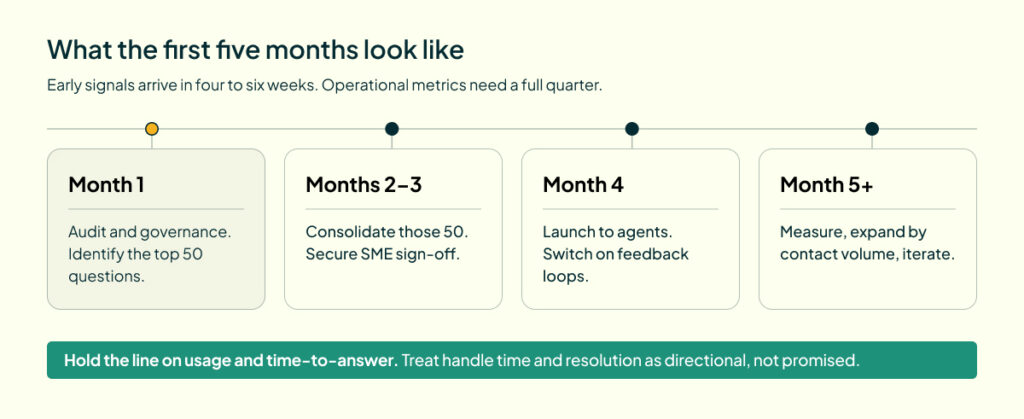
Timeline for an AI ready knowledge foundation
- Month 1 — Audit and governance. Identify the top 50 questions.
- Months 2–3 — Consolidate those 50. Get SME sign-off.
- Month 4 — Launch to agents. Switch on feedback loops.
- Month 5 onward — Measure, expand by volume, iterate.
Early signals arrive within four to six weeks of launch, usually as reduced time-to-answer and better agent confidence. Meanwhile, the harder metrics lag. However, operational metrics take a quarter, because they need enough volume to separate signal from noise.
Why an AI ready knowledge foundation matters more now
Everything above is ordinary contact center knowledge management discipline, and it was worth doing before anyone mentioned AI. Notably, the research agrees: APQC found that knowledge workers lose close to three hours a week simply looking for or requesting information, long before any bot entered the picture.
What changed is the cost of skipping it. For example, a human agent who distrusts the knowledge base works around it and quietly protects the customer. An AI agent has no such instinct. It retrieves what you gave it and delivers the answer with complete confidence, at volume.
So an AI ready knowledge foundation is not a prerequisite you clear before the interesting work starts. Ultimately, it decides whether the interesting work succeeds at all.
Frequently asked questions
For an AI ready knowledge foundation, budget roughly one full-time equivalent per 50 agents. Half an FTE below 20 agents, one and a half to two above 100. What matters more than the ratio is that it is somebody’s actual job with time protected for it.
In short, centralisation matters more than the tool. A well-organised wiki that agents actually open beats a sophisticated platform they never visit. That said, dedicated platforms handle version control, review cycles, guided workflows and failed-search analytics natively, which makes an AI ready knowledge foundation considerably easier to maintain at scale.
Start with the top 50 questions, consolidated into one hub. Get adoption on that core, then expand by contact volume. Attempting a full migration first is the most common way this stalls.
Three things: quarterly review, a flag mechanism that takes seconds, and one accountable owner. Those three matter more than any feature. Clear ownership with a simple tool beats a sophisticated tool with no owner.
Yes, and running them in parallel is better than sequencing. The agents will answer from whatever you have built by the time they go live. Just be honest in the plan about which contacts your knowledge can actually support at launch.


 Word Document)
 Excel File)


