 12 Min



The 2026 CX automation stack looks complete on paper. Nearly every contact center now runs an AI agent, a copilot, a knowledge search bar, a chatbot, and auto-summarization. Adoption is effectively saturated. Yet repeat contacts keep climbing, agents still escalate, and pilots stall before they reach production. The AI in customer service 2026 statistics explain why, and the answer is not the tools most teams are buying.
The gap sits one layer down. AI agents, copilots, and chatbots are all consumers of knowledge; they can only resolve what they can retrieve. But knowledge management, the discipline that keeps content accurate, current, and machine-retrievable, is the least-automated part of the entire stack. Everyone deployed the answer-givers faster than they fixed the answers.
Table of contents
What the 2026 CX Automation Stack Reveals
A brief for CX leaders on why the layer everyone under-invested in decides whether the rest works.
A CX operations leader pulls up her automation dashboard in mid-2026 and sees five tools live: an AI agent on chat, a copilot in the agent desktop, a knowledge search bar, a legacy chatbot on the website, and auto-summarization on wrap-up. On paper, the contact center is fully automated. In practice, repeat contacts are up, and she can’t say why. Our guide to contact center automation covers the wider picture.
Her situation is the industry’s. The AI in customer service 2026 statistics show near-universal adoption of automation capabilities, sitting on a thin, cracked foundation. This is a brief on what the adoption numbers actually reveal, and why the layer everyone under-invested in is the one deciding whether the rest works.
The stack, ranked by adoption
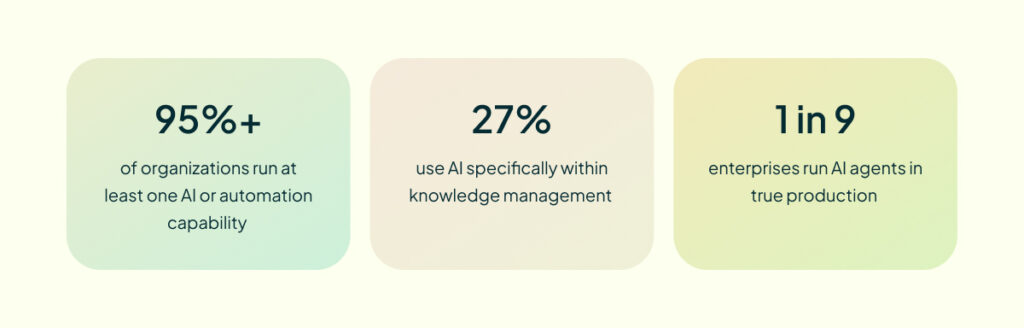
A May 2026 Valoir report gives the clearest read on what CX teams have actually deployed. More than 95% of organizations now run at least one AI or automation capability, so adoption is effectively saturated. But the ranking underneath that headline is where the story lives.
| Capability | Adoption | What it does |
|---|---|---|
| AI agents | 61% | Autonomously handle defined customer intents |
| Copilots | 55% | Assist human agents in real time |
| Knowledge search | 54% | Surface answers from the knowledge base |
| Chatbots (traditional) | 50% | Scripted, rules-based deflection |
| Automated summarization | 48% | Draft wrap-ups and case notes |
Read it top to bottom and it looks like a healthy, layered stack. Read it as a dependency chain and a problem appears. AI agents, copilots, and chatbots are all consumers of knowledge; they cannot resolve anything they cannot retrieve. Yet the knowledge layer they all depend on, knowledge search, sits at 54%, behind the very tools that rely on it. The industry deployed the answer-givers faster than it fixed the answers.
Rebuild the Bottom of Your Automation Stack
The 27% that explains the production gap
The most revealing single number in the 2026 data isn’t about agents at all. It’s that just 27% of businesses use AI within knowledge management, the discipline of keeping content accurate, current, and machine-retrievable. Knowledge management is the least-automated corner of the contact center, even as it becomes the most load-bearing.
Put that next to the deployment reality and the picture snaps into focus. Nearly four in five enterprises (79%) have adopted AI agents in some form, but only about one in nine (11%) runs them in true production, a roughly 68-point gap, among the largest deployment backlogs in enterprise technology . Companies bought the tools. They never went live. And the postmortems keep pointing at the same culprit: the model answered fluently from duplicated, expired, or contradictory knowledge , so it never earned the trust required to run unsupervised.
The pattern in one line: enterprises automated the parts of CX that are visible in a demo, and under-automated the part, knowledge, that decides whether the demo survives contact with real customers.
Why the money keeps flowing anyway
None of this has slowed spending, because the prize is enormous. AI is projected to cut roughly $80 billion in contact center labor costs by 2026, and the agentic AI market is on a path from about $7.6 billion in 2026 to a projected $236 billion by 2034, a compound growth rate north of 40%. Boards see those numbers and fund the agents. The unglamorous knowledge work that would make the agents pay off rarely gets its own line item.
That is the arbitrage available to CX leaders right now. Everyone is buying the top of the stack. The teams that will actually capture the savings are the ones quietly rebuilding the bottom of it, because a cheaper AI grounded in governed knowledge outperforms a frontier model grounded in chaos, every time.
See What a Knowledge-First Stack Looks Like in Action
What a healthy stack looks like
Invert the adoption ranking. In a stack that actually resolves customer issues, the knowledge layer is the most mature, most governed, most invested-in component, not the fourth priority. Three traits separate the teams whose automation works.
1. One source, many consumers
The AI agent, the copilot, the chatbot, and the self-service portal all read from the same governed knowledge base. When an answer changes, it changes once and propagates everywhere. This is the difference between managing knowledge and managing copies of knowledge. The moment the same policy lives in five places, four of them are already wrong. Contradictions between channels, the fastest way to destroy customer trust, become structurally impossible when every tool draws from one source.
2. Knowledge that is built to be retrieved
Content is structured as decision trees, guided workflows, and self-contained articles rather than long PDFs and tribal Slack threads. This is what lifts knowledge search above its 54% ceiling. Retrieval quality is a property of how knowledge is authored, not just of the model doing the searching. A frontier model still fails if it has to pull an answer out of a 40-page manual written for auditors, not agents. Break that same content into discrete, intent-mapped steps and even a modest model resolves the query cleanly.
3. Governance as a running discipline
Ownership, version control, and effective dates make every answer traceable and current. This is the 27% frontier, applying AI and workflow to knowledge management itself, and it is where the next two years of CX advantage will be won. Governance is not a one-time cleanup project. It is the operating rhythm that keeps the other two traits true over time, because a single source only stays trustworthy if someone owns it, and retrieval-ready content only stays accurate if it expires on schedule.
The takeaway for CX leaders
The 2026 automation stack is top-heavy. Enterprises bought agents, copilots, and summarizers faster than they fixed the knowledge those tools stand on, and the pilot-to-production gap is the bill coming due. The correction is not more AI at the top; it is investment at the bottom. Audit your knowledge layer against the tools that depend on it, and you will usually find the reason your automation dashboard looks full while your repeat-contact rate climbs.
Ready to Build Your Own Customer Service Knowledge Base?
FAQs
More than 95% of organizations run at least one AI or automation capability, per a May 2026 Valoir report. AI agents lead at 61%, followed by copilots (55%), knowledge search (54%), chatbots (50%), and automated summarization (48%).
Only about 27% of businesses apply AI within knowledge management. It is unglamorous, hard to demo, and rarely gets its own budget line, even though AI agents, copilots, and chatbots all depend on it to resolve anything.
Roughly one in nine (11%) do, despite nearly four in five (79%) having adopted them, a 68-point gap. The recurring cause is ungoverned knowledge: models answer fluently from duplicated, stale, or contradictory content and never earn the trust to run unsupervised.
AI is projected to cut around $80 billion in contact center labor costs by 2026. Capturing that depends less on the model tier and more on grounding AI in complete, current, governed knowledge.


 Word Document)
 Excel File)


