 11 Min


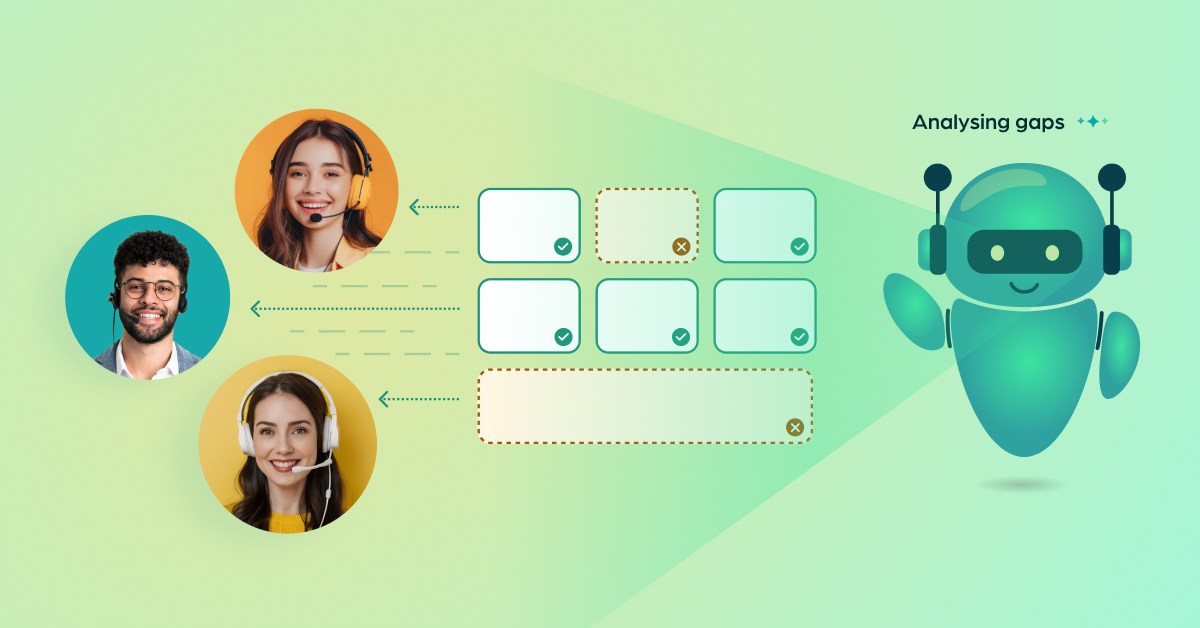
Everyone expected AI to wipe out jobs. What’s actually happening in contact centers in 2026 is stranger. AI isn’t cutting your headcount, it’s exposing all the AI knowledge gaps your team was quietly covering up.
Ask any experienced agent how they hit their targets and they’ll tell you the truth: they just know stuff. They know which policy is actually current, which help article is useless, and who to message on Slack when the official answer is wrong. None of that is written down anywhere. It lives in their heads, and it’s what keeps customers happy. AI doesn’t have any of it. So the second you connect AI to your knowledge base, every gap those agents were filling suddenly shows up, all at once.
This is what most CX leaders get wrong. The real question in 2026 isn’t “how many agents can AI replace?” It’s “what happens when AI reads my whole knowledge base out loud to a customer?”
Table of contents
Why AI Knowledge Gaps Are Impossible to Hide
The gap doesn’t go away. It just gets dressed up to look like a real answer, and then gets sent to customers at full speed.
That’s why so many AI projects never take off. Gartner’s widely cited research shows that around 89% of AI agent pilots never make it to launch, and most fail for the same reasons: messy answers and no clear owner for the content. Both of those are knowledge problems dressed up as tech problems. The few teams that succeed are usually the ones that cleaned up their knowledge first.
Here’s the hard truth: your AI’s accuracy isn’t something you fix in the settings. It’s a live, public report card on how healthy your knowledge base really is, shown to customers in real time.
What actually happens to the support team
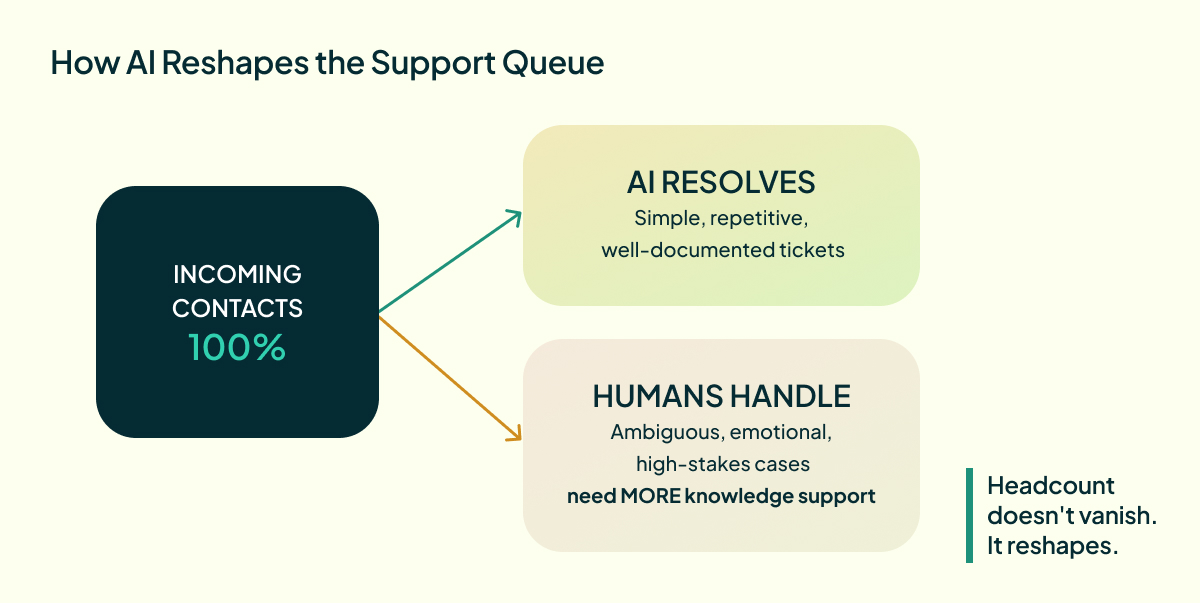
Headcount doesn’t vanish. It reshapes.The real shift is that AI knowledge gaps that used to stay hidden now surface instantly.
The volume of simple, repetitive contacts falls, because AI can genuinely resolve them once the knowledge behind them is clean. What’s left for humans is harder: the ambiguous, emotional, high-stakes cases where judgment matters most. Those agents don’t need less knowledge support. They need more.
Consider a financial services contact center. AI can confidently handle “how do I reset my online banking password” once that article is accurate and current. But a customer disputing a fraudulent transaction, mid-panic, needs an agent who can navigate policy exceptions, regulatory obligations, and emotional de-escalation at the same time. That agent’s effectiveness depends entirely on whether the knowledge behind them is trustworthy because now they’re only handling the hard calls, with no easy tickets to catch their breath between.
The numbers tell the same story from a distance:
| Metric | Figure | Source |
|---|---|---|
| Organizations that have deployed AI agents to date | 17% | Gartner, 2026 |
| Organizations planning to deploy within two years | 60% | Gartner, 2026 |
| Enterprises with at least one AI agent in production | 31% | S&P Global / McKinsey, 2026 |
| Agentic AI projects Gartner expects canceled by 2027 | 40% | Gartner, 2025 |
The gap between wanting AI and actually running it isn’t a tech problem. It’s the difference between “we bought AI” and “our knowledge is actually ready to feed it.” Teams that use AI as a reason to fix their knowledge, giving every article a clear owner, a verification date, and one single source of truth, make it across that gap. Teams that use AI as an excuse to cut staff find out the hard way: the AI just inherits the same mess the agents were quietly cleaning up, only now there’s no human left to catch the mistakes.
Why this reframe matters now, not next year
AI adoption in CX has crossed from curiosity to commitment, and that’s exactly why AI knowledge gaps are suddenly everyone’s problem. Most enterprise teams already have a pilot running or budgeted, which means the knowledge base is about to be tested whether it’s ready or not. Waiting until after deployment to discover the gaps is the most expensive possible order of operations, because by then the wrong answers are already reaching customers.
There’s also a compounding effect. Every inaccurate AI response trains customers to distrust self-service, which pushes them back to human agents , the exact outcome AI was meant to reduce. A messy knowledge base doesn’t just cap your AI’s ceiling; it actively erodes the deflection you already had. Fixing knowledge early isn’t a nice-to-have ahead of an AI rollout. It’s the thing that determines whether the rollout pays back at all.
Is your knowledge base at risk? A quick self-check
Before you point AI at your content, run through these five questions to find your AI knowledge gaps before your customers do.
- Owners: Does every article have a named person accountable for keeping it accurate?
- Freshness: Can you tell at a glance when each article was last verified?
- Consistency: If two articles answer the same question, do they say the same thing?
- Coverage: Are your top 20 contact drivers documented clearly and completely?
- Findability: Would an AI retrieving on keywords surface the correct article, not an outdated one?
This isn’t a theoretical exercise. Each “no” is a place where AI will confidently repeat something wrong to a customer.
Create Your Knowledge Base with These Templates
How to make your knowledge base AI-ready
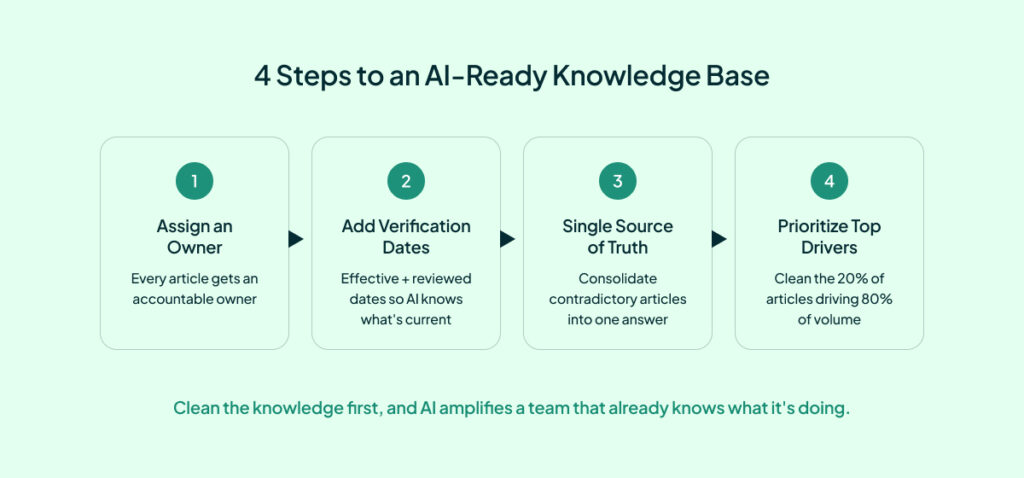
You don’t need a full content overhaul before you start. You need governance and prioritization. Four moves matter most:
- Assign every article an owner. Unclear content ownership is one of the top reasons pilots fail. If no one owns an answer, no one is accountable when the AI repeats it wrong.
- Add effective and verification dates. An AI can’t tell a current policy from a stale one. Dates give both your agents and your AI a signal for what to trust.
- Consolidate contradictory sources into a single source of truth. Two conflicting articles don’t cancel out — the AI will confidently pick one, and it may be the wrong one.
- Prioritize your top contact drivers first. You don’t have to clean everything. Clean the 20% of articles that drive 80% of your volume, and you’ve de-risked most of what AI will actually surface.
A governed, AI-ready knowledge layer turns your knowledge base from a liability into an asset the moment AI starts reading it out loud.
The move for CX leaders in 2026:
Stop asking how many agents AI can replace. Ask what your knowledge base looks like the day an AI reads every word of it aloud to a customer. If that question makes you nervous, that nervousness is the project.
Fix the knowledge, and AI amplifies a team that already knows what it’s doing. Skip it, and AI amplifies the gaps — at the speed of software.
Ready to Build Your Own Customer Service Knowledge Base?
Frequently Asked Questions
Not wholesale. In 2026, AI is resolving high-volume, well-documented contacts and shifting human agents toward complex, judgment-heavy cases. The bigger effect is that AI exposes the AI knowledge gaps that experienced agents were quietly covering for.
Most failures trace back to inconsistent output quality and unclear content ownership rather than the model itself. Both are knowledge-management problems: an AI agent can only be as accurate and consistent as the knowledge it’s grounded in.
It reshapes headcount more than it shrinks it. Repetitive contact volume drops, while the remaining human work becomes harder and more valuable — which means agents need stronger, not weaker, knowledge support.
Assign every article an owner, add effective and verification dates, consolidate contradictory sources into a single source of truth, and prioritize your top contact drivers first.


 Word Document)
 Excel File)


