 12 Min


By now you have seen the number in a dozen board decks. Gartner projects that agentic AI customer service will autonomously resolve around 80% of common issues by 2029. In 2024 the figure sat in low double digits. Most people read that as a forecast about artificial intelligence. In other words, the models are on an unstoppable curve, and human contact centers sit three years from obsolete.
That reading is a myth. The number itself is fine. What people assume it measures is not. Because 80% does not describe how smart the models will get. Instead, it describes how much of your knowledge will sit in a state that a machine can safely act on. And that single reframe changes what your team should do this year.
Table of contents
What the agentic AI customer service forecast actually measures
Watch how the 80% figure travels. First, a vendor drops it on a slide beside a glowing brain. Then a consultant uses it to justify a headcount plan. Finally, an executive hears that AI will do 80% of the work. So comes the inevitable question: why does the contact center still need its budget? In every retelling, the implied subject is the model, as though resolution arrives in a software update.
But a model does not resolve anything alone. Rather, it resolves a problem using knowledge, inside a process. Strip away the knowledge and the process, and even a frontier model becomes a very articulate guesser.
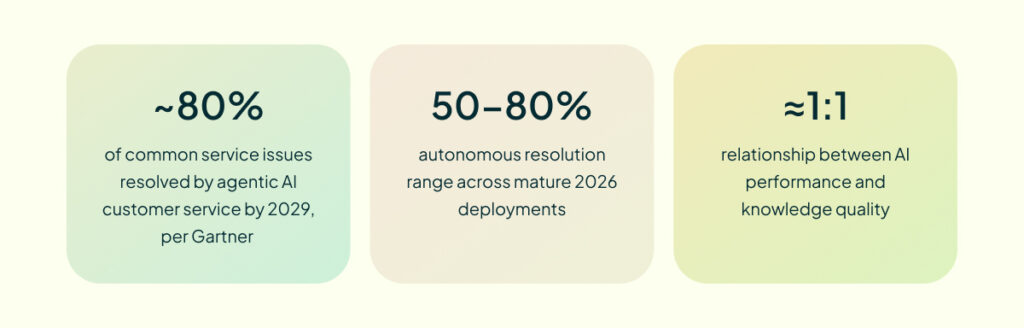
The 2026 benchmarks make this concrete. Mature autonomous deployments resolve somewhere between 50% and 80% of routine tickets today. However, the biggest variable between the bottom of that range and the top is not the model version. It is content quality. In fact, reporting across the year keeps landing on the same blunt conclusion. Agentic AI customer service performance is roughly proportional to the knowledge behind it.
So here is the honest translation. By 2029, leading enterprises will have moved 80% of common issues into a knowledge-and-process state AI can resolve. In short, the forecast describes an organizational bottleneck rather than a computational one.
Create Your Knowledge Base with These Templates
Capability versus resolution: the same model, 40 points apart
Consider two enterprises buying the identical agentic AI customer service platform in 2026. Both get the same model, the same orchestration layer, and the same voice and chat channels.
Company A spent two years consolidating knowledge into a single governed source. Its processes live as decision trees with explicit branches. Every article carries an owner, an effective date, and a verification date. So when the AI checks whether a customer qualifies for a refund, the logic sits right there, unambiguous and current.
Company B points the same model at a SharePoint graveyard. Four thousand documents, half of them stale, three competing answers for most questions, and no owner for any of it. As a result, the AI retrieves confidently and answers wrong. No single right answer exists to retrieve.
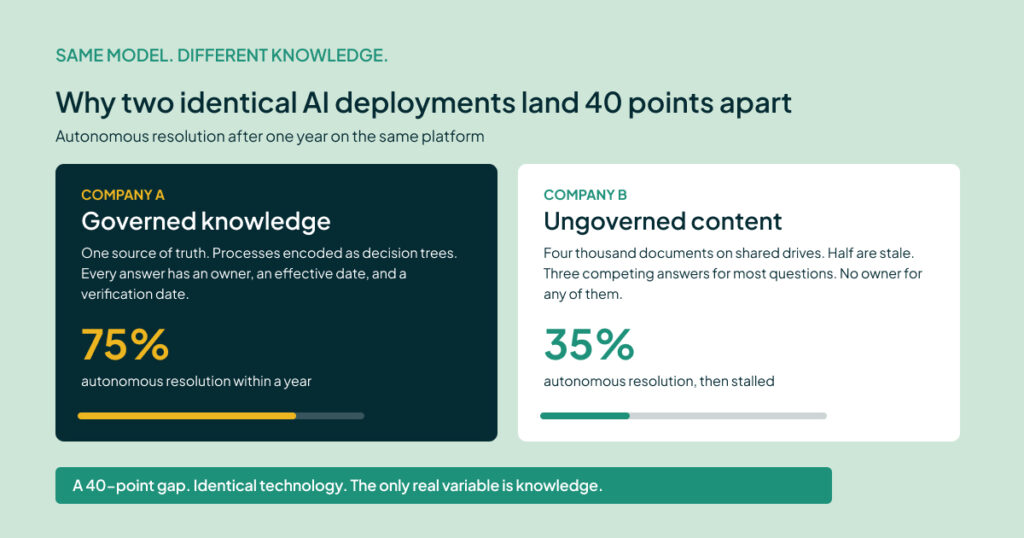
Company A reaches roughly 75% autonomous resolution within a year. Meanwhile, Company B stalls near 35% and blames the vendor. Same intelligence, 40 points apart. That gap is the whole story of the 80% number. It has nothing to do with parameters or training runs.
Read 80% as a deadline, not a forecast
Once you accept that knowledge is the constraint, the projection stops being a spectator sport and becomes a countdown. Suppose 80% of your common issues must become resolvable by agentic AI customer service by 2029. Then you have roughly three years. Three years to move your content from human-readable to machine-actionable, governed, and current.
That is not a light lift. Nor does it happen by buying a model. Instead, it happens through unglamorous knowledge work. You consolidate sources, restructure processes into decision logic, and assign ownership. Then you build the governance that lets a machine act on your content unsupervised.
Put simply, the enterprises that hit 80% in 2029 will treat 2026 as year one of a knowledge program. The ones still waiting for a better model to rescue a bad knowledge base will not.
Create FAQs with these Industry-Based FAQ Templates
The 20% that stays human is not random
A second myth hides inside the first. Many leaders assume the remaining 20% is simply the hard stuff AI cannot do yet. They expect it to shrink automatically as models improve. It will not, because knowledge conditions define that 20%, not difficulty.
The issues that stay human share one trait. Knowledge is absent, contested, or changing faster than anyone can govern it. Think brand-new products, edge-case regulation, judgment calls with no documented policy, and moments that need empathy more than information. No model resolves what nobody has decided. So if you never capture the tacit knowledge in your best agents’ heads, agentic AI customer service will never reach it.
Which means the size of your automatable share is, once again, a knowledge decision. You can grow it by capturing and governing more of what your experts know. Alternatively, you can let it stay locked inside people who eventually leave.
This is also why deflection is such a dangerous metric to chase. A bot can push a call away without resolving anything. That inflates an automation number while the underlying knowledge gap stays open and the customer calls back. Contained resolution, measured honestly, is the only number that tells you whether your knowledge is doing the work.
A three-year plan to make agentic AI customer service work
If 80% is a deadline, here is the shape of a program that meets it. Notably, none of these steps require a model upgrade.
Year one: consolidate and structure
Collapse your scattered sources into a single source of truth. Then identify your highest-volume issue types and convert those processes into governed decision trees. That means explicit logic a machine can follow, not prose it has to interpret. This step alone moves the resolution ceiling further than any model change available to you.
Year two: govern and instrument
Give every answer an owner, an effective date, and a verification date. Next, stand up the review pipeline that keeps AI-generated and human-authored content current. Finally, start measuring contained resolution and knowledge health instead of deflection. The goal is simple: reach a state where you can point AI at your content and not flinch.
Year three: expand the automatable share
Systematically capture the tacit knowledge that keeps issues in the human column. Debrief your best agents, document the judgment calls, and turn edge cases into governed content. Each capture converts a human-only issue into one that agentic AI customer service can resolve. As a result, you grow your share of the 80% deliberately rather than hoping the model closes the gap.
Build a Self-Service Knowledge Base with Ease
But the models will just get better
The strongest objection to this argument is simple. Model progress is real and fast, and tomorrow’s models will paper over messy knowledge in ways today’s cannot. There is truth in it. Retrieval keeps improving, context windows keep growing, and reasoning keeps getting more robust. A skeptic could reasonably argue that the knowledge-quality penalty will shrink over time. On that view, heavy investment in structure over-engineers a problem the model layer will eventually absorb.
That objection deserves a serious answer. Even so, a better model cannot resolve a contradiction that exists inside your source content. Suppose three documents say three different things and none carries an authoritative flag. No amount of reasoning tells the model which one your compliance team stands behind. And in regulated CX, the excuse that the model was probably right is not a defense. You need to show that an answer had an owner, an approval, and a current date.
Better models raise the floor. However, they do not remove the need for a source of truth to reason over. Nor do they supply the accountability to stand behind every answer. Knowledge work is not a hedge against weak models. It is the substrate that strong agentic AI customer service needs.
Ready to Build Your Own Customer Service Knowledge Base?
FAQs
Gartner projects that agentic AI will autonomously resolve around 80% of common customer service issues by 2029. In 2024 the figure sat in low double digits. Importantly, it covers common, well-scoped issues rather than every possible contact.
Because agentic AI customer service depends on grounding the model in accurate, structured, governed knowledge. The 2026 benchmarks show performance tracks content quality almost one to one. So the same model delivers very different resolution rates depending on the knowledge base behind it. In other words, the constraint is organizational readiness, not model capability.
Issues where knowledge is absent, contested, or changing faster than anyone can govern it. That includes new products, edge-case regulation, undocumented judgment calls, and situations that need empathy over information. These stay human because no model can resolve what an organization has never decided or captured.
Treat it as a three-year knowledge deadline. First, consolidate to a single source of truth and structure processes as decision trees. Next, add owners and verification dates, then measure contained resolution instead of deflection. Finally, capture tacit knowledge systematically so agentic AI customer service can resolve a larger share of your volume.


 Word Document)
 Excel File)


