 13 Min



Contact center knowledge gaps are expensive, and most published figures on exactly how expensive are worth very little. Aggregator sites recycle each other, arithmetic drifts, and a number gets quoted for years after anyone last checked it.
So this post does the opposite. Two credible studies, both named and dated. The arithmetic shown in full. A range rather than false precision, and the inputs exposed so you can substitute your own.
Table of contents
- What research says about contact center knowledge gaps
- The contact center knowledge gaps cost model, in full
- Why the range is wide, and why that is honest
- What contact center knowledge gaps cost beyond wasted hours
- Run the numbers for your own team
- How the number moves with your wage assumption
- Presenting this to finance
- Why contact center knowledge gaps persist
- Frequently asked questions
What research says about contact center knowledge gaps
Two sources survive scrutiny. However, they disagree, which matters.
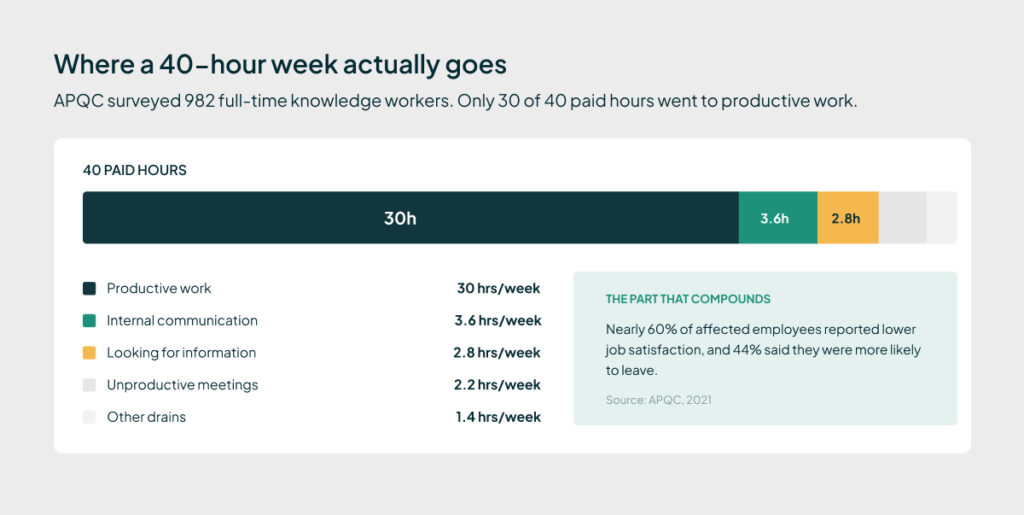
APQC, 2021, n=982. APQC surveyed 982 full-time knowledge workers and found the average knowledge worker spends only 30 hours of a 40-hour week on productive work. Weekly, the biggest drains were 3.6 hours on internal communication, 2.8 hours looking for or requesting information, and 2.2 hours in unproductive meetings.
That “30 of 40 hours” figure is the one worth remembering. In short, a quarter of your payroll does not go to productive work.
McKinsey Global Institute, 2012. The widely cited finding that employees spend 1.8 hours a day, or 9.3 hours a week, searching and gathering information. It is a strong number with a real caveat: it dates from 2012, and anyone citing it as current should say so.
A note on what we removed. An earlier draft of this analysis used a figure of 936 hours per employee per year. It traces to a statistics aggregator, and it cannot be right — 1.8 hours a day across 260 working days is 468 hours, not 936. We cut it rather than repeat it.
The contact center knowledge gaps cost model, in full
Same assumptions applied to both studies. Loaded cost of $70,000 per employee, 2,080 paid hours a year, giving $33.65 an hour.
| Input | APQC (2.8 hrs/week) | McKinsey (1.8 hrs/day) |
|---|---|---|
| Search time per week | 2.8 hours | 9.0 hours |
| Working weeks per year | 2.8 hours | 52 |
| Hours per employee per year | 146 | 468 |
| Hourly loaded cost | $33.65 | $33.65 |
| Cost per employee per year | $4,913 | $15,748 |
| 50-agent contact center | $245,650 | $787,400 |
| 200-agent contact center | $982,600 | $3,149,600 |
Both columns use the same wage assumption, so the gap comes entirely from the two studies’ estimates of search time.
See How Gen AI Can Elevate Your CX
Why the range is wide, and why that is honest
Admittedly, a factor of three looks unsatisfying in a business case. Even so, it beats a single confident number nobody can defend.
The two studies measured different things. APQC asked knowledge workers to estimate time spent specifically looking for or requesting information. McKinsey’s figure covers searching and gathering, a broader activity that includes assembling information once found.
Furthermore, contact center work differs from general knowledge work. Agents search under time pressure, mid-conversation, across more systems than a typical office worker. Reasonable people can argue that pushes them toward the higher end.
So treat $4,900 as the conservative floor and $15,700 as the plausible ceiling. If you need one number for a board paper, use the floor. A defensible small number persuades better than an indefensible large one.
What contact center knowledge gaps cost beyond wasted hours
The table above counts wasted hours only. Three further costs are real but harder to quantify honestly, so we have not invented figures for them.
Repeat contacts. Naturally, an agent working from incomplete information resolves less on first contact. The customer calls back, and you pay for the same conversation twice.
Quality and compliance risk. In financial services, insurance and healthcare, an agent citing superseded policy is not an inconvenience. It is an audit finding. We have seen no reliable public figure for the average cost, so we are not offering one.
Attrition. Here APQC does give us something solid. The same study found nearly 60% of affected employees reported lower job satisfaction and 44% were more likely to leave. Given contact center turnover, anything that measurably worsens satisfaction deserves attention on its own.
Run the numbers for your own team
Four inputs, and you should replace all four.
- Your loaded cost per agent. Salary plus benefits, tax and overhead. Finance has this figure.
- Your hourly rate. Loaded cost divided by paid hours, typically 2,080.
- Your actual search time. Do not borrow ours. Ask twenty agents to log, for one week, how long they spend hunting for answers. A week of real data beats any published average.
- Your headcount in scope. Agents only, or include team leads and QA if they also search.
Then multiply. Consequently, the output is defensible, because every input is yours.
That third step is the one teams skip, and it is the one that makes the business case survive contact with a CFO.
Provide Intelligent Support 24/7
How the number moves with your wage assumption
One input dominates the output, and it is not search time. It is loaded cost. So before anyone argues about which study to trust, check the wage figure against your own payroll.
Notice the spread. A contact center in a lower-cost market and one in a high-cost metro can run identical processes and land nearly $800,000 apart on the same analysis. Therefore any single published figure for the cost of contact center knowledge gaps is really a statement about somebody else’s payroll.
That is also the answer to the objection you will hear in the room: “those numbers feel high.” Usually they feel high because the loaded cost in the model does not match the one in your ledger.
Presenting this to finance
Three things make the difference between a business case that clears and one that gets sent back.
Lead with your own measurement, not the studies. A week of logged search time from twenty of your own agents beats any published average, because it is unarguable. Use the studies to show your figure sits inside a credible range, not to supply the figure.
Show the arithmetic on one slide. Four inputs, one multiplication, no black box. Finance teams reject models they cannot reproduce, and rightly so.
Claim the recoverable share, not the total. You will not recover 100% of search time, and claiming you will is how the case dies. Halving it is an ambitious, defensible target. So model the benefit at 40% to 50% of the gross figure and let the reviewer be pleasantly surprised rather than sceptical.
Done that way, even the conservative column produces a serious number. At $245,650 gross for 50 agents, recovering half is roughly $123,000 a year, against a platform cost you can name precisely.
Why contact center knowledge gaps persist
Ultimately, three structural reasons explain it, and none are anybody’s fault.
Nobody owns consistency. Product teams document features. Support documents edge cases. Operations sets policy. Everyone creates knowledge and no one is accountable for keeping it coherent, so it diverges quietly.
Information lands wherever is nearest. A CRM note, a ticket comment, a shared drive, a chat thread. Capture follows convenience, not architecture.
Tribal knowledge scales badly and fails suddenly. Documented procedures in SOP software survive turnover; memory does not. At five agents, everyone knows the same things. At fifty, new hires cannot absorb it fast enough, and documentation shifts from optional to load-bearing without anyone deciding it has.
Fixing all three needs the same three ingredients: one place answers live, clear ownership with review cycles, and a low-friction way for agents to flag what is wrong. A well-run call center knowledge base with an owner beats a sophisticated platform with none.
Frequently asked questions
Credible estimates range from about 2.8 hours a week to 9 hours a week, depending on the study and how broadly you define searching. Rather than adopt an average, measure your own team for a week against your own contact center knowledge management setup.
It certainly makes finding things faster. However, it does not make fragmented or stale content correct. AI retrieving bad knowledge is quick and wrong, which is worse than slow and right, because the wrong answer now arrives at scale.
For heavily fragmented knowledge, expect three to six months to consolidate the highest-volume topics. Meanwhile, the return arrives before completion. Full coverage takes longer, but the return arrives with the first tranche because that is where the volume sits.
Ideally a named person or small team reporting into operations or customer success rather than any single department. Support teams create knowledge; an owner keeps it accurate and findable. Without that, it becomes everyone’s side project.


 Word Document)
 Excel File)


