 12 Min



Every EU AI Act contact center compliance plan written in early 2026 assumed August would be the month AI regulation got serious in Europe. Then the Digital Omnibus arrived, headlines announced a delay, and a lot of compliance programs quietly went back to sleep.
That was the wrong read. For anyone running an EU AI Act contact center obligation, 2 August 2026 came and went with the transparency rules intact. Something else moved instead, and the distinction matters enormously if customer-facing AI answers your phones or your chat widget.
Table of contents
The EU AI Act contact center timeline: what moved and what didn’t
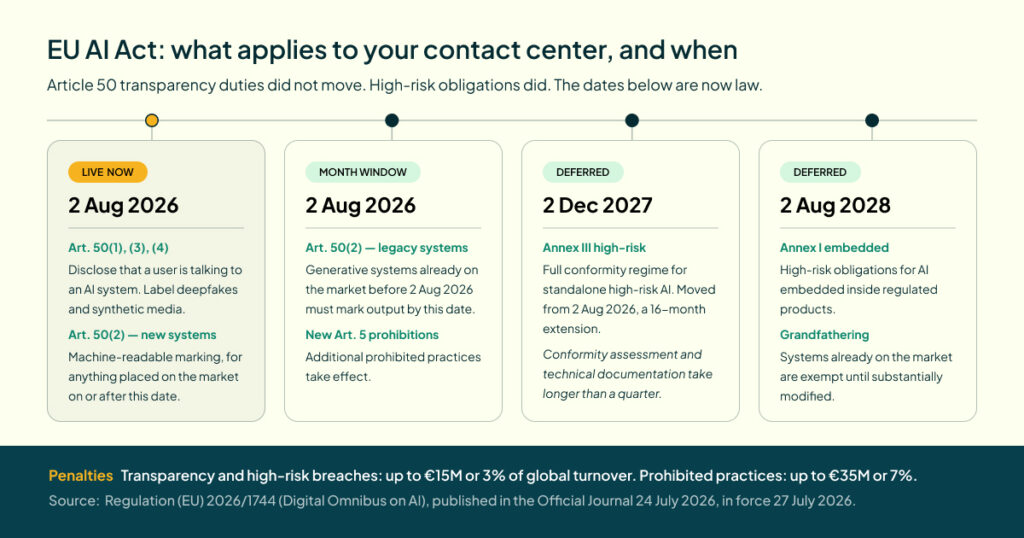
The amendments are no longer a negotiating text. Regulation (EU) 2026/1744, the Digital Omnibus on AI, appeared in the Official Journal on 24 July 2026 and entered into force on 27 July. So the dates below are law rather than forecast.
As law firm analysis of the Omnibus sets out, it pushed high-risk obligations for standalone Annex III systems out to 2 December 2027, and high-risk AI embedded in regulated products to 2 August 2028. Meanwhile, it left most of Article 50 exactly where it was.
| Obligation | Deadline | Applies to |
|---|---|---|
| Disclose that a user is interacting with an AI system (Art. 50(1)) | Live — 2 Aug 2026 | EU-facing chatbots, voice AI, virtual agents |
| Labelling of deepfakes and synthetic media (Art. 50(4)) | Live — 2 Aug 2026 | Marketing, IVR voice cloning, avatars |
| Machine-readable marking of AI-generated output (Art. 50(2)) — systems placed on market on or after 2 Aug 2026 | Live — 2 Aug 2026 | New generative systems in customer journeys |
| Machine-readable marking of AI-generated output (Art. 50(2)) — systems already on market before 2 Aug 2026 | 2 Dec 2026 | Existing generative systems (most deployments) |
| New Article 5 prohibitions | 2 Dec 2026 | Providers and deployers |
| Full high-risk conformity regime, Annex III standalone | 2 Dec 2027 | Systems classified high-risk |
| Full high-risk conformity regime, Annex I embedded | 2 Dec 2028 | AI inside regulated products |
THE SPLIT THAT CATCHES PEOPLE OUT
Read rows three and four together. Disclosure under Article 50(1) applies now, to everyone. Machine-readable marking splits by when the system reached the market. If your generative assistant went live last year, you have until 2 December 2026. If you ship a new one next month, it must mark from day one.
Naturally, penalties give the dates weight. Transparency and high-risk breaches sit in the tier up to €15 million or 3% of global turnover. Prohibited practices reach €35 million or 7%.
Article 50 in plain contact center terms
Strip out the legal drafting and Article 50 asks three questions of every AI touchpoint you run in the EU. A fourth question is coming, and it is the expensive one.
Does the customer know? Disclosure must be clear and timely, which means at the start of the interaction rather than buried in a footer or produced only when someone asks. A chatbot called “Sam” with a human avatar and no disclosure line is now a documented exposure.
Can a machine tell? AI-generated output needs machine-readable marking. For most CX teams that is a metadata and publishing-pipeline question rather than a copywriting one. Consequently it belongs to whoever owns your knowledge management platform, not your brand team.
Is synthetic media labelled? Cloned IVR voices, generated avatars, and any content depicting a real person all fall under Article 50(4), and that obligation started in August with no transitional window.
Can you reconstruct it later? This one sits mostly outside the August tranche. Even so, it is where the December 2027 high-risk regime points, and it is by far the hardest thing to retrofit. When a regulator or an ombudsman asks why your AI said what it said in March, you need the answer and the source it drew from.
One footnote worth handing to counsel rather than guessing at. Article 50(4) also covers AI-generated text published to inform the public on matters of public interest, with an exemption where a human took editorial responsibility. Whether a help-center article on refund eligibility meets that description is a judgment call for your legal team, not a settled question. Document your review process regardless, because the December 2027 regime will want it anyway.
The EU AI Act contact center readiness gap
Set the legal picture against the operational one and the tension in every EU AI Act contact center program becomes obvious.
Industry surveys through 2026 put AI adoption in contact centers near universal, and voice AI now handles a materially larger share of inbound volume than it did two years ago, with banking and telco leading. Yet the same research consistently shows very few organizations running on a single unified platform. Most operate several contact center technologies side by side.
Those two facts multiply rather than add. Disclosure and provenance requirements land per touchpoint. Fragmentation happens per organization. So a transparency rule that costs a fortnight on one channel costs a quarter across four, not because the rule got harder but because nobody can say with confidence how many EU-facing AI touchpoints they run, or which knowledge sources each one draws from.
Therefore, start with that inventory. Almost every team I have seen underestimates it.
Why disclosure is the easy half
For most teams, the first EU AI Act contact center task is trivial. Adding “You’re chatting with an AI assistant” to a widget is a sprint ticket. Most teams will close the August obligations in a fortnight and feel finished.
In reality, they are not finished. The genuinely demanding requirement arrives with the high-risk regime in December 2027, and with any serious customer complaint long before that. It is the ability to show what your AI answered from.
That is not a model capability, and this is the part vendors gloss over. A model can tell you what it generated. It cannot tell you whether the article it retrieved was the approved version, who owned that article, when someone last reviewed it, or whether a contradicting article sat beside it in the index. Answer auditability lives in the knowledge layer or it does not exist at all.
Reliability already ranks as the leading challenge for organizations deploying agentic AI for customer service. Regulation is about to convert a reliability problem into an evidentiary one.
There is a grandfathering wrinkle here too, and it cuts both ways. Systems placed on the market before the new high-risk deadlines can avoid the full conformity regime until they are substantially modified. Useful, certainly. However, it also means every significant upgrade to an EU-facing AI system needs a conformity question attached to the change request.
A 90-day EU AI Act contact center action plan
- Inventory every EU-facing AI touchpoint. Chat, voice, in-app assist, help-center search, agent copilot. Expect the real number to exceed your working assumption by roughly a third.
- Ship disclosure everywhere, uniformly. One approved wording, one placement standard, applied across channels rather than negotiated vendor by vendor.
- Sort your generative systems by market date. Anything live before 2 August 2026 has until December for machine-readable marking. Anything new does not. Until you know which is which, you cannot know your real deadline.
- Map each touchpoint to its knowledge sources. If you cannot trace a bot answer back to a specific governed article, your December 2027 remediation project starts today.
- Put named owners and review dates on the content those systems retrieve. Editorial control you cannot evidence is editorial control you do not have.
- Log retrievals, not just conversations. Transcript archives tell you what was said. Retrieval logs tell you why, and only the second answers a regulator.
Notably, steps four through six are ordinary contact center knowledge management discipline. That is the encouraging part. Compliance here rewards work most CX teams already know they should have done.
What the EU AI Act contact center rules mean for CX leaders
The August deadline was never the hard part. Equally, the December 2027 delay is not a reprieve — it is a runway.
EU AI Act contact center readiness compounds. Organizations that spend the runway building governed, attributable knowledge will find high-risk conformity turns into a documentation exercise. Organizations that treat compliance as a disclosure banner will spend 2027 trying to reconstruct eighteen months of AI answers from AI knowledge management systems that were never designed to remember.
Ultimately, one of those is a project. The other is an excavation.
FAQs
From 2 August 2026, Article 50 transparency obligations apply. You must clearly disclose that a user is interacting with an AI system, and label synthetic media depicting real people. Machine-readable marking of AI-generated output also applies immediately to systems placed on the market on or after that date.
Yes. Regulation (EU) 2026/1744, the Digital Omnibus on AI, moved standalone Annex III high-risk obligations to 2 December 2027 and embedded Annex I systems to 2 August 2028. Article 50 transparency obligations were not delayed.
Probably not until 2 December 2026. Generative systems placed on the market before 2 August 2026 received a four-month transitional window for the Article 50(2) marking obligation. Systems launched on or after 2 August 2026 get no grace period. Note that the extension covers the marking mechanism only, not the disclosure duty.
It can. The Act reaches providers and deployers whose AI systems produce outputs used in the EU. So US and APAC organizations running EU-facing support channels fall in scope even without an EU entity. Confirm your position with counsel.


 Word Document)
 Excel File)


