 17 Min


Six minutes into a call I listened back to last week, the agent has done everything the training deck asked. They acknowledged the frustration. They used the customer’s name. At no point did they interrupt. The angry customer on the other end is still furious, will still be furious at the end of the call, and the survey score will land on the agent’s record rather than on the three things that actually caused this.
The call was not lost in those six minutes, though. It was lost on Tuesday, and the recording is from Thursday.
Every guide on how to deal with an angry customer starts at this moment, with the call already connected. That is the part of de-escalation almost no training program addresses. We teach agents to handle anger as though it arrives from nowhere, a weather event to survive with the right breathing technique and the right opening phrase. Sometimes it does. Often it does not. In many cases the operation built it, step by step, then handed the finished product to whoever answered next.
Table of contents
- The case for teaching agents to handle an angry customer
- What customers do before they ever reach you
- Where an angry customer is actually made
- How to respond to an angry customer when the cause sits upstream
- The objection that deserves a straight answer
- What changes when you treat the angry customer as an output
- Frequently asked questions
The case for teaching agents to handle an angry customer
Start with what the conventional view gets right, because it gets a lot right.
An agent who can steady a hostile call is worth more than one who cannot. That is not in dispute. The skills are real and they are teachable: name the emotion before you name the policy, slow your speech instead of matching theirs, resist the urge to defend the company in the first thirty seconds. Most teams that invest properly in this see their hardest calls get shorter. Attrition improves too, since absorbing hostility without technique is one of the fastest routes out of the profession.
The wider argument for effort reduction sits on solid ground as well. Matthew Dixon, Karen Freeman and Nick Toman made the case in Harvard Business Review back in 2010, and the central observation has held up for fifteen years: the assumption that service teams should aim to delight goes almost entirely unexamined, while almost everyone underestimates the cost of making customers work.
So none of what follows is an argument against training. The standard advice on dealing with angry customers covers the technique well, and technique matters.
The argument is about sequence. Training is the last line, and most operations treat it as the only one.
What customers do before they ever reach you
Here is the number that should reframe the whole conversation.
Gartner surveyed 5,728 customers in December 2023 and found that self-service fully resolves only 14% of customer service issues. The tooling is rarely the constraint, since most large operations already run capable self-service platforms.
Read those together and the arithmetic is uncomfortable. Most people try to help themselves first. They fail. Then they call you.
Look at those last two bars again, because they are the whole argument. The answer was not wrong. The policy was not unfair. People could not find it, and nearly half felt the company had misread what they were asking. An angry customer is rarely angry about the thing they mention first.
Think about what that does to somebody’s mood before a single ring tone. They searched. Something nearly applied, so they read it. Then a chatbot looped them back to the same page. Twenty minutes went somewhere. Now they are in a queue, and the queue message tells them their call is important.
The agent inherits all of it, then answers for the outcome. This is the mechanism behind the Dixon, Freeman and Toman argument above, and behind the shift to customer effort score as a loyalty measure. Effort accumulates upstream. Satisfaction lands downstream, at the one point in the chain where the company retains the least control.
Where an angry customer is actually made
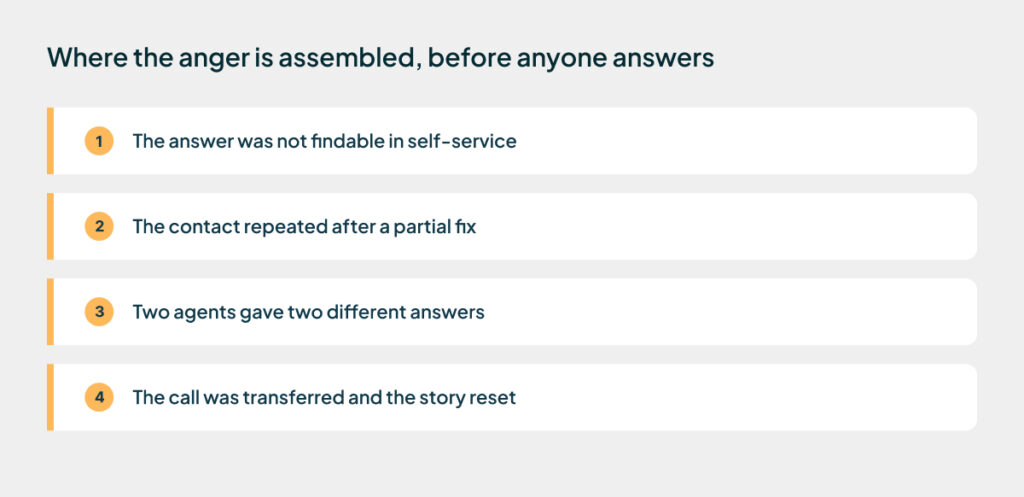
The pattern is fairly consistent across operations. Anger arrives in four parts, and none of them are the agent. Each part looks harmless on its own. Stacked in sequence, they deliver an angry customer with a well-documented grievance and a timeline to recite.
The answer was not findable. They looked, and came up short. That is where most of this begins.
The contact repeated. They called on Tuesday, got a partial answer, and the issue resurfaced. Second contacts start at a higher emotional baseline than first contacts. This is what first contact resolution is really measuring, and why treating it as a productivity statistic misses the point. It is an anger metric.
The answers disagreed. Tuesday’s agent said one thing. Today’s agent says something else. Both were reading whatever they could find. Nothing resembles a lie more than two confident, contradictory answers from the same company, and no amount of empathy training survives that discovery mid-call.
The call transferred. Each handoff resets the story and makes them tell it again.
How a handle time target manufactures transfers
The fourth deserves a note, because operations often build it themselves. When average handle time is the number that governs the floor, transferring a complex call is the rational move for an agent under pressure. The metric rewards passing it on, and the agent who absorbs the difficult call instead gets a worse scorecard for the trouble. So squeezing agents on handle time tends to produce more transfers, where fixing what they can find, which is what contact center knowledge management means in practice, reduces them, and transfers produce exactly the customer that de-escalation training then has to absorb.
You can hold an entire quality program accountable for tone while the machinery upstream keeps producing furious people at a steady rate.
One column belongs to the agent on the call. The other belongs to whoever owns the process, and no amount of coaching moves it.
| Where the anger came from | What the agent can do on this call | What the operation has to fix |
|---|---|---|
| Self-service did not surface the answer | Name the wasted effort out loud before solving anything | Search relevance for the top contact reasons |
| The customer already called about this | Open with the history instead of asking them to repeat it | First contact resolution, measured as an anger metric |
| A previous agent gave a different answer | Say plainly which answer is correct and why the other appeared | One source of truth, with conflicting articles retired |
| The call bounced to another team | Summarise the case to the next agent while the customer listens | Warm transfer with context, and a handle time target that does not punish keeping the call |
Knowledge Management For a Higher CX Standard
How to respond to an angry customer when the cause sits upstream
Knowing the origin changes the opening line. Nearly all scripts hand agents one all-purpose apology and hope it covers everything. It does not. Here are four openings, one for each origin, in the words an agent would actually use.
Four openings, matched to where the anger started
- When they tried self-service first. Lead with the wasted effort, because that is the injury they are carrying. Say: “Before we start, I can see you tried to sort this on the site first. That should have worked and it did not, so let me get it done here and now.” Naming it costs eight seconds and removes the need for the customer to justify being annoyed.
- When this is a repeat contact. Never make them tell the story twice. Open with something like: “I have your call from Tuesday in front of me, so you do not need to go through it again. Let me tell you what I can see and you correct me where I am wrong.” This one line does more for de-escalation than any breathing technique.
- When a previous agent said something different. Resist the urge to defend the company. The line that works is: “Two agents told you different things and only one of them is right. The correct position is X, and I am sorry you had to find that out by asking twice.” Customers forgive a wrong answer far more readily than they forgive feeling managed.
- After a transfer. Own the handoff rather than the queue. Try: “We have passed you around and that is on us. I am staying on this until it is finished, and if I need a colleague I will bring them to us rather than sending you to them.” Then do that, which is where handle time targets start to matter.
Scripts decay, and a stale script is worse than none
Script examples of angry customer situations are easy to find online, and most of them fail for the same reason: they address a caller whose history nobody checked. Keep your own list short, since nobody retains fifteen scripted lines under pressure. They work better as spoken prompts than as verbatim text: an agent reading a script aloud sounds like one.
Build role plays from your own contact data
If you build angry customer role play scenarios for training, build them from your own contact data rather than from a generic template. Pull ten real cases from last month where the customer had already been in touch, strip the identifying details, and run those. Agents recognize their own operation immediately, and the exercise stops feeling like theatre. Whoever assembles those ten cases also has to read them closely, which is an audit in itself. Whoever assembles the cases tends to find process defects before the role play is ever run.
The objection that deserves a straight answer
Someone in the room always says: not all of it is our fault. They are right, and the honest version of this argument has to concede three things.
Some anger has nothing to do with you. The customer’s day was already bad. The bill arrived in a difficult month. No process fix reaches that.
Some anger is proportionate. The product genuinely failed, the delivery genuinely did not arrive, and the customer is angry for the correct reason. Findable answers help them less than a fast remedy does.
And a small number are abusive rather than angry, a different problem entirely, closer to safeguarding than service design.
There is a harder concession too. Learning how to de-escalate an angry customer is a skill an agent picks up in two weeks, and it pays back just as fast. Fixing the upstream causes is slow. Auditing content findability, consolidating conflicting answers, and rebuilding a metric that governs the whole floor will take quarters. With one budget cycle and a CSAT problem, train the agents. That is the correct short-term call, and anyone who tells you otherwise has not run a service floor.
The mistake is stopping there and calling the problem solved.
Read the Full Case Study
What changes when you treat the angry customer as an output
Three things, in order of how much they cost.
First, start recording where anger came from. Nearly every quality framework scores how the agent handled the call. Almost none capture whether the customer had already tried self-service, already called about this, or already received a different answer. Add those three flags to the wrap-up form. Within a month you will have a distribution rather than an anecdote, and it will show how often that angry customer had already been in touch. Teams that count this properly are usually surprised by how much of the anger they made themselves.
Findability is not the same as coverage
Second, measure what people can find rather than what you have published. The Gartner finding was not that the content was missing. It was that customers could not find it. Those are different failures with different fixes, and content teams almost always measure the first one. Take the twenty most common contact reasons, then try to answer each one from the public site as a customer would, with a stopwatch running. Use the search box, not your memory of the URL structure. Anything that takes over ninety seconds is a future call, and anything that returns three articles which disagree is a future complaint. The exercise is uncomfortable and it takes an afternoon.
Two answers mean two sources of truth
Third, resolve the contradictions. Where two agents can find two different answers to the same question, you do not have a training problem. You have two sources of truth. Consolidating those, whether through a single customer service knowledge base or through an interactive decision tree that hands every agent the same path, removes a whole category of contact that currently arrives pre-annoyed.
None of this is a reason to stop teaching de-escalation. Keep doing it. But an operation that trains for anger while quietly manufacturing it has decided, without ever putting it in writing, that absorbing the damage is cheaper than preventing it. That decision belongs in writing, where somebody can argue with it.
Ready to Build Your Own Customer Service Knowledge Base?
Frequently asked questions
Separate the apology from the blame. You can be sorry the customer sits in this position without accepting a fault that is not there, and most people accept that distinction when you say it plainly. What they reject is a defense offered first.
Commit to the next step rather than the outcome. Telling the customer you will take the case to the team that owns it, by a named time, settles most callers and stays inside what you control. Vague reassurance does the opposite, and experienced complainers hear it instantly.
Open with the history and take the repetition off their shoulders. Read back the previous two contacts before asking a question, then name what everyone missed. Third contacts rarely concern the original issue. By then the pattern itself is the complaint.
Stop the transfer chain, even at the cost of a longer call. Bring the specialist into the conversation instead of sending the customer onward, and where that proves impossible, take a number and call back yourself. A third transfer creates a story they retell.
Send one when something actually went wrong, and skip it otherwise. A short note confirming what you agreed, and by when, gives the customer a record and cuts repeat contacts. An apology email to an angry customer that only restates regret reads as process, not care.


 Word Document)
 Excel File)


