 20 Min


A customer opens a chat at lunch to ask why a card payment failed. A reply arrives by email that evening. The next morning she calls, because the email did not fix it. Three channels, three conversations, one problem. Whether the third person she reaches already knows about the first two is the practical difference between a call center and a contact center.
So what is a contact center, exactly? This guide answers the questions buyers and new managers ask. It covers the definition, how the work flows, how a contact center differs from a call center, the main types and what the operation runs on. It also covers when the model is the wrong choice, because for some teams it is.
Table of contents
- What is a contact center? A definition you can quote
- How does a contact center work, from first contact to resolution?
- What is a contact center vs a call center, and does the difference matter?
- What are the types of contact centers?
- What are the benefits of a contact center?
- What does a contact center run on: people, process and technology?
- What is a contact center’s biggest weakness? Answers that differ by channel
- When is a contact center the wrong model?
- Frequently asked questions
What is a contact center? A definition you can quote
A contact center is a centralized hub that manages customer interactions across every channel a company offers: phone, email, live chat, SMS and messaging, social media and self-service. The term covers both the team of agents and the software they use to receive, route and resolve those contacts. It manages the channels as one workload, so routing, customer history and the source of answers are all shared.
That is the contact center meaning in one paragraph.
The contact center definition grew out of the call center, and the history explains the name. According to the Wikipedia entry, the first call centers appeared in the 1960s, and Rockwell International patented its Galaxy automatic call distributor in 1973. Contact centers emerged during the 1990s. They extended the telephone operation to letters, email, live chat and social media. The word “contact” simply replaced “call” once the phone stopped being the only way in.
People phrase the question in several ways, such as “what is contact center” or “define contact center”. The answer holds in each case. In India and the Philippines, where much of the world’s outsourced service work happens, you will also see the phrase contact center in BPO, which means the same operation run by an outsourcing firm on behalf of a client brand.
What does a contact center do, day to day?
In short, a contact center does four jobs. It answers questions and fixes problems. It handles transactions such as refunds and plan changes. And it records what happened, so the next person can pick up the thread. Some also sell, collect payments or run outbound campaigns, much as phone-first service call centers have done for decades. The scale is large: the BLS outlook counts 2,666,000 customer service representative jobs in the United States in 2025, and notes that many of them work in call centers.
How does a contact center work, from first contact to resolution?
Every contact passes through the same six stages, whatever the channel. The list below follows the card payment problem from the introduction. It is an illustration rather than a case study. Still, each step is where real contact centers either hold the thread or drop it.
- Intake. At 1:10 p.m. the customer types “my card got declined at a store but I have money in the account” into chat. A bot asks for the last four digits and tags the contact as “card decline, debit”.
- Triage. Software reads the tag and the customer’s tier. It sends the chat to the payments queue instead of the general one, because a decline with funds available usually needs account access.
- Context. The agent opens the conversation and sees the bot transcript, the account and the last three contacts on one screen. Nobody asks the customer to repeat herself. Without this step, a contact center is a call center with more inboxes.
- Answer. The agent searches the knowledge base for “declined with funds available” and finds the article. It says to check for a fraud hold, then a daily limit, then a merchant category block. There is a fraud hold, placed at 12:58 p.m.
- Resolution. The agent says, “I can see a security hold from 12:58. I have released it, so the next payment should go through.” She closes the chat with the outcome recorded as “fraud hold released”.
- Learning. That evening, a supervisor notices 40 contacts tagged “card decline, debit” with one cause behind most of them. The knowledge team adds a line to the self-service article, and the fraud team reviews its new rule.
Where the thread usually breaks
Steps 3 and 4 decide the outcome. If the agent cannot see the earlier contacts, the customer repeats her story. If she cannot find the right article in the call center knowledge base, she guesses. In fact, CX Trends 2026 from Zendesk reports that 74% of customers find it frustrating to tell their story over and over to different agents, which is exactly what a broken step 3 costs.
What is a contact center vs a call center, and does the difference matter?
A call center handles phone calls. A contact center handles every channel and treats a customer’s chat, email and call as one case. The table sets out where that difference shows up in daily work.
| Dimension | Call center | Contact center |
|---|---|---|
| Channels | Inbound and outbound phone | Phone, email, chat, messaging, social and self-service |
| Customer history | Call notes, often per agent or per site | One timeline across every channel |
| Routing | By phone menu choice and queue | By intent, channel, customer value and agent skill |
| Self-service | IVR menus | IVR, chatbots, help center articles and AI agents |
| Agent workspace | Phone controls plus separate tools | One screen for every conversation and channel |
| Where answers live | Scripts, binders and agent memory | A shared knowledge base used by agents, bots and the help center |
Does the contact center vs call center difference matter? Mostly, yes, because customers no longer stay on one channel. A Gartner survey of 265 service leaders, published in August 2025, found that leaders expect live chat, self-service portals and knowledge management systems to pass phone and email as the most valuable customer service technologies by 2027.
However, the label matters less than the plumbing. Plenty of operations that call themselves contact centers run each channel as a separate team, which is really a multichannel model with a newer name. And the phone has not gone away. Complex, emotional and high-value work still arrives by voice.
What are the types of contact centers?
Part of answering what is a contact center is knowing which kind you are looking at. Most guides sort them along three lines: the direction of contact, the channel model and where the work happens. Real operations usually combine one choice from each.
Inbound, outbound and blended contact centers
An inbound contact center takes contacts that customers start: support questions, orders, complaints and account changes. An outbound contact center starts the contact itself. Typical reasons are sales, collections, renewals, surveys and service notices such as a delivery delay. A blended contact center does both with the same agents, so idle time on inbound queues goes to outbound lists. Blending raises utilization, but it also asks one agent to switch between a calm service tone and a sales target within the same hour, and that switch is harder than most workforce plans assume.
Multichannel and omnichannel contact centers
A multichannel operation offers several channels but runs them apart. Each one keeps its own queue and history. An omnichannel contact center links them, so a chat that turns into a call keeps its context. That design is, indeed, harder to build. It is also far better for customers, since the context travels with the case.
Cloud, on-premises, virtual and outsourced contact centers
A cloud contact center runs its phone system, routing and recording as software delivered over the internet. An on-premises contact center owns and maintains that hardware in its own building, which gives more direct control at the price of slower changes. A virtual contact center puts agents at home or across many small sites, connected through cloud software. Outsourced operations, often run by a BPO, hand the work to a specialist firm that serves customers under the client’s brand. Once you look, examples are everywhere: a bank’s card services line, a telecom’s chat support, an airline’s rebooking desk, a hospital’s appointment line and a retailer’s returns team are all contact center examples.
What are the benefits of a contact center?
The main benefit of a contact center is that customers can reach the company on the channel they prefer and still get one consistent answer. Five benefits follow from that:
- Fewer repeated stories. Because agents see earlier chats and emails, customers do not start over.
- Faster simple answers. Bots and help center articles take routine questions, which leaves people free for the complex ones.
- Better use of agent time. Routing by skill and channel also sends each contact to someone who can resolve it.
- Customer insight. One record across channels shows why people get in touch, so product and policy teams see what to fix.
- Sales and retention. With full context, an agent can spot a renewal or upgrade at the right moment instead of pitching blind.
However, each of these depends on the shared history and shared answers described above. A contact center that adds channels without connecting them pays for every channel and collects none of these benefits.
Read the CCW Report on Knowledge for a Higher CX Standard
What does a contact center run on: people, process and technology?
People come first, of course. A contact center agent handles the contacts. Team leaders coach a group of agents, while quality analysts review a sample of interactions against a scorecard. Planners in workforce management forecast volume and build schedules, and a knowledge team writes and maintains the answers everyone uses. In smaller operations, one person holds three of those roles.
The technology underneath supports those people in five layers:
- Channels and telephony. The phone system, chat widget, email inbox and messaging connections, increasingly delivered from the cloud.
- Routing and IVR. Interactive voice response menus, automatic call distribution (ACD) for voice and intent-based routing for digital contacts.
- Customer record. A CRM or help desk that keeps the history the agent sees in step 3.
- Knowledge. The articles, decision trees and policies that agents, bots and the help center draw from.
- Workforce and quality. Forecasting, scheduling, call recording, live monitoring and real-time reporting.
Most buying attention goes to the first two layers. Yet contact center technology lives or dies on the fourth one, since it decides whether a customer hears the same answer twice. It is also the layer that contact center automation depends on, because a bot can only repeat what the knowledge base says.
What is a contact center’s biggest weakness? Answers that differ by channel
The biggest weakness of most contact centers is inconsistent answers. Teams unify channels on the routing screen long before they unify them underneath. So the chat bot reads from a help center article, the email team works from a shared drive, and phone agents follow a script that someone last updated in the spring. The customer from the introduction could get three different explanations for one fraud hold, all from the same company and all in good faith.
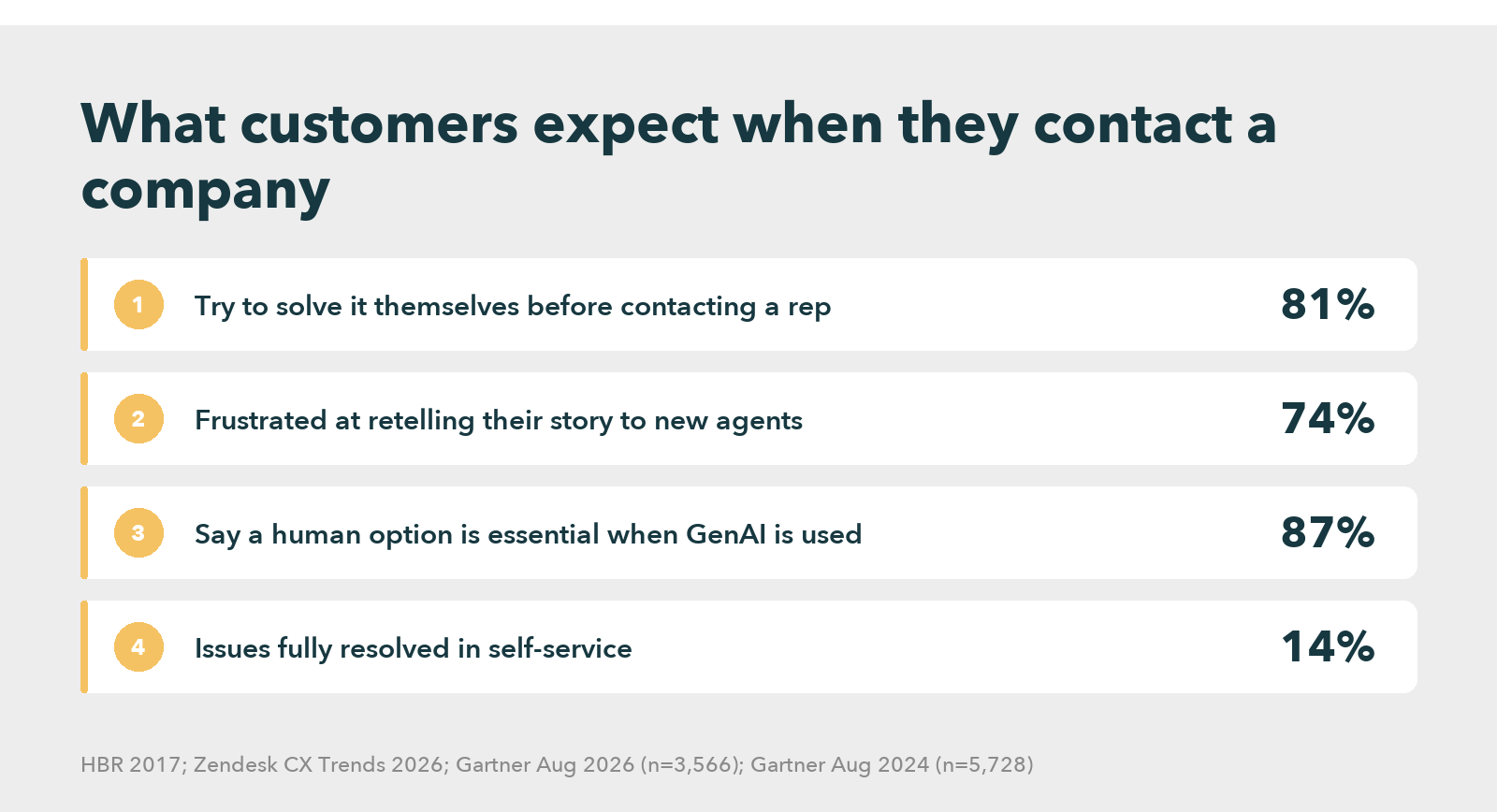
Why the relay from article to bot to agent breaks
The chart shows why that matters more each year. Customers start on their own, so the self-service article is the first answer they see. But self-service rarely finishes the job. A self-service study by Gartner found that customers fully resolved only 14% of issues there, and 43% of failures came from customers not finding relevant content.
Eventually they reach a person. An August 2026 survey of 3,566 customers found that 87% consider access to a human agent essential when a company uses GenAI. Every contact center now runs a relay, from article to bot to agent. The relay works only when every runner carries the same answer.
That is a knowledge problem rather than a routing one. The fix is a single source of approved answers that every channel reads from, with an owner for each article and a review date, which is what contact center knowledge management means in practice. Built that way, one knowledge base serves the agent in step 4, the bot in step 1 and the help center the customer tried before either.
Knowmax works at that layer. It sits beside the phone system, CRM and help desk rather than replacing them. Agents get one search across articles, interactive decision trees and step-by-step visual guides, with a browser extension so they do not toggle between screens. One Fortune 500 retailer reports lower handling time, fewer agent errors and higher CSAT in its Knowmax case study, and the panel below links to the full write-up with its figures.
See How a Fortune 500 Retailer Cut Handling Time
When is a contact center the wrong model?
For a small team, the honest answer to what is a contact center is: more than you need. A full contact center is the wrong model when the volume does not justify it. Picture a company with a few hundred contacts a month, mostly by email. It gains little from intent routing, a workforce management system and a separate knowledge team, and a shared inbox, a small help center and one owner for the answers will serve its customers better at a fraction of the cost. Building the full stack too early mostly produces software that nobody configures properly.
It is also the wrong model when the work is genuinely voice only. Emergency lines, crisis support and some clinical triage desks work better as focused call centers. There the conversation itself is the service, and adding channels splits attention without helping anyone.
And a knowledge platform is not always the first fix. If customers repeat their story because the CRM does not show earlier contacts, better articles will not help, because step 3 has to work before step 4 matters. So the first fix belongs to whichever step drops the most cases.
Headcount is the last trap. In its outlook, the BLS projects a 5% decline in customer service representative jobs from 2025 to 2035 as self-service and automation take over simple tasks, yet it still expects about 289,500 openings a year from turnover alone. Plans that count on technology replacing people, rather than on technology changing which contacts people handle, usually end up short of both.
Ready to Give Every Contact Center Agent the Same Answer?
Frequently asked questions
No. A BPO is a business process outsourcing company, and a contact center is one of the operations it can run. Many BPOs run contact centers for client brands, but they also handle back office work such as claims processing and accounting.
A virtual contact center is one where agents work from home or from many small sites instead of one building, connected by cloud software for calls, chat, routing and the customer record. Done well, customers notice no difference. The management challenge shifts to coaching, security and keeping remote agents on the same answers.
The number of agents depends on contact volume, average handle time, opening hours and the service level target. Workforce managers therefore calculate it per half hour with Erlang C or simulation models, then add shrinkage for breaks, training and absence.
An in-house contact center does not make money directly. The business funds it as a cost of serving customers and earns its return through retention, renewals and sales that agents handle. Outsourced contact centers run by BPOs do earn revenue, billing clients per agent hour, per handled contact or per outcome such as a completed sale.
Contact center as a service, or CCaaS, is software rented by subscription and run in the vendor’s cloud. It covers telephony, routing, digital channels, recording and reporting, so a company does not buy or maintain its own phone hardware. Knowledge, CRM and quality tools usually connect to it through integrations.


 Word Document)
 Excel File)


