 20 Min


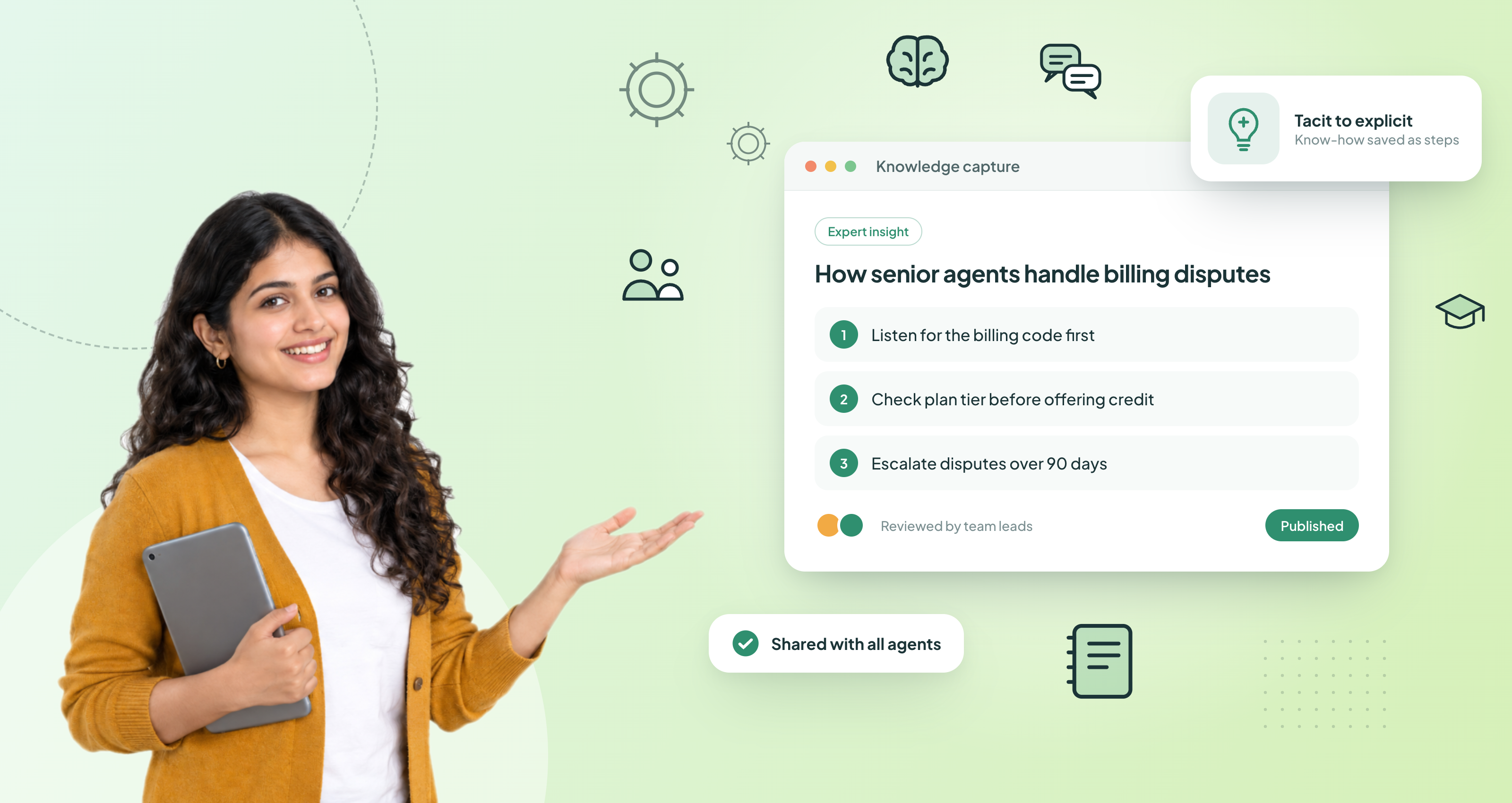
Ask the best agent on the floor how she knows a billing call is about to turn into a cancellation. She will pause, then say something like “you just hear it.” She is right. She is also no help to the trainer who wants to turn that instinct into a script. The gap between what people know and what they can say has a name, and the name is older than the contact center.
Tacit knowledge is the know-how a person holds but cannot fully put into words: the pacing, the judgment and the pattern recognition that come from doing a job rather than reading about it. This post follows the idea from philosophy to management theory to the agent desktop. It shows what the idea looks like on a support floor. And it asks how much of that know-how a team can capture before the people holding it leave.
Table of contents
- What tacit knowledge is, and why Polanyi said we know more than we can tell
- Tacit knowledge examples from a support floor
- 1990: Nonaka’s SECI model made tacit knowledge a management problem
- The 2000s codification wave wrote everything down and missed the point
- Where tacit knowledge management stands now: capture at the point of work
- How to capture tacit knowledge without flattening it
- What the current answer still cannot do
- Frequently asked questions
What tacit knowledge is, and why Polanyi said we know more than we can tell
Tacit knowledge is knowledge that a person finds difficult to express, extract or write down, and that comes mainly from experience rather than instruction. The term belongs to the chemist and philosopher Michael Polanyi. He introduced “tacit knowing” in Personal Knowledge in 1958. In The Tacit Dimension in 1966 he gave the field the line it still quotes: we can know more than we can tell. That history, with the standard examples, sits in Wikipedia’s definition of the term.
His own examples were deliberately ordinary, for instance riding a bicycle or recognizing a face in a crowd. Nobody balances a bicycle by consulting the physics, and nobody can describe a friend’s face well enough for a stranger to pick it out. Both skills are reliable. Still, the telling is the hard part.
So the tacit knowledge meaning most searchers want is this: skill and judgment that live in a person, that pass on through practice and close contact rather than through documents, and that the person often cannot explain even when asked nicely.
Tacit knowledge beside explicit and tribal knowledge
Explicit knowledge is the opposite case. A refund policy, a product manual, a knowledge base article: someone writes each of them once, and a reader who never met the author can use them. Many writers also say tribal knowledge for the informal, unwritten version that spreads inside a team, and the two terms overlap heavily. Among the broader types of knowledge an organization holds, a working split of the types of tacit knowledge separates physical skill, judgment and relationships. A support floor runs on the second and third.
One caution first. Polanyi argued that all knowledge rests on a tacit base, and later researchers questioned how separate the tacit and explicit categories really are, so every capture method in this piece lives in the grey zone between them.
Tacit knowledge examples from a support floor
On a support floor, tacit knowledge in customer service rarely looks like expertise. It looks like an agent who stays calm when the queue is not. The scenarios below are composites of what support teams describe, not measured cases. Each one ends with what walks out of the building when the person holding it resigns.
Five tacit knowledge examples, and what leaves with the person
- Hearing the cancellation before the customer says it. A customer opens with “I just want to understand this charge.” A veteran asks, “Before we go line by line, can I check what you expected the bill to be?” Lost on resignation: the ability to read intent from a first sentence, which no script contains.
- Knowing which “it’s not working” means which fault. On a broadband line, “the light is blinking orange” and “the light is orange” point to different faults. The experienced agent asks, “Is it blinking, or steady?” before the customer finishes, and skips four troubleshooting steps. Gone with the agent: the shortcut.
- Reading the pause in a chat. A customer stops typing for forty seconds after seeing a price. One agent waits. Another sends, “Take your time. If it helps, here is what most people on your plan choose.” The feel for timing that took hundreds of chats to build has no heir.
- The unwritten order of operations. In one billing system, canceling a subscription before issuing the refund makes the refund fail silently. The policy page explains both actions and never mentions the sequence. New agents learn it by breaking it. The cost of losing it: a workaround that never became a procedure.
- Knowing who actually decides. The escalation matrix names a role. A veteran knows the night-shift holder of that role never approves a goodwill credit above a certain level, and knows which team lead will if the case notes take a certain shape. Her map of the organization as it really works leaves with her.
In every case the explicit version exists, and the tacit layer makes it usable. That is why tacit knowledge in the workplace stays invisible until a resignation makes it visible.
1990: Nonaka’s SECI model made tacit knowledge a management problem
Polanyi described the phenomenon. Ikujiro Nonaka turned it into something a company could act on. In 1990 he proposed a model of knowledge conversion with four modes, known by its initials as the SECI model, and Hirotaka Takeuchi later developed it. Nonaka set out the argument in a Harvard Business Review article that the magazine reissued in July 2007. In an uncertain economy, the companies that last keep creating new knowledge. Creation happens when tacit and explicit knowledge convert into each other.
The four modes map cleanly onto a contact center, and so do their failure points.
| Mode | Conversion | What it looks like on a support floor | Where it breaks |
|---|---|---|---|
| Socialization | tacit to tacit | Shadowing, side by side coaching, listening to recorded calls together | Does not scale past the people in the room |
| Externalization | tacit to explicit | An expert walks a writer through a real fix, which becomes a guided flow | The expert leaves out whatever feels too obvious to say |
| Combination | explicit to explicit | Merging scripts, policy and articles into one searchable base | Duplicates and contradictions multiply |
| Internalization | explicit to tacit | Agents use the article until they no longer need it | Nobody notices when the article goes stale |
The bread machine, and what it proves about externalization
The illustration that travels with the model, retold on Wikipedia’s tacit knowledge page, is Matsushita’s bread machine. Its engineers could not make the machine knead properly. Then a team member apprenticed with a hotel baker and noticed a twisting stretch in how the baker worked the dough, and the engineers built that motion into the machine. No one at the hotel could have written the motion down in advance, because nobody knew it was the important part.
That story is the whole case for externalization, and also its warning. The knowledge came out because somebody stood next to the expert during real work, not because the expert filled in a template.
Start With the Basics of Knowledge Management
The 2000s codification wave wrote everything down and missed the point
Once companies had declared knowledge a competitive asset, the obvious response was to store it. In 1999, Morten Hansen and colleagues named two strategies firms already followed: codification and personalization. The knowledge management entry on Wikipedia still uses that framing. Codification moves knowledge from people into documents so that others can reuse it without the author. Personalization connects people to the experts directly. Most large organizations chose codification, because documents cost less than experts and are easier to count.
What two decades of codification left behind
The results of that choice are measurable. A 2023 Gartner survey of 4,861 digital workers found that 47% struggle to find the information they need to do their jobs. The same Gartner survey put the average knowledge worker on 11 applications, up from six in 2019. The information existed, in eleven places. Finding it was the job.
An older figure is the more telling one for tacit knowledge. A 2012 McKinsey report from the McKinsey Global Institute found that interaction workers spend nearly 20 percent of the workweek looking for internal information or tracking down colleagues who can help. Tracking down colleagues is the tell. When the document fails, people go looking for the person. In other words, nobody captured the tacit layer in the first place; the explicit material simply buried it.
Here the argument of this piece deserves plain statement. The codification wave did not fail because it wrote things down. It failed because it wrote the wrong thing down, in the wrong shape. A policy page describes a refund. It does not say that the refund fails if you cancel first. The expert’s knowledge is the sequence and the exception, and those dropped out because the author described the process instead of walking through a case.
There is a cost to admit on the other side. Personalization, however, does not scale. A support floor with two hundred agents cannot route every hard question to the one person who knows. Codification was the right instinct with the wrong unit of capture.
How Knowledge Management Raises the CX Standard
Where tacit knowledge management stands now: capture at the point of work
The current answer, in most contact centers, is a hybrid that Nonaka would recognize. Explicit knowledge lives in a knowledge base. The senior agents hold the tacit layer, and the organization tries to pull it across the line one case at a time, increasingly with AI drafting the first version.
Gartner’s data on where leaders are taking this is striking. A December 2025 Q&A covers a Gartner survey of 321 customer service and support leaders. In it, 58% said they plan to upskill agents as knowledge management specialists who review and curate AI-generated content. Read that against the examples above. The people who will curate the explicit layer are exactly the people who hold the tacit one. That is either the smartest move in the plan or the moment the tacit knowledge gets flattened into more articles nobody can find.
Which of those it becomes depends on the unit of capture. The smallest container available suits tacit knowledge best: a single decision, with its condition and its exception, in the place the agent is standing when the decision comes up. That is a different artifact from an article, and a different step in the knowledge management process from writing one.
So tacit knowledge management, as teams practice it now, is less about storage and more about interception. Catch the judgment at the moment the agent exercises it, on a real case, and record the decision rather than the narrative around it.
Plan the Rollout Before You Capture Anything
How to capture tacit knowledge without flattening it
Each method below is a version of standing next to the baker.
Interview the expert on a real case, never in the abstract
Ask a senior agent how they handle billing disputes and the answer will be a policy summary. Pull up yesterday’s hardest billing call instead and ask what they did at minute three. The sequence and the exception appear. Case-based interviews are the most reliable form of tacit knowledge transfer. The expert does not have to decide what is worth saying. In other words, the case decides.
Record the decision, not the story
Out of that interview should come a branch, a condition and an action, not a paragraph. An interactive decision tree holds “if the light is blinking, skip to step five” in a form a new agent can follow mid-call. A paragraph would need reading, understanding and remembering. Guided flows are externalization with the obvious parts kept in, because the structure forces the expert to state them.
Budget for socialization, because it still works
Shadowing does not scale, and it remains the only method that transfers pacing, tone and the feel for a pause. A team that pairs every new agent with a veteran on live calls for the first weeks is doing the one conversion the knowledge base cannot. The trade is explicit: hours of a senior agent’s queue time for knowledge that has no other route.
Keep the explicit layer inside the workflow, and measure training time
A captured decision in a separate tab is one nobody opens during a call. A knowledge management platform that surfaces the flow inside the ticket or the CRM screen closes the gap between knowing and doing, the very gap tacit knowledge sharing exists to close.
The honest test is how long a new agent takes to handle the hard cases alone. If the figure for training time does not move after a capture program, the program produced documents, not knowledge.
Knowmax is one example of a tool built around that unit of capture. The people who handle the cases author its decision trees and visual guides from real calls, and agents see them inside the conversation rather than in a separate portal. Other platforms take different routes. What matters more than the vendor is whether the artifact is a decision to act on or a page to read.
Turn One Expert’s Fix Into a Guided Flow
What the current answer still cannot do
The capture industry tends to imply that enough interviews and enough decision trees would eventually empty the expert’s head into the system. They would not, and Polanyi explains why.
Part of what the expert knows is tacit because it is relational. The veteran in example five knows which team lead approves credits when the notes take a certain shape. Writing that down is possible and also unwise, because the knowledge depends on a relationship that the document would damage. It should stay tacit. The organization should fix the escalation rule instead.
Another part is tacit because the situation is new. A guided flow holds decisions that someone has already made. The first time a product fault appears there is no branch for it, and the agent who handles it well draws on judgment the system cannot yet contain. So capture lags novelty by definition.
And some stays tacit because extraction costs more than it returns. An expert’s hour in a capture interview is an hour off the queue. On the long tail of rare cases that trade does not pay. Nor should it.
Where capture goes next
The next shift is already visible. AI systems can now draft a decision flow from a batch of call transcripts, which cuts the extraction cost sharply. They cannot tell which transcript holds the expert and which holds the guess, and they cannot hear the pause in a chat. So the capture tools do not replace the experts. They promote the experts into the role of deciding what the tools got wrong. That is where the Gartner upskilling figure above points, and it is a reasonable place for the holders of tacit knowledge in organizations to end up.
The decision left for a support leader is therefore not whether to capture tacit knowledge. It is which decisions to capture first, and how much of a senior agent’s time the organization will spend standing next to the baker.
Ready to Capture What Your Best Agents Know?
Frequently asked questions
An agent who hears that a billing call is about to become a cancellation, and changes approach before the customer says so, is using tacit knowledge. The skill is reliable and comes from experience, yet the agent cannot fully explain it. Riding a bicycle is Polanyi’s classic example of the same thing.
The person holding tacit knowledge often cannot say what the important part is, which is why it is so hard to transfer. Polanyi’s point was that we know more than we can tell. Transfer therefore needs close contact and real work, such as shadowing or case-based interviews, rather than a document.
Partly. Nonaka’s SECI model calls the conversion externalization. It works when someone observes an expert on a real case and records the decision, the condition and the exception in a usable form such as a guided flow. Pacing, tone and relational knowledge resist conversion and still pass on mainly through practice.
Tribal knowledge is the informal, unwritten knowledge that circulates inside a team, such as which workaround to use or whom to ask. For Polanyi, tacit knowledge is the broader idea: anything a person knows but cannot fully articulate. Most tribal knowledge is tacit. Some of it could go into a document and simply never did.
Michael Polanyi, a chemist turned philosopher, introduced the idea of tacit knowing in Personal Knowledge in 1958 and developed it in The Tacit Dimension in 1966. Ikujiro Nonaka later brought the term into management theory with the SECI model, which he proposed in 1990.


 Word Document)
 Excel File)


