 16 Min



A service desk analyst picks up a ticket about a failed VPN push. She searches the knowledge base. Three articles come back: one from 2023, covering a client the company dropped; one that contradicts it; one still in draft since March. She reads the middle one, half trusts it, then calls the network team anyway.
Stopping exactly that is what ITIL knowledge management is for, and the guidance has changed shape twice trying. The 2007 books made knowledge a formal process and handed it an architecture. The 2019 rewrite pulled the architecture out and called it a practice instead. Each move was defensible on its own terms. Neither, however, was sufficient. Because the problem that actually sinks a knowledge base is not structural at all: somebody has to keep the articles alive long after the implementation project closes.
What follows is the chronology, the gap the current version leaves open, and what has to fill it now that machines read the knowledge base before people do.
Table of contents
- What is knowledge management in ITIL, and why the answer keeps changing
- Before 2007, ITIL knowledge management had no home of its own
- ITIL v3 made knowledge a process and gave it a system nobody could buy
- ITIL 4 turned the process into a practice, and stopped telling you how
- The failure ITIL knowledge management never names: articles rot
- Where a service desk knowledge management system is the wrong model
- Now a machine reads ITIL knowledge management before any human does
- Frequently asked questions
What is knowledge management in ITIL, and why the answer keeps changing
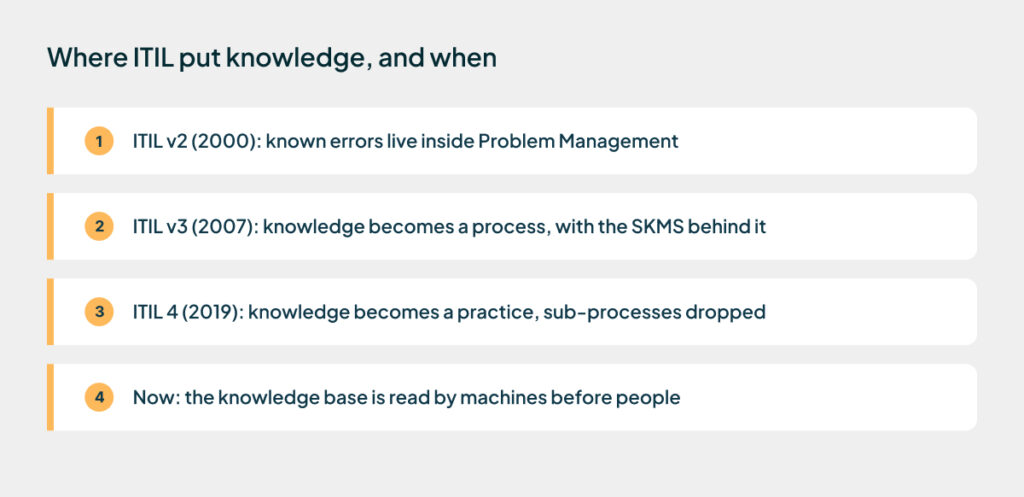
Knowledge management in ITIL is the discipline of capturing, storing and sharing what a service organization knows, so that nobody solves the same problem twice. That purpose has held since 2007. The thing that moved, twice, is where the guidance files the discipline and how much it tells you to do about it.
The v3 books arrived in 2007 and made knowledge management a formal process inside Service Transition. Consequently it came with an owner, defined inputs and defined outputs. February 2019 brought ITIL 4, which dissolved that process into a general management practice and dropped the sub-processes entirely.
Both versions still run in the field. Plenty of service desks operate v3-shaped processes under an ITIL 4 badge, because certification moves faster than tooling and much faster than habit. So the question has two honest answers. Which one applies to you depends less on your certificate than on the version your last process audit quoted.
Before 2007, ITIL knowledge management had no home of its own
Version 2 landed around the turn of the century, built on two core books: Service Support and Service Delivery. Neither carried a knowledge management process. The knowledge existed anyway, obviously. It simply survived as a by-product of other work rather than as something a named owner looked after.
The clearest survivor of that era is the known error database. Problem Management would find a root cause it could not yet fix, record the fault and its workaround as a known error, and expect the service desk to search that record before escalating. A known error database does its job well. Although it is narrow by design. In fact, holding faults and nothing else, it says nothing about configuring a mailbox, nothing about the refund window, and nothing about which of four VPN clients the field engineers happen to run this quarter.
Most people over forty in this industry will recognize what came next. Teams documented faults properly, since a process owned them and an auditor checked them. Everything else lived in email threads, on a shared drive, and inside whoever had been there longest. That person was the real knowledge base. And they took two weeks off every August.
ITIL v3 made knowledge a process and gave it a system nobody could buy
The 2007 books went at the gap directly, and the 2011 refresh tightened the wording without changing the shape. That process took a name and a place: knowledge management, inside the Service Transition stage. Two ideas came attached to it.
First, the DIKW hierarchy. Data becomes information, information becomes knowledge, knowledge becomes wisdom. As an operating model it is thin. Still, as a teaching model, it earns its place in a room full of people who have never once distinguished a log line from an answer.
Second, the service knowledge management system, or SKMS. On paper it holds everything a service organization knows. It sits above the configuration management system and the configuration management database, presenting one coherent view to anyone who needs it.
Good ambition, and the right one. The difficulty is that a service knowledge management system was never something a buyer could purchase, and the guidance never pretended otherwise: it described a logical architecture, not a product. Vendors nonetheless sold against the diagram. So a generation of service desks ended up with a tool badged SKMS that was, underneath the badge, a wiki with a permissions model and a search box that mostly returned attachments.
ITIL 4 turned the process into a practice, and stopped telling you how
February 2019. Practices replaced processes, and knowledge management landed among the general management practices, beside continual improvement and supplier management. The purpose survived intact. The machinery, however, did not, and the practice now specifies no sub-processes at all.
Read that as a retreat and you read it wrong. Enough organizations had run the v3 process as a compliance exercise that the artifacts reliably outlived the value: a named knowledge manager, a quarterly review meeting, an SKMS diagram in a steering slide, and agents still turning around in their chairs to ask the person behind them. Version 4 stopped prescribing the mechanism because prescribing it had demonstrably not worked.
Direction is what it offers instead. Start where you are, improve continually, co-create value. Decent instincts, all three. Instincts are nevertheless not a design. Your organization still has to decide who writes an article, and who approves it. It has to set how long an article may sit unread before it goes. And it has to say what happens when the product team ships a change on a Thursday afternoon.
People searching for itil v4 knowledge management are usually asking one practical question underneath the terminology: what should I actually do on Monday morning? The framework has stopped answering that, deliberately. Any answer now comes from inside the organization that needs it, or it does not come at all.
The failure ITIL knowledge management never names: articles rot
Every version of ITIL knowledge management answers where knowledge should sit. None of them answers the thing that quietly kills a knowledge base, which is decay.
Gartner surveyed 187 customer service and support leaders across July and August 2024. Among them, 61% carried a backlog of knowledge articles to edit. Notably, more than a third had no formal process for revising outdated articles at all. The same survey put 85% of those leaders somewhere between exploring and piloting customer-facing conversational generative AI for the following year.
Both figures describe the same organizations. In other words, the content layer carries a maintenance debt, and the plan is to point a language model at it.
Stale content is not a new discovery. The McKinsey Global Institute put the cost at nearly 20% of the workweek back in 2012. That was the share of time the average interaction worker spent hunting for internal information. That number is old. Ultimately it has aged well, because the mechanism never changed: when the written answer looks untrustworthy, people stop reading and start asking.
A review cadence nobody owns is the first thing to go
Most itil knowledge management best practices published since 2019 put a review cadence somewhere on the list. Far fewer of them, though, name the person who answers for it, which is a knowledge governance question rather than a documentation one. As a result, a cadence nobody owns is a recurring calendar invite, and calendar invites lose to incident queues every time.
The known error database is the counter-example worth studying. It outlasted every framework rewrite that followed, precisely because it had both halves. A process owned it, and a trigger created the entries without anyone scheduling them: an unresolved root cause produced a record. Nothing about a review cadence works that way. Which is why the cadence is the first thing a busy team quietly drops.
Signs of a correction have started to appear. Gartner returned to the subject in a December 2025 discussion of a survey covering 321 leaders. Across that September and October, 58% said they plan to upskill agents into knowledge management specialists. Those specialists review and curate the content. It is a staffing decision rather than a framework decision, which is rather the point.
Knowledge Management For a Higher CX Standard
Where a service desk knowledge management system is the wrong model
The guidance also gets applied to work it never had in view, and that is worth saying plainly, because ITIL knowledge management is not built for every support team that adopts it.
At root, ITIL is IT service management guidance. Its assumed reader is an internal technician fixing an internal fault, and nearly every design decision follows from that one assumption. Customer-facing support runs on different economics. Of course, the audience does not know the product. Similarly, volume sits an order of magnitude higher. Language has to survive a nervous first-time reader. One answer has to render correctly in chat, in an IVR prompt, in a help center article and on an agent’s screen. Teams end up writing it four times.
Push customer content into a service desk knowledge management system that inherits those assumptions and you tend to get articles that are accurate, auditable and unusable at the front line. A better fit for that work is knowledge centered service. The Consortium for Service Innovation built the methodology on a simple premise. Instead, whoever solves the case writes and improves the article while solving it. A separate authoring function, writing it up weeks later, is exactly what the method removes. Current guidance leaves room for that approach. It does not hand it to you.
For a contact center the stakes sit in metrics leadership already watches. Good contact center knowledge management shows up in handle time, not in an audit.
Knowmax ran this with a Fortune 500 retailer operating more than 10,000 stores across 27 countries. The retail rollout cut handling time by 13% and agent error by 30%, and lifted CSAT by 11%.
Read the Full Case Study
Now a machine reads ITIL knowledge management before any human does
The next shift is already underway. It changes what a good article looks like, not where you keep it.
A retrieval system does not read your knowledge base the way an analyst does. It pulls fragments, rather than pages. A Stanford-led team tested how language models use long inputs in 2023 and found accuracy peaks when the relevant passage sits near the beginning or the end of the context. Accuracy falls away sharply once the model has to locate that passage in the middle of a long document.
So a four thousand word article titled “Billing: everything you need to know” is now close to the worst possible unit of knowledge. Certainly it always punished a human under time pressure. It punishes a retrieval layer harder, because that layer will surface a confident fragment from the middle and attach your brand to it.
One question per article, with the answer at the top
The demand here is unglamorous and mostly editorial. One question per article. The answer at the top. Structure that survives the chopping, version dates that mean something, and governance tight enough to keep a retired policy out of the index six months after its replacement shipped. Those are the same itil knowledge management best practices the framework has always gestured at. The failure mode is simply harsher now. A stale article used to waste an agent’s time. Today it answers a customer directly, in your voice, with nobody in between.
Overall, tooling earns its place at exactly this point. Look for knowledge management software that enforces a review date, tracks which articles get retrieved, and shows what customers actually asked. Whether AI helps at all mostly comes down to whether the content underneath deserves reading.
Nothing in ITIL knowledge management tells you who owns the review queue. Twice now, in two different vocabularies, it has told you the queue matters. That single decision determines whether the next version finds anything left worth managing.
Ready to Give Your Service Desk One Source of Truth?
Frequently asked questions
Measure it on outcomes the business already tracks, not on article counts. The useful set is first contact resolution, average handle time, repeat contact rate, self-service success rate, and the share of articles that clear their review date on time. An article count climbs while quality falls, which therefore makes it the one number worth ignoring.
A knowledge article is a single documented answer to a single question, shaped so somebody can find it and use it at the moment of need. In a service desk context it usually covers one fault, one procedure or one policy, and it carries a stated owner and a review date. Length, meanwhile, is not the measure. Resolution is.
Knowledge centered service, or KCS, is a methodology from the Consortium for Service Innovation. Agents capture and improve knowledge as part of solving each case, rather than writing it up separately afterwards, so the knowledge base grows as a by-product of support work. That fits high volume customer-facing teams better than ITIL does.
The SKMS, or service knowledge management system, is the ITIL v3 concept of one logical store holding everything a service organization knows, layered above the configuration management database. ITIL 4 subsequently dropped the term. You still need what it described, which is a single trustworthy place to look, even though no vendor can sell you a diagram.


 Word Document)
 Excel File)


