 13 Min


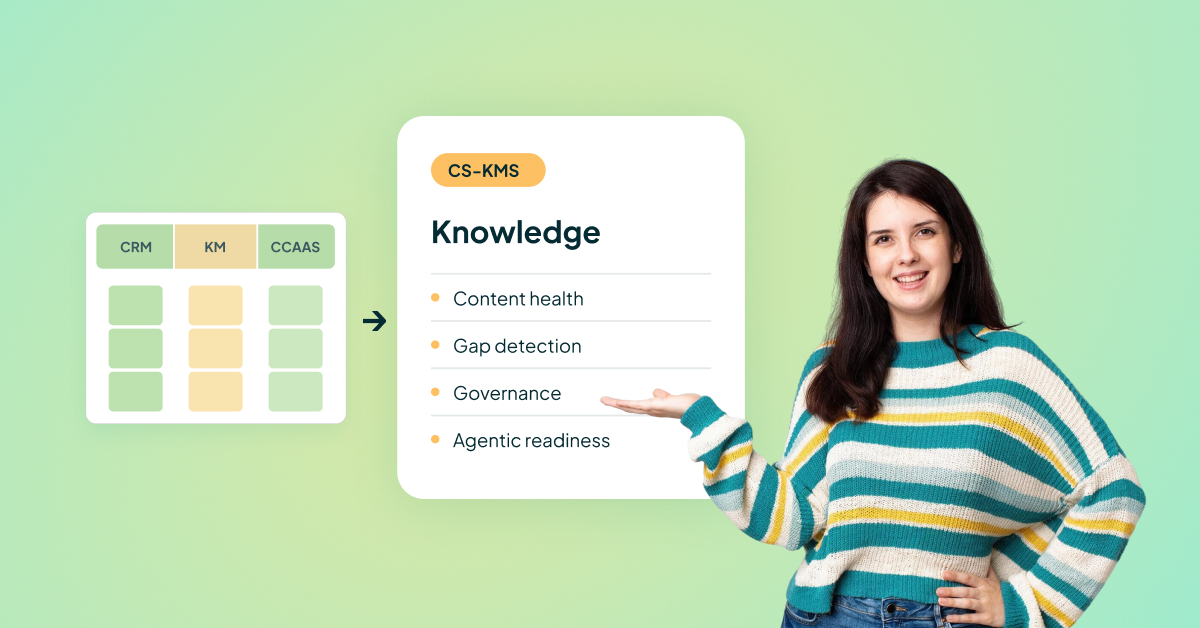
For most of the last decade there was simply no knowledge management Magic Quadrant, because knowledge showed up in analyst research as a feature rather than a market. A column in a CRM evaluation. A capability line inside a contact centre suite. Buyers who wanted to compare knowledge platforms on their own terms had nowhere neutral to look.
That changed in July 2026, when Gartner published its first Magic Quadrant for Customer Service Knowledge Management Systems. So began a standalone CS-KMS category, with its own vendors, its own criteria and its own Leaders. eGain, Salesforce and Shelf took the Leader positions in the inaugural report.
Predictably, the dot placements will get argued about for months. The more useful story is what it took for the category to exist at all, and what that tells you about how enterprise CX buying is shifting.
Table of contents
- Why a knowledge management Magic Quadrant appeared in 2026
- What the knowledge management Magic Quadrant rewards
- What the knowledge management Magic Quadrant changes for buyers
- What the knowledge management Magic Quadrant does not tell you
- A 30 day way to use the knowledge management Magic Quadrant well
- How to actually use it
- Frequently asked questions
Why a knowledge management Magic Quadrant appeared in 2026
Categories appear when buying behaviour outgrows the existing map. Two forces pushed knowledge past that line.
First comes pressure. Service organisations spent 2026 under sustained board level expectation to deploy AI, and that pressure produced a wave of assistants, copilots and autonomous agents. All of them share one dependency. They answer from your content.
Second comes disappointment. The gap between AI pilots and AI in production became the defining CX story of the year. Salesforce reported AI agent adoption in customer service climbing from 39% to 66% between 2025 and 2026, while Gartner warned that more than 40% of agentic AI projects will likely be cancelled before the end of 2027. Naturally, those two figures only coexist if a large share of adoption never reaches production.
Notably, when teams trace why, the failure is rarely the model. It is coverage, contradiction and staleness in the knowledge the model reads.
So the category logic follows. Once the quality of your knowledge base determines the quality of your AI, knowledge stops being a feature of the CRM and starts being an independently evaluated system of record.
The Beginner’s Guide To Knowledge Management
What the knowledge management Magic Quadrant rewards
Read the vendor assessments and a consistent set of themes emerges quickly. These are worth more than the dot positions, because they describe what the analyst community now treats as table stakes.
Knowledge quality as a measurable asset. eGain earned its Leader position on an AI KnowledgeOps approach. Analytics track content health over time, continuous evaluation runs alongside, and source citations plus guardrails keep automated answers accurate and compliant. The signal is that “we have a knowledge base” has stopped being a claim. It is a metric with a trend line.
Structure and ontology, not just storage. Shelf’s placement rests partly on ontology driven design and an engine that detects knowledge gaps, overlaps and risks. In other words, the platform is expected to tell you what is missing and what conflicts, not merely hold what you wrote.
Agentic use cases and ecosystem. Salesforce won its position through heavy investment in agentic AI use cases, plus a strong partner network and customer feedback loop. That reflects where demand sits, which is knowledge feeding autonomous resolution rather than knowledge sitting in a portal.
Governance you can prove. Centralised governance, role based personalisation and granular auditability recur throughout. As regulated industries push AI into customer facing answers, showing who approved what, when, and what the customer was told becomes a procurement requirement rather than a differentiator.
What the knowledge management Magic Quadrant changes for buyers
| Before the category existed | After |
|---|---|
| Knowledge evaluated as a line item inside a CRM or CCaaS bake off | Knowledge evaluated on its own criteria, with its own budget conversation |
| “Do you have a knowledge base?” as a yes or no question | “What is your content health trend, coverage rate and freshness service level?” |
| AI accuracy debated at the model layer | AI accuracy traced to knowledge coverage and governance |
Consequently, a CX leader can now defend knowledge spend without routing it through an AI project. That is genuinely new. For years the only way to fund content work was to attach it to a platform migration.
What the knowledge management Magic Quadrant does not tell you
Still, three honest caveats apply, because an inaugural report is a starting map rather than a finished one.
It is a partial field. Gartner evaluated a defined set of vendors against inclusion criteria that typically favour revenue scale and geographic spread. Several established specialists sit outside that field, including Knowmax, ProcedureFlow and Zingtree. A vendor’s absence says something about those thresholds and very little about capability on a specific requirement. If your priority is guided decision workflows, visual how to content or depth in a particular vertical, the shortlist that matters to you may not match the one in the report.
It evaluates platforms, not your content. Every vendor in the quadrant will perform differently against a knowledge base carrying 40% duplicate coverage than against one with named owners and enforced review dates. The report cannot control for the variable that matters most in your environment, which is the state of what you already have.
It reflects a moment. An inaugural quadrant in a fast moving category is a snapshot of a market mid reshuffle. Treat it as a shortlist input rather than a shortlist.
The Beginner’s Guide To Knowledge Management
A 30 day way to use the knowledge management Magic Quadrant well
Admittedly, reports like this tend to generate meetings rather than decisions. Here is a sequence that produces the opposite.
Week 1. Pull the criteria out, discard the rankings. Write down the four capability themes as scoring lines. Measurable content health. Gap and contradiction detection. Auditable governance. Agentic readiness. Add a fifth line for anything specific to your industry, such as regulated disclosure handling or multilingual coverage.
Week 2. Score what you already own. Run your incumbent platform against those five lines, honestly, with the people who use it daily rather than the people who bought it. Separately, score your content: how many of your top fifty contact drivers have exactly one current, owned answer?
Week 3. Separate the two problems. Now you can see which failures belong to the platform and which belong to your operating model. Typically most sit in the second bucket, and no procurement exercise fixes those.
Week 4. Build the shortlist from the gaps, not the quadrant. If your scoring exposes weak gap detection, prioritise vendors strong there. If it exposes missing guided workflows for conditional processes, prioritise that instead, and accept that the right vendor may sit outside the report entirely.
That last point deserves emphasis. A call center knowledge base requirement built around branching troubleshooting and visual how to content produces a genuinely different shortlist from one built around enterprise search across a document estate. Both are legitimate. Only one of them matches what the inclusion criteria reward.
How to actually use it
Ultimately, the most valuable thing to extract is the criteria rather than the ranking.
Therefore take the four themes above, namely measurable content health, gap and contradiction detection, auditable governance and agentic readiness, and turn them into your own scorecard. Then run your incumbent through it before you run anybody else.
Interestingly, most teams discover the same thing when they do. The platform is not the constraint. The constraint is that nobody owns the answer, nothing expires, and three versions of the truth are all technically published. Fixing that changes outcomes more than switching vendors does, and it usually costs less.
In short, score your own environment first. Then use the knowledge management Magic Quadrant to tell you which vendors have built for the gaps you actually found.
Frequently asked questions
Gartner published its first standalone knowledge management Magic Quadrant for customer service, known as CS-KMS, in July 2026. It evaluates vendors providing knowledge platforms for customer service on completeness of vision and ability to execute, separately from CRM and contact centre suites.
eGain, Salesforce and Shelf hold the Leader positions in the inaugural report, with further vendors spread across the other quadrants. eGain’s placement reflects its AI KnowledgeOps approach, Shelf’s its ontology driven design and gap detection, and Salesforce’s its agentic AI investment and partner ecosystem.
Largely because AI performance in customer service turned out to depend on knowledge quality. With service leaders under sustained pressure to deploy AI, and a large share of agentic projects stalling before production, knowledge moved from a feature of other systems to an independently evaluated system of record.
No. Magic Quadrants apply inclusion criteria that typically cover revenue thresholds and geographic reach. Several established specialists fall outside those criteria, including Knowmax, ProcedureFlow and Zingtree, yet they still fit specific requirements well: guided decision workflows, visual how to content, or depth in a particular vertical.


 Word Document)
 Excel File)


