 18 Min


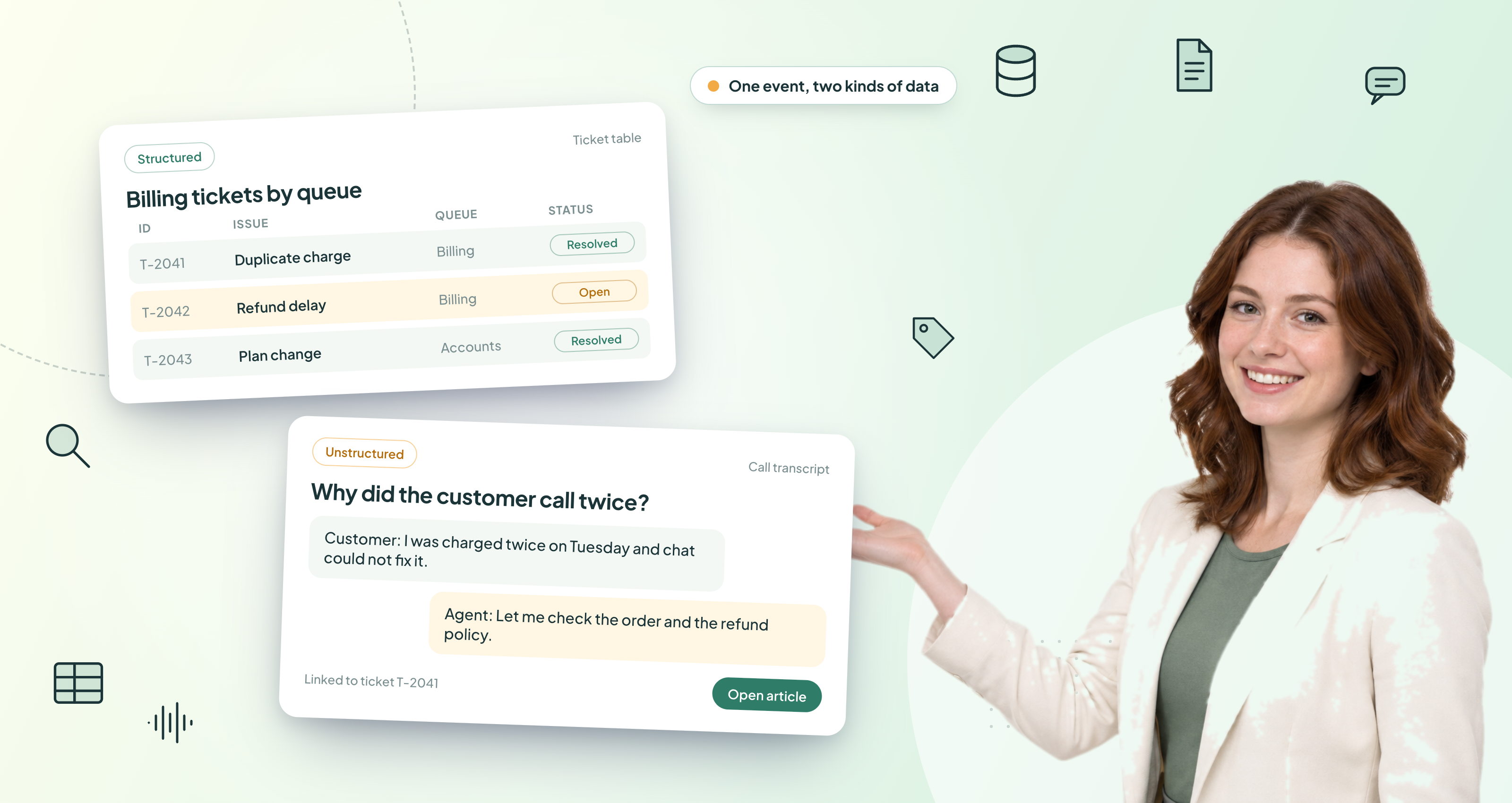
A support team opens its dashboard and gets a tidy answer. Ticket volume by queue, billing on top, handle time creeping up. Then someone asks why billing calls run long, and the dashboard has nothing to say. The reason lives in call recordings, chat transcripts and agent notes. None of that fits in a column.
That gap shows structured vs unstructured data in a single scene, and it explains why every data guide opens with the split. This post defines structured vs unstructured data with examples a contact center will recognize. After that it argues something less common: the split is a useful first sort and a poor plan.
Table of contents
- Structured vs unstructured data: the standard definitions
- The case for treating unstructured data as the problem
- Where structured vs unstructured data misleads a support team
- The cost of unstructured data lands on search
- The best objection: structure everything and let AI read the rest
- Structure by decision, not by data type
- Structured and unstructured data work as a pair
- Frequently asked questions
Structured vs unstructured data: the standard definitions
The Wikipedia entry defines unstructured data as information that either has no pre-defined data model or sits outside a pre-defined organization. Structured data is the opposite case. It lives in fields, and each value belongs to a category that someone defined before the data arrived. The IBM guide adds the practical consequence: structured data fits rows and columns in a relational database or warehouse, while unstructured data usually stays in its native format in a data lake or a nonrelational store.
What is structured data?
In a support operation, it means ticket ID, product, queue, resolution code, timestamp and handle time. Each value has a named field and a fixed type, so a query can count it on the first try, and a report can trend it across months without anyone reading a single ticket.
What is unstructured data?
It covers the words a customer typed, the audio of the call, the note an agent left and a screenshot of an error. Nothing tells a database where one fact ends and the next begins.
What is semi-structured data?
Plenty of data lands between the two. IBM calls that middle group semi-structured data: no fixed schema, but tags or metadata give it some shape.
| Dimension | Structured | Semi-structured | Unstructured |
|---|---|---|---|
| Shape | Fixed fields and types | Tags or keys, flexible layout | No predefined model |
| Support example | Ticket record, CRM fields | Chat log with timestamps, JSON from an API | Call audio, email body, agent note |
| Easy question | How many tickets per queue? | Which chats mention a refund? | Why are customers angry? |
| Hard part | Defining fields up front | Keeping tags consistent | Extracting meaning at all |
The last row carries the whole structured vs unstructured data debate. One side is hard to design and easy to query. The other costs nothing to create and a great deal to interpret.
The case for treating unstructured data as the problem
The strongest version of the common belief runs like this. Most organizational data has no schema, analytics tools read only the structured slice, and so the larger pile holds the value nobody collects. Convert the pile, and the insight appears.
Numbers usually travel with the belief. Wikipedia traces the best-known one, that unstructured data makes up as much as 80 percent of enterprise data, to a 1998 Merrill Lynch statement, and adds that the origin of the figure is unclear. Other pages push the share toward 90 percent and credit analyst firms, though the original reports sit behind paywalls. Treat any exact percentage as an order of magnitude, since nobody has measured it the way a census would.
Still, the direction is not in dispute. Transcripts, documents, messages and recordings pile up faster than anyone fills in a form. For a contact center, which runs on conversations, the pile is enormous.
What the binary gets right
Two things, and both deserve credit. The type of data decides which tools can touch it: a SQL query cannot read a call recording, and a speech model is overkill for a ticket count. The split also forces an honest inventory of structured vs unstructured data. A team that sorts its assets into two columns usually finds far more unstructured material than it assumed.
So the split earns a place in a first conversation. Trouble starts when it becomes the plan.
Where structured vs unstructured data misleads a support team
Take one fact: a customer paid twice for the same order. It lives in four places at once.
- The ticket record says category “billing,” subcategory “duplicate charge,” status “resolved.” That counts as structured.
- The call transcript records that the customer saw two charges on Tuesday, called on Friday, and had already tried chat. That one is unstructured.
- The agent’s note reads “refund approved, customer upset about the wait.” It stays unstructured, though short.
- The policy article says duplicate charges above a threshold need supervisor approval. It is free text too, but it carries an owner and a review date.
Nobody would call these four different things. They describe one event from four angles, and each angle answers a different question. The ticket says how often. A transcript says why. The note, in turn, shows what the agent decided, while the article shows what the company allows.
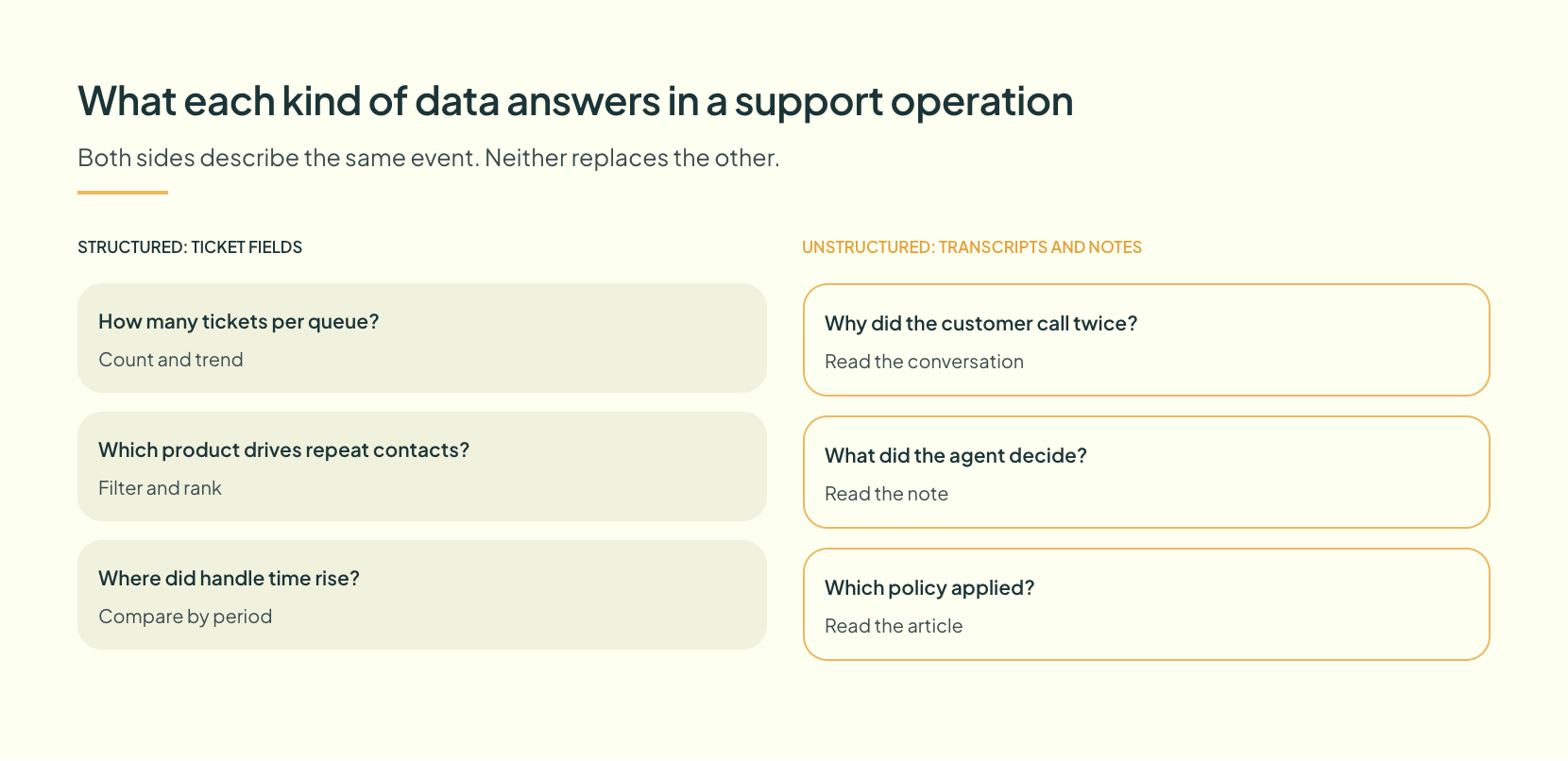
Treating structured data as the clean half does damage. A ticket category picked by a tired agent from a dropdown at shift end looks structured and is frequently wrong. In contrast, a well-edited troubleshooting article has no schema yet reads exactly right. Structure describes the container. It says nothing about the reliability of what sits inside.
Examples of structured and unstructured data in a support team
The table below sorts the assets a support team actually owns.
| Asset | Type | What a team can do with it today |
|---|---|---|
| Ticket fields | Structured | Count, trend, route, report |
| Chat log | Semi-structured | Search by keyword, filter by time and channel |
| Call recording | Unstructured | Transcribe, then analyze the text |
| Knowledge article | Unstructured, with metadata | Search, link, review on a schedule |
| SOP | Unstructured, with ordered steps | Follow, audit, convert to a guided flow |
Look at the last two rows. Articles and SOPs have no schema by definition, yet teams govern them better than any recording because someone gave them a title, an owner and a review date. So a thin layer of metadata turns a file into something a system can manage, filter, route and retire when nobody uses it any more. That is the same idea behind data versus information: value arrives with context, not with a schema.
The cost of unstructured data lands on search
If one half is cheap to query and the other costly to read, the bill arrives as time. The research on that bill comes from knowledge work in general.
A 2023 Gartner survey of 4,861 digital workers found that 47% struggle to find the information they need to do their jobs. An APQC survey of 982 knowledge workers in 2021 put a number on the cost: 2.8 hours a week spent looking for or requesting information. And a 2012 McKinsey report on social technologies found that interaction workers spend nearly 20 percent of the workweek searching, with a searchable record of knowledge cutting that time by as much as 35 percent.
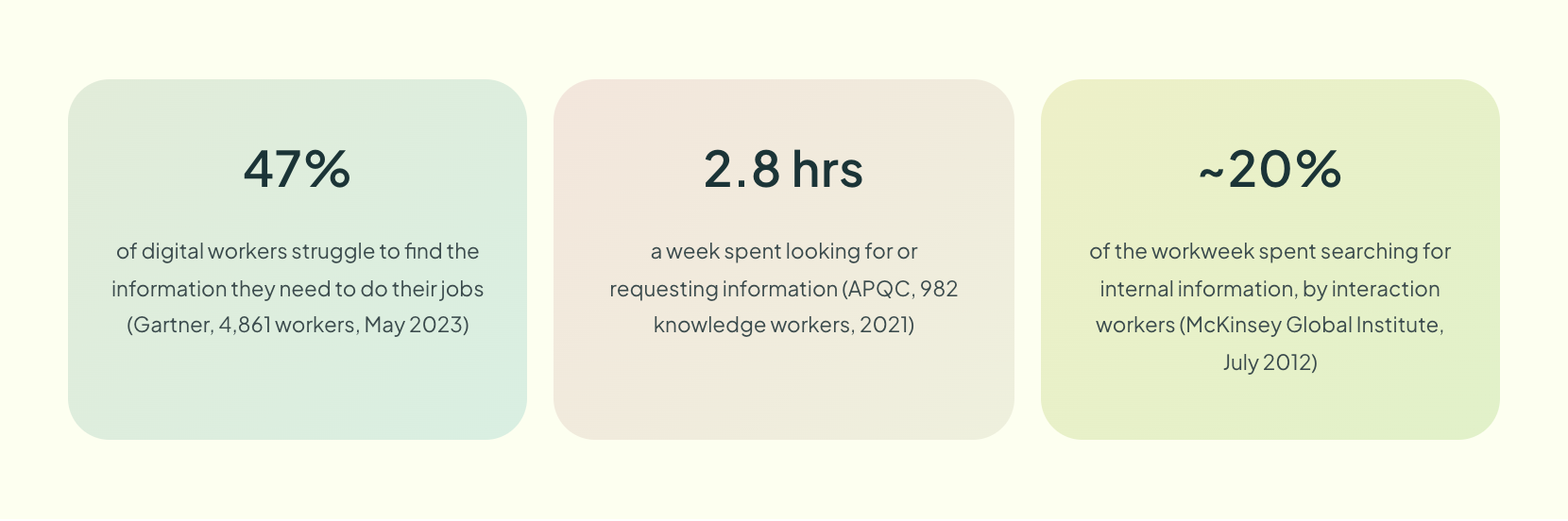
None of those studies compares structured vs unstructured data. They measure findability, and findability depends on how teams label, own and organize content, whatever its format. A thousand well-tagged articles beat ten thousand ungoverned files.
Get the Basics of Knowledge Management Explained
The best objection: structure everything and let AI read the rest
A fair challenger would say the whole problem is temporary, and that the structured vs unstructured data split will fade with better models. Language models read free text well enough that tagging has stopped mattering. Instead, point one at the transcripts and the shared drive, then ask it questions.
Part of that holds up. IBM lists retrieval-augmented generation and chatbot text analysis among the main uses of unstructured data, so the technology exists, and teams do find patterns in raw transcripts that nobody could have defined in advance.
The limit shows when the answer has to be right. A model that reads three conflicting versions of a refund policy will summarize all three without knowing which one is current. Retrieval quality depends on approval status, ownership and the date of the last review. So the metadata, the very thing that gives content structure, decides how far teams can trust an AI layer. Models cut the cost of reading unstructured data. They do not say which of it carries authority, and a wrong answer delivered fluently costs more than a slow one, since the customer has no reason to doubt it.
There is an honest cost on the other side too. Adding structure takes effort, and a team that tags everything in a hurry will tag badly, because tired people pick the nearest label and move on to the next ticket. A small operation with a stable product can run on plain documents and a good search box for a long time. That effort pays off when volume or change outruns what people can remember.
Put Your Existing Knowledge to Work for AI
Structure by decision, not by data type
The revised position on structured vs unstructured data is short. Ask which decisions the business makes again and again, add the structure those decisions need, and leave the rest alone. A decision made constantly deserves a field. A decision made twice a year deserves a paragraph and the name of the person who knows.
For a support team, that comes to four moves.
- Structure the fields that route and measure work. Category, product, resolution code and outcome. Keep the list short enough that an agent can fill it without guessing.
- Label narrative content with owner, topic and review date. A call transcript needs a link to its ticket and little else, whereas an article needs an owner, because a stale article is worse than a missing one.
- Turn repeated, branching procedures into guided flows. When a decision depends on answers collected mid-call, an interactive decision tree places the structure where the agent needs it, one question at a time.
- Leave judgment unstructured. The sense that a call is turning toward cancellation fits no schema, and coaching reaches it better than forms do.
That ground belongs to tacit knowledge.
Format choice follows the same logic. An article, an SOP and a decision tree can hold one fact with different amounts of structure, and the right amount depends on what the reader is doing, a point the post on explicit knowledge works through.
Turn a Written Procedure Into a Guided Flow
Where tooling earns its place
A spreadsheet can track owners and review dates for a few dozen articles. But past a few hundred, someone has to enforce them. Knowledge base software records owners, expiry and usage, and shows which items agents actually open, so review effort goes where the traffic is. Knowmax targets that case. It keeps articles, SOPs and decision trees in one governed library inside the agent’s workflow, though other platforms do versions of the same job. What matters is whether the review loop runs without anyone remembering to start it, because a loop that depends on memory stops the week a product launch eats the owner’s calendar, and nobody notices until an agent quotes a retired policy to a customer who already knows better.
Structured and unstructured data work as a pair
The binary will survive because it is a useful first sort. Fields with a schema tell a team how much and how often. Free text tells it why, and what to do next. An operation that reads only the first half gets a tidy dashboard that cannot explain itself. One that reads only the second gets stories without trend lines.
The decision for a support leader is smaller than the data guides suggest. Pick the three or four decisions that cost the most when an agent gets them wrong. Add structure to the content behind those decisions, and name an owner for each item. Then stop converting. Whatever remains stays as narrative, and that is not a failure of the program. In fact, it is the part of the work that only people read well.
Ready to Give Your Agents Answers They Can Find?
Frequently asked questions
Structured data follows a predefined schema, such as ticket fields in rows and columns, so a query can count or filter it directly. Unstructured data has no predefined model, such as call audio, emails and documents, so it needs transcription, search or language models before anyone can analyze it.
The body of an email counts as unstructured because it is free text with no fixed fields. The header counts as structured: sender, recipient, date and subject sit in defined fields. Many teams therefore describe an email as semi-structured, since it carries both kinds of data in one message.
Semi-structured data has no rigid schema but carries tags, keys or metadata that give it some shape. A chat log with timestamps and channel labels is one example, and a JSON response from an API is another. A system can filter it by those tags even though the content varies.
A knowledge base article counts as unstructured text, since its body is free prose. Its metadata, such as title, owner, category and review date, follows a fixed structure. That mix is what lets a system search, route and review articles while the writing itself stays readable for people.


 Word Document)
 Excel File)


