 16 Min


The bot answers the balance question in four seconds. Then the customer asks why the fee appeared, the bot offers three articles that do not quite fit, and the contact lands with an agent who inherits an irritated customer and no context at all. Containment rose that week. So did repeat contacts, though nobody put the two numbers on the same slide.
Contact center automation gets bought as a volume problem. It behaves like a content problem. The technology to answer a billing question has been commodity for years. Meanwhile the answer itself sits in a PDF that three teams disagree about, so the automation confidently returns the wrong version of it.
What follows is a sequence rather than a shopping list. It covers what to automate in the first six weeks, what to leave until the twelfth, who owns each phase, and which numbers tell you whether any of it is working. The order matters more than the vendor does.
Table of contents
- What contact center automation is actually buying you
- Before phase one, the content prerequisite most rollouts skip
- Phase one: automate the transaction, not the conversation
- Phase two: route by failure type, not by volume
- Phase three: give the automation one source it can be held to
- A contact center automation rollout, phase by phase
- How to tell contact center automation is working
- What to do when containment rises and CSAT falls
- Frequently asked questions
What contact center automation is actually buying you
Start with the target, because the wrong target produces the wrong sequence.
The pitch is usually headcount. Evidence points elsewhere. In a Gartner survey of 321 customer service and support leaders conducted in October 2025, only 20% had reduced agent staffing because of AI. In the same survey, 55% reported stable staffing levels while handling higher customer volumes.
Read that second number again. It is the one worth buying. Absorbing growth without adding heads is a real outcome, though it is a different project from cutting a service budget, and it fails in different ways.
So the target for contact center automation in year one is narrow. Repeatable work completes without an agent. The hard work reaches a better prepared agent faster. Any phase that improves one at the expense of the other gets rolled back, which is a rule worth writing down before the first vendor call.
Before phase one, the content prerequisite most rollouts skip
Contact center automation does not create answers. It retrieves them, and it retrieves whatever is there.
Gartner surveyed 5,728 customers in December 2023 and found that only 14% of customer service issues are fully resolved in self-service. The failure reasons matter more than the headline does. In 43% of self-service failures, customers could not find content relevant to their issue. Separately, 45% of customers who started in self-service said the company did not understand what they were trying to do.
Neither of those is a bot problem. Both are content problems wearing a bot costume. Buying a better bot will not touch either one.
So three things have to be true before anything is automated. One team owns each answer, by name, with a review date attached. The top contact drivers have a current article each, written as an instruction rather than as a policy summary. And the same article serves the customer, the agent and the machine, because three divergent versions guarantee the automation contradicts the agent in front of a customer reading two of them at once.
This is unglamorous work. It is also where contact center knowledge management earns its budget. Teams that skip it do not avoid the cost. Instead they pay it later, in escalations, while explaining to an executive why containment looks excellent and satisfaction does not.
Phase one: automate the transaction, not the conversation
Weeks one to six. The operations lead owns this phase, alongside one named content owner who can actually approve wording.
Start where the customer already knows what they want. Order status, payment, appointment changes, address updates, plan details, delivery windows. These are transactions with a defined end state, so success is unambiguous and failure shows up immediately.
Customers are ahead of most service teams here. Gartner surveyed 3,566 B2B and B2C customers across February and March 2026, and 58% of those who use GenAI had used it to complete a task on their behalf, rising to 74% in B2B. Half said interactions are easier when companies use GenAI. Yet 87% said an option to reach a human is essential.
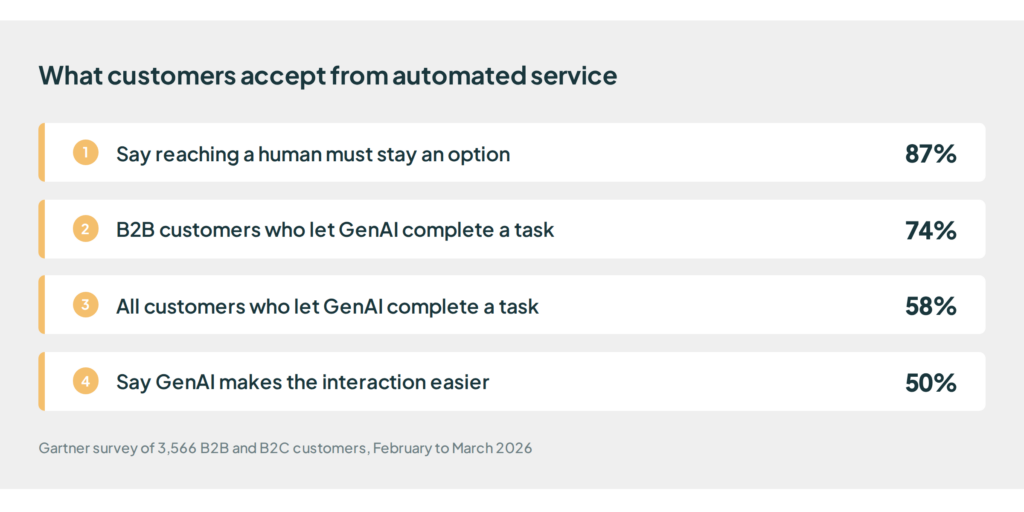
Among customers unwilling to engage with AI at all, the most common thing that would change their mind was exactly that escape hatch. Eric Keller, a Senior Director Analyst in Gartner’s customer service practice, states the design rule plainly: “Service leaders should not use GenAI as a mandatory first step for every issue.” An exit that works on the first request costs almost nothing, since those customers were never going to be contained.
Contact center automation use cases that survive a real queue
The ones that hold up share a shape. Intent is unambiguous, the system of record can confirm the outcome, and the whole thing finishes inside one exchange. Password resets qualify. Refund eligibility usually does not, because eligibility depends on a policy that has exceptions, and exceptions are where most call center automation ideas quietly fall apart.
Leave the emotionally loaded contacts alone for now. Complaints, cancellations, billing disputes and anything carrying a compliance obligation go to a person, deliberately, until phase two is built.
Knowledge Management For a Higher CX Standard
Phase two: route by failure type, not by volume
Runs from week six to week fourteen. The operations lead and the quality lead own it jointly, because this phase is judged on quality rather than on throughput.
Most contact center automation programs tune the handoff by volume, sending the busiest failed intents to agents first. Better evidence is available now for tuning it by failure type instead.
What a randomized trial found about the handoff
Researchers ran a field experiment on Alibaba’s Taobao platform, reported by Wang, Zhu, Feng, Lu and Jia in a 2026 paper on agentic AI and human intervention. Workers in the treatment group supervised an agentic system that resolved eligible chats. Control workers handled everything themselves. Deployment cut average chat duration and barely moved retrial rates. It also lowered ratings substantially on the chats the AI handled.
The interesting part is what happened after escalation. Human intervention preserved service quality on technical escalations, where the AI had simply hit the limit of what it could resolve. On emotional escalations it was much less effective. The authors trace that partly to the agents themselves, since on those contacts workers sent fewer messages, took a smaller share of the conversation, and were less proactive about seeking information or offering solutions.
That result should change how the handoff gets built. A technical dead end can wait a few turns, because an agent picking it up recovers the outcome. Frustration cannot wait. By the time it is escalated the agent inherits a worse conversation and engages less with it, and the same paper finds that early intervention is what sustains effort after escalation.
So build two separate exits out of the automation. One fires on capability, after a set number of unresolved turns. The other fires on sentiment, immediately, with no retry loop. An interactive decision tree behind the second route hands the receiving agent the current path rather than a transcript to read, which is the difference between recovering a contact and restarting it.
Phase three: give the automation one source it can be held to
Starts at week twelve and runs to week twenty-four, alongside phase two rather than after it. A knowledge manager owns it, funded as an actual role rather than as a rotation.
By now the automation answers, the handoff works, and the failure mode has moved. It is no longer that the bot cannot answer. Instead nobody can say where a given answer came from, so nobody can fix it when it turns out wrong.
Call center process automation stops being a bot project here. It becomes a governance one. Every answer the automation gives needs a traceable origin: a published article, with an owner, a date and a version. When compliance changes a refund window, one edit has to reach the customer channel, the agent desktop and the assistant at once, because otherwise the three drift apart and the drift stays invisible until a customer quotes one of them back against another.
A single governed source is the requirement, and several routes reach it. A disciplined team with AI call center software and a strict publishing process gets there. So does a knowledge platform where the same article drives self-service, agent guidance and the assistant from one record. What does not work is three teams, three repositories and a quarterly reconciliation meeting.
A contact center automation rollout, phase by phase
| Phase | What you automate | Who owns it | What proves it worked |
|---|---|---|---|
| Phase one, weeks 1 to 6 | Status, payments, appointment changes, address updates | Operations lead plus one named content owner | Task completion inside the flow, not deflection |
| Phase two, weeks 6 to 14 | The handoff: when the bot stops, and who it stops to | Operations lead and quality lead jointly | Rating on escalated contacts, split by technical and emotional |
| Phase three, weeks 12 to 24 | Retrieval for bot and agent from one governed source | Knowledge manager, funded as a role | Share of answers traceable to a dated, owned article |
Notice what is absent from the last column. Deflection rate appears nowhere, because deflection counts contacts that left rather than problems that ended. A contact center automation program judged on deflection will optimize for the customer who gives up.
How to tell contact center automation is working
Four numbers, read together, and never one of them alone.
Task completion inside the automated flow, measured against the system of record rather than against the customer hanging up. Repeat contact rate within seven days, split by whether the first contact was automated. Average handle time on escalated contacts specifically, which should fall as the handoff improves and rise sharply when it does not. And satisfaction on escalated contacts, tracked separately from satisfaction overall.
That last split is the one most teams miss. Blended satisfaction hides the damage, because the automated transactions score well and dilute the contacts where the customer had to fight their way to a human.
Deflection belongs in the same skeptical category. A ticket deflection number rewards you for a customer who gave up, which is why it rises reliably in the month before repeat contacts rise.
For a sense of what the content layer is worth once it is in place, a Fortune 500 retailer running Knowmax across more than 10,000 stores in 27 countries recorded roughly 13% lower handling time, around 30% fewer agent errors and about 11% better satisfaction in its retail rollout. Those gains came from agents and customers reading the same current answer. That is the prerequisite, rather than the automation layer sitting on top of it.
Read the Full Case Study
What to do when containment rises and CSAT falls
This combination is common enough to plan for. It is also the clearest signal that phase one ran without phase two.
The usual reading is that customers dislike automation. Sometimes true, though the Gartner customer data argues against it as a general rule, since half of customers find AI-assisted interactions easier. A narrower explanation fits better. Automation is holding on to contacts it should have released, and the customers who eventually escape arrive angry at an agent starting from zero.
The fix is unglamorous and fast. Shorten the retry loop before escalation. Add the sentiment trigger if it does not exist. Pass the full context across, including what the automation already tried, so the agent does not open with a question the customer has answered twice.
Then check the content layer, because a rising escalation rate on a single intent is almost always a stale article rather than a broken model. Pull the ten intents with the worst escalation rate, read the article behind each, and check the review date. Teams doing this for the first time tend to find the same thing. The article is technically accurate and written for an auditor, rather than for somebody trying to finish a task in ninety seconds.
A caution before any of this begins. Where the contact mix is dominated by genuinely complex, emotionally weighted work, such as claims, bereavement, debt or safety, automation in contact center operations will return very little on a first year’s investment. That money goes further on agent guidance and content quality. Automation pays where volume is repeatable. Elsewhere it mostly adds a layer for customers to get past.
Ready to Automate the Calls That Should Never Reach an Agent?
Frequently asked questions
Call center automation uses software to complete service tasks without an agent handling them: authenticating a caller, checking an order, taking a payment, or routing a contact to the right queue. Conversational AI sits on top, so the customer asks in plain language while the system completes the transaction behind it.
Agent headcount has moved far less than forecasts implied. Surveyed service leaders mostly report stable staffing while volumes keep growing. The work mix changes first. Routine transactions leave the queue, so what remains is harder, longer and more emotionally demanding, which raises the skill requirement for agents rather than removing the role.
Automate transactions before conversations, and build the exit before you build the flow. Keep a visible route to a human on every interaction, fire it immediately on frustration rather than after a retry loop, and pass full context across. Track satisfaction on escalated contacts separately, because a blended score hides the damage.
Buy the knowledge layer before the conversational layer. Retrieval quality sets the ceiling on everything a bot or an assistant can do, so a governed content source with owners, review dates and one version per answer pays back across every channel added later. Most disappointing rollouts bought them in the opposite order.


 Word Document)
 Excel File)


