 9 Min
9 Min


A customer calls a utility at 7:12 a.m. to report a power outage and question a disputed charge on the same bill. No hold music. No press-1 menu. A voice AI answers, confirms the outage in their area, files the report, explains the charge, and offers a callback once crews are dispatched. The whole call takes ninety seconds, and no human touches it. In 2024 that scenario was a demo. In 2026 it is a Tuesday.
Voice AI in the contact center has crossed from novelty to infrastructure. However, the reason it works, or fails, has almost nothing to do with the voice model itself. Instead, it comes down to the knowledge the voice agent stands on.
Table of contents
Why 2026 is the tipping point for voice AI in the contact center
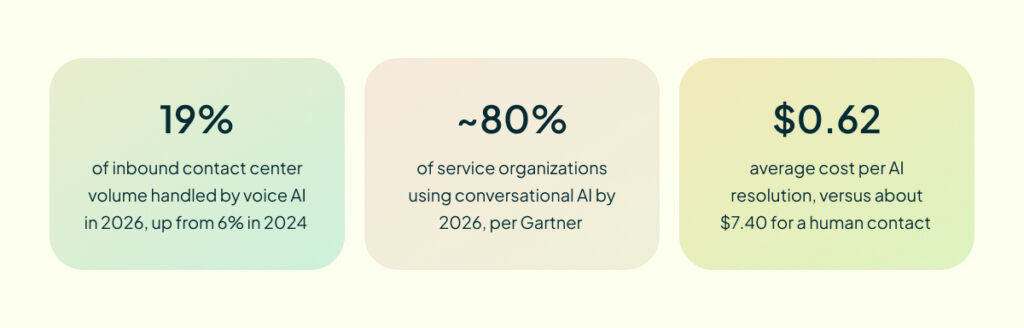
The numbers describe a genuine inflection. Today voice AI handles roughly 19% of inbound contact center volume, up from about 6% in 2024. That is a threefold jump in two years. Gartner projects that by 2026 around 80% of customer service organizations will use conversational AI in some form. By 2028, some 70% of customer interactions will begin with it. The pressure runs top-down too. A 2026 Gartner survey found 91% of service leaders are being pushed by executives to implement AI.
The economics explain the urgency behind voice AI in the contact center. Across a 2026 McKinsey sample, an AI resolution averaged around $0.62, against roughly $7.40 for a human-handled contact. Gartner has also projected that conversational AI could cut global agent labor costs by $80 billion in 2026. So once the model is finally good enough and an order of magnitude cheaper per contact, adoption stops being a question of if.
Why voice is harder than chat
Voice AI is not chat with a microphone bolted on. Rather, it is a harder problem in three specific ways, and each one raises the cost of a weak knowledge base.
There is no screen to hide behind
In chat, an AI can surface three links and let the customer pick. On a voice call, though, it has to commit to one answer, out loud, in real time. So ambiguity that a chat interface quietly papers over becomes an audible wrong answer on voice.
The conversation is linear and unforgiving
Callers interrupt, change topic, and hand over details out of order. Meanwhile, the AI has to hold a branching process in its head and still land on the correct next step. That is a decision-tree problem, not a search problem.
Errors are louder
A wrong link in chat is a shrug. A wrong instruction spoken with confidence on a billing or medical call is a complaint, a compliance event, or a churned customer. In other words, voice compresses the distance between a knowledge gap and a business consequence.
Build a Self-Service Knowledge Base with Ease
Knowledge is the real bottleneck for voice AI in the contact center
Here is the uncomfortable finding buried in the 2026 benchmarks. AI agent performance is roughly proportional to content quality. Mature voice and chat deployments resolve anywhere from 50% to 80% of routine contacts end to end. Yet the spread within that range is driven far more by the knowledge base than by the model. Two teams can license the same voice platform and land 30 points apart on resolution, purely because one fed it governed, structured content while the other pointed it at a folder of PDFs.
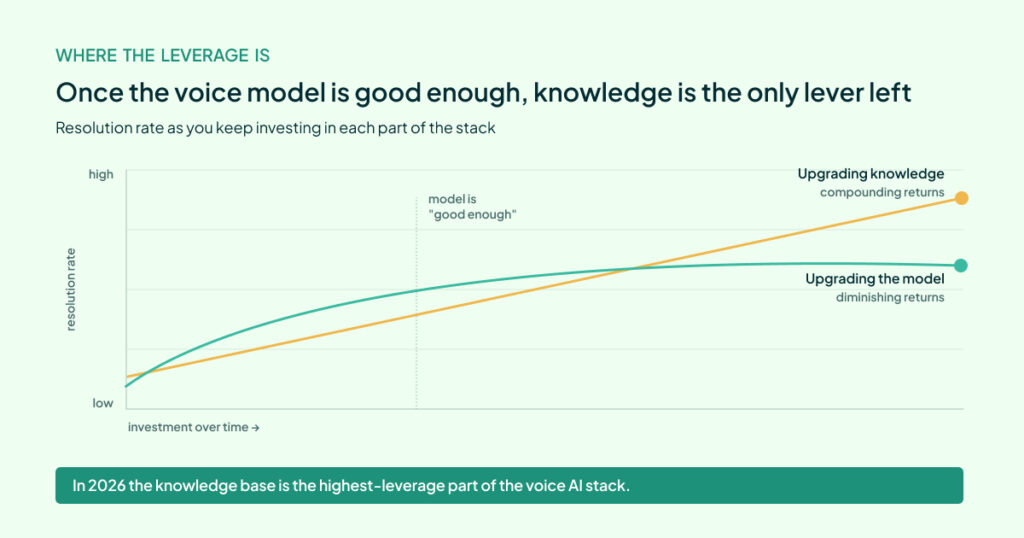
It also helps to separate two numbers vendors love to blur. Deflection counts calls a human did not take. Resolution counts problems actually solved. A voice bot can deflect a call and still leave the problem unsolved, so the customer just calls back angrier. Resolution is the honest metric, and resolution is a knowledge outcome before it is a model outcome.
What voice-ready knowledge looks like
Voice-ready knowledge is not merely accurate. It is structured for a machine that has to answer instantly and unambiguously. So before you scale voice AI in the contact center, four properties matter most.
Decision trees, not documents
A voice agent handling a conditional process, such as troubleshooting, eligibility, or claims intake, needs the logic encoded rather than narrated. A governed decision tree gives the AI an explicit next-best step at every branch. That is exactly what a linear voice conversation demands.
One governed source behind every channel
The voice bot, the chatbot, the agent copilot, and self-service should all draw the same verified answer. When they diverge, customers who escalate from voice to a human hear a different story, and trust collapses. Therefore a single source of truth is what keeps the answer consistent across the handoff.
Owners, effective dates, and verification dates
Voice removes your ability to caveat. If the AI is going to say something out loud as fact, that fact needs a named owner and a verification date behind it. Governance is what lets you deploy voice AI in regulated contexts, from banking to insurance to healthcare, without holding your breath.
Built for the handoff to a human
The best voice AI in the contact center resolves most contacts and escalates the rest cleanly. That means the human who picks up sees the same knowledge the AI used, plus the context of the call. As a result, there is no starting over and no contradiction.
Ready to Build Your Own Customer Service Knowledge Base?
FAQs
Voice AI handles roughly 19% of inbound contact center volume in 2026, up from about 6% in 2024. Gartner projects that around 80% of service organizations will use some form of conversational AI by 2026, rising to most first-touch interactions by 2028.
Voice has no screen to show options on, so the AI must commit to one spoken answer in real time. Conversations are also linear and easily interrupted. And errors are louder, because a confident wrong instruction spoken aloud carries more risk than a wrong link in chat. Each factor raises the cost of a weak knowledge base.
Knowledge quality, more than the voice model. AI agent performance is roughly proportional to content quality. So the same platform can deliver very different resolution rates depending on whether it is grounded on governed, structured knowledge or on unstructured documents.
Structure content as governed decision trees rather than documents. Consolidate to a single source of truth that feeds every channel. Attach owners and verification dates to every answer. Finally, design for clean escalation so a human inherits the same knowledge and context the AI used.


 Word Document)
 Excel File)


