 10 Min



There’s a moment every contact center leader recognizes: the agent who knows everything. The one other agent’s route is difficult for calls to. The one who’s memorized every edge case, every product quirk, every exception to the exception. Ask any team lead who they’d least like to lose, and they’ll name someone who fits this description.
That agent’s knowledge, carefully accumulated over years, is typically nowhere in your knowledge base. It lives in their head. And when they leave, it goes with them.
Gartner’s 2026 survey of customer service leaders found that 58% are actively trying to change this, not just by documenting better, but by formalizing agent roles as knowledge contributors and specialists. This isn’t a documentation initiative. It’s a structural change to how contact centers create, maintain, and distribute expertise.
Here’s what that actually looks like in practice, and how to build it.
Table of contents
Why the Agent Role Is Changing
The contact centers that have deployed AI broadly are discovering a structural irony: AI is handling more volume, but the interactions reaching agents have become harder and more nuanced. Routine queries: balance inquiries, order status, and FAQs are deflected to self-service or handled by virtual agents. What’s left requires judgment, contextual reasoning, and often, knowledge that no one has thought to document.
This creates two problems simultaneously. Agents are being asked to handle a more cognitively demanding portfolio of interactions while also serving as the sole source of institutional knowledge for edge cases. The Gartner report on blending human strengths with AI intelligence puts this plainly: the value of the human agent in 2026 is not in volume or capacity; it’s in knowledge quality and judgment. Organizations need to structure roles to reflect that.
What a Knowledge Specialist Role Actually Involves
The term “knowledge specialist” is broader than it might sound. It isn’t a separate full-time role that replaces handling interactions. It’s a set of responsibilities layered onto the existing agent role, accountabilities that transform how expertise flows through the organization.
| Responsibility | What It Looks Like Day-to-Day | Time Investment |
|---|---|---|
| Knowledge Flagging | Marking articles as outdated, incorrect, or incomplete during or after interactions | 2–5 min/day |
| Article Creation | Converting resolved complex interactions into structured knowledge drafts for review | 15–30 min/week |
| Peer Review | Reviewing and approving proposed knowledge updates in their topic area | 30–60 min/week |
| Gap Identification | Surfacing knowledge categories that repeatedly generate escalations or uncertainty | Weekly team meeting contribution |
| Quality Monitoring | Owning accuracy for a defined set of knowledge categories (e.g., billing, returns) | Ongoing lightweight ownership |
The Playbook: Building a Knowledge Specialist Program in Three Phases
Phase 1 — Foundation (Weeks 1–4)
- Identify Your Knowledge Champions and Define Ownership
Every contact center already has informal knowledge champions, the agents others go to for answers. Start by formalizing their role. Map your top 20–30 knowledge categories to specific agents or small pods of agents. Give each person a defined scope of ownership. Don’t try to cover everything at once. Start with your highest-traffic, highest-escalation categories.
Phase 2 — Activation (Weeks 4–12)
- Equip Agents with the Tools to Contribute
The knowledge specialist role only works if contributing to the knowledge base is frictionless. Agents need: one-click flagging of outdated content during interactions, a simple workflow to convert resolved interactions into knowledge drafts, clear visibility into articles under their ownership, and a recognition mechanism that ties knowledge contributions to performance metrics. Platforms like Knowmax provide these workflows natively within the agent desktop, so contributing knowledge doesn’t require switching context or navigating a separate system.
Phase 3 — Institutionalization (Month 3+)
- Measure, Recognize, and Expand
Knowledge contributions need to be visible and valued. Build KM contribution metrics into your team scorecards: articles reviewed, gaps flagged, and knowledge freshness scores for owned categories. Run monthly recognition for top contributors. Gradually expand the program to your full agent population, using Phase 1 and 2 participants as internal champions and trainers.
Download our free Knowledge Management Framework Template
The Tools That Make It Work
The most common reason knowledge specialist programs stall is tooling friction. If contributing to the knowledge base requires logging into a separate system, navigating a complex authoring interface, or waiting weeks for an editorial review cycle, agents won’t do it. The program becomes a compliance exercise rather than a genuine knowledge flywheel.
What agents need from their knowledge platform:
- Inline flagging from within their interaction interface, not a separate tool, not a separate login.
- AI-assisted article creation, the ability to generate a draft article from interaction notes or a resolved case, which the agent reviews and refines rather than creates from scratch.
- Visual decision tree authoring is for complex, multi-step processes where a decision tree communicates more clearly than a written article.
- Content health dashboards, showing agents the current status, freshness, and usage metrics for articles they own.
- Structured review workflows, so proposed knowledge updates move through a defined approval chain without manual coordination.
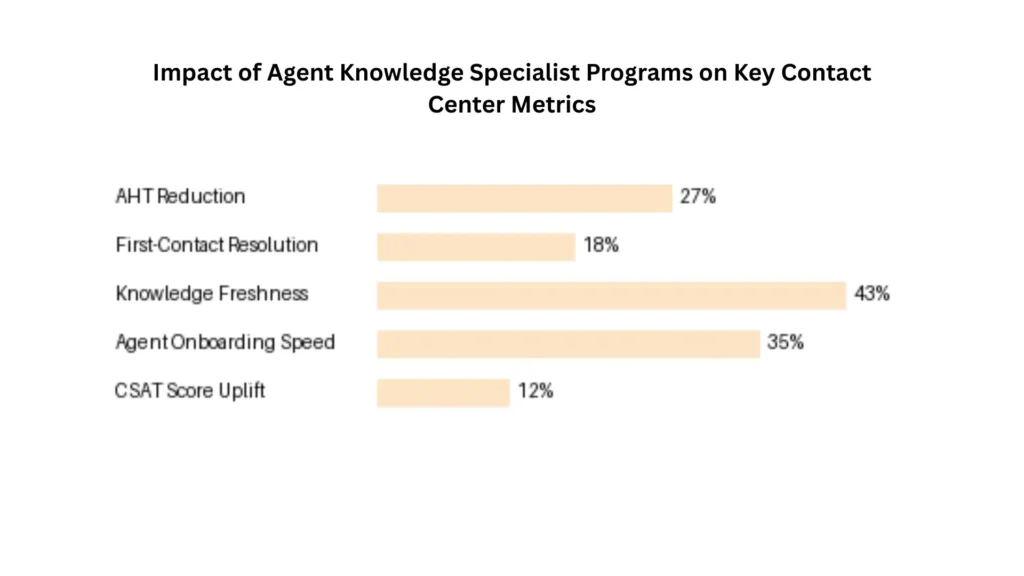
FAQs
AI now handles routine queries, leaving agents with harder, more complex interactions. The problem? The knowledge needed to resolve these lives is in agents’ heads, not your knowledge base. When they leave, it goes with them.
Five essentials: inline content flagging, AI-assisted article drafting, visual decision tree authoring, content health dashboards, and structured review workflows, all within the agent desktop. If it requires a separate login, they won’t use it.
Track articles reviewed, gaps flagged, drafts submitted, and knowledge freshness scores for owned categories. Put these on team scorecards. If it’s not measured, it won’t happen.
Your best agents, the ones everyone routes hard calls to, usually have no formal recognition for that expertise. This model changes that. It gives them a growth path, visible contribution metrics, and a sense that their knowledge is valued. Experts stay. Interchangeable processors leave.


 Word Document)
 Excel File)


