 18 Min



Healthcare call centers support everything from appointment scheduling and benefits inquiries to post‑care instructions and triage lines. Unlike most industries, these centers handle sensitive patient data, dynamic clinical guidelines, strict regulatory mandates (HIPAA, SOC2), encrypted communications, and emotionally stressed callers.
A survey of modern healthcare operations shows that information trapped in siloed systems or outdated documentation leads to slow responses, compliance risks, and uneven patient experiences.
This article breaks down the top challenges healthcare call centers face, explains their root causes, and shows tested solutions CX leaders can apply, backed by real Knowmax case studies.
Table of contents
- Why Healthcare Call Centers Are Uniquely Challenging
- Top 6 Healthcare Call Center Challenges and How to Solve Them
- How CX Leaders Should Approach Healthcare Call Center Transformation
- Why Knowledge Management Matters in Healthcare
- How Knowmax Helps Solve Healthcare Call Center Challenges
- Final Thoughts
- FAQs
Why Healthcare Call Centers Are Uniquely Challenging
Unlike other industries, healthcare call centers must manage:
- Sensitive patient and health-related information
- Frequently changing policies, procedures, and care protocols
- Multiple departments, handoffs, and cloud-based systems
- Strict compliance and regulatory requirements (HIPAA, SOC2)
- Emotionally stressed or vulnerable patients
- Multilingual support and technology integrations with EHR/CRM systems
These factors make traditional call center setups, static SOP documents, shared folders, and manual training ineffective for delivering consistent and compliant patient experiences at scale.
Medical SOP Template for Patient Care
Top 6 Healthcare Call Center Challenges and How to Solve Them
1. Inconsistent and Incorrect Information Shared With Patients
The Challenge
Patients receive different answers from different agents for the same query.
Why It Happens
- Information is spread across PDFs, emails, spreadsheets, internal chats, and CRM/EHR systems
- SOPs are outdated or not updated in real time
- Critical knowledge resides with a few experienced agents
Impact
- Patient confusion and dissatisfaction
- Repeat calls and escalations
- Increased compliance and legal risk
How to Solve It
Healthcare organizations need a single source of truth that ensures all agents access the same approved, up-to-date information. A centralized AI knowledge management platform like Knowmax enables consistent and accurate information delivery across every interaction.
2. High Average Handle Time (AHT)
The Challenge
Agents take longer to resolve calls, increasing wait times and operational costs.
Why It Happens
- Agents switch between multiple systems during live calls (CRM, EHR, telephony, billing platforms)
- No guided workflows or structured decision paths
- Frequent dependency on supervisors for clarifications
Impact
- Longer patient wait times
- Lower CSAT scores
- Increased agent fatigue and burnout
How to Solve It
Guided knowledge workflows help agents quickly navigate complex scenarios and find the right answers during calls. Structured knowledge reduces search time, improves AHT, and integrates seamlessly with call routing and cloud-based systems.
See how a leading online food delivery app reduced AHT by 15% with guided knowledge workflows
3. Low First Call Resolution (FCR)
The Challenge
Patient issues are not resolved in the first interaction.
Why It Happens
- Partial or outdated information
- Lack of contextual guidance for complex queries
- No standardized resolution paths
Impact
- Higher call volumes
- Increased operational costs
- Poor patient experience
How to Solve It
Decision trees, scenario-based workflows, and integrations with telehealth and CRM systems enable agents to resolve patient queries accurately the first time, improving both FCR and overall patient satisfaction.
3. Slow and Ineffective Agent Onboarding
The Challenge
New agents take weeks or months to become productive.
Why It Happens
- Heavy reliance on classroom-based training
- Static SOPs that are difficult to understand and apply
- No access to real-time guidance during live interactions
Impact
- Longer ramp-up times
- High training costs
- Inconsistent service quality
How to Solve It
A healthcare-ready knowledge management system supports learning in the flow of work, allowing new agents to rely on guided knowledge rather than memory, and integrates training with cloud-based telephony and CRM tools.
4. Compliance and Information Accuracy Risks
The Challenge
Agents unintentionally share outdated or non-compliant information.
Why It Happens
- Lack of content governance and approval workflows
- No version control for SOPs and policies
- Limited audit visibility
Impact
- Regulatory violations
- Legal and financial exposure
- Damage to brand trust
How to Solve It
Governed knowledge platforms with approval workflows, role-based access, version control, and encryption help healthcare organizations maintain compliance and audit readiness. Knowmax is designed to support compliance-focused knowledge management in healthcare environments.
5. Knowledge Silos and Agent Dependency
The Challenge
Only a small group of senior agents can handle complex patient queries.
Why It Happens
- Expert knowledge is not documented
- No structured process for capturing best practices
- High attrition risk
Impact
- Operational bottlenecks
- Poor scalability
- Service disruption when experienced agents leave
How to Solve It
Capturing expert knowledge into a centralized, searchable knowledge base ensures all agents can handle complex scenarios confidently and consistently. Integrations with CRM, EHR, and cloud telephony enable scalable access.
How CX Leaders Should Approach Healthcare Call Center Transformation
From working closely with healthcare CX and operations teams, a consistent pattern emerges: meaningful and sustainable improvement in healthcare call centers does not come from isolated fixes such as more training sessions or additional headcount. It comes from addressing the underlying systems that shape agent behavior and patient interactions.
CX leaders should take a structured, long-term approach by focusing on:
- Standardizing patient communication to ensure every agent delivers accurate and consistent information across channels
- Reducing dependency on individuals by capturing expert knowledge and making it accessible to the entire team
- Ensuring accuracy and compliance through governed processes, approvals, and version-controlled information
- Empowering agents with real-time guidance so they can confidently handle complex queries during live interactions
- Designing systems that scale with organizational growth, rather than relying on manual processes and tribal knowledge
At the core of all these initiatives lies structured knowledge. When knowledge is centralized, governed, and embedded into daily workflows, healthcare call centers can improve performance, maintain compliance, and deliver consistently better patient experiences at scale.
Why Knowledge Management Matters in Healthcare
Healthcare ecosystems demand fast, compliant, and accurate responses. Relying on memory, outdated docs, or supervisors raises costs and risks. A healthcare-ready AI knowledge management platform can:
- Centralize policies, procedures, and compliance rules
- Guide agents with interactive workflows
- Cut AHT and improve FCR
- Support audits with version logs
- Elevate patient satisfaction through consistent service
The Beginner’s Guide To Knowledge Management
Healthcare KPIs Every CX Leader Must Track
Implementing structured knowledge management in healthcare call centers directly impacts the metrics CX leaders care about most:
- Average Handle Time (AHT): Reduced by enabling agents to find the right information quickly during calls
- First Call Resolution (FCR): Improved through guided resolution paths that help agents address issues correctly the first time
- Customer satisfaction (CSAT): Increased by delivering faster, more accurate, and consistent responses to patients
- Agent Productivity: Enhanced as agents spend less time searching for information and more time resolving patient issues
- Training Time: Shortened by supporting on-the-job learning and reducing reliance on memorization
- Compliance Accuracy: Strengthened by ensuring agents always use approved, up-to-date information
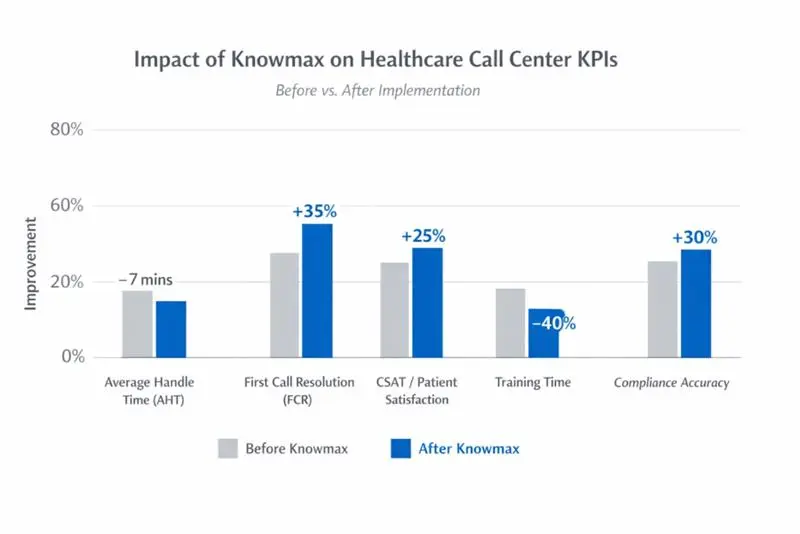
How Knowmax Helps Solve Healthcare Call Center Challenges
Knowmax AI knowledge management software guides agents in real-time and ensures accuracy and compliance. By providing a single source of truth with structured workflows, integrated agentic AI, and intelligent automation, Knowmax helps healthcare call centers to:
- Reduce AHT by automating repetitive tasks and providing AI-driven next-best-action guidance to agents
- Improve FCR through AI-assisted recommendations and scenario-based workflows that surface the right information at the right time
- Shorten agent onboarding with automated training pathways and real-time AI support during live interactions
- Ensure compliant, consistent patient experiences with governed knowledge, automated version control, and proactive compliance alerts
Knowmax has documented success across industries that closely mirror healthcare call center KPIs: Knowmax Case Studies
- 21% improvement in FCR at a leading telecom group
- 46% reduction in call volume + error rates in CX workflows
- $60,000 cost savings with guided knowledge deployment
- Significant reductions in training time + AHT improvements in fintech & retail CX teams
These outcomes clearly show what structured knowledge systems combined with agentic AI and automation can unlock in complex environments like healthcare.
Experience How Knowmax Enables Faster, Compliant Healthcare Support
Final Thoughts
Healthcare call center problems aren’t caused by agents; they’re symptoms of fragmented systems, outdated SOPs, and poor knowledge governance. Centralizing and structuring knowledge dramatically improves performance, compliance, and patient trust.
For CX leaders, the path forward is clear: centralize knowledge, standardize communication, and enable agents with accurate information at the moment of need. Organizations that invest in structured knowledge management consistently deliver better patient experience, operational efficiency, and trust.
FAQs
Inconsistent information, high AHT, low FCR, slow agent onboarding, and compliance risks are the most common challenges.
By standardizing information delivery, reducing call handling time, and ensuring agents have access to accurate, up-to-date knowledge.
Knowledge management ensures information accuracy, compliance, faster resolution, and a consistent patient experience across all interactions.


 Word Document)
 Excel File)


