 20 Min



Institutional knowledge is the accumulated know-how of an organization: what its people understand, what its documents record, and the reasons behind how things are done. It is also called institutional memory or organizational memory.
A senior agent named Dana resigns on a Friday. By the following Wednesday, her old queue is spiking: a billing edge case she always handled, a carrier whose outage notices arrive late, a customer segment that cancels unless someone calls back within the hour. None of it lived in an article. All of it lived in Dana. That quiet transfer from a person to a gap is what institutional knowledge loss looks like from the floor.
Most teams only notice it once it has gone, so this post defines it, shows where it sits in a contact center, names its types, explains how it gets lost, and lays out a 90-day plan for deciding what to keep, capturing it, and checking that it stuck.
Table of contents
- What institutional knowledge is, and what it is not
- Types of institutional knowledge
- Institutional knowledge examples from a support operation
- Why institutional knowledge loss is so costly
- How organizations lose institutional knowledge
- The plan: keep the knowledge worth keeping in 90 days
- How to tell the plan is working
- What to do when it is not working
- Institutional knowledge and AI
- Frequently asked questions
What institutional knowledge is, and what it is not
The organizational memory entry on Wikipedia describes the same idea under a second name, institutional or corporate memory: the data, information and knowledge an organization builds up over its existence. It places that memory in two repositories, the organization’s archives and its individuals’ memories. For most readers, the institutional knowledge meaning comes down to that split. Part of it is written. Part of it walks out the door at 5 p.m.
Three neighbors get confused with it, so the boundaries are worth stating.
- Data and records are inputs. A ticket archive becomes institutional knowledge only when someone knows what the patterns in it mean.
- Written material is the documented part. It covers policies, procedures and reference pages, which the companion post on explicit knowledge treats in detail.
- Tribal knowledge is the informal part, the unwritten rules a team passes along by habit. Some writers treat it as a synonym. It fits better as a name for the unwritten half.
Institutional knowledge versus tacit knowledge
The two overlap, but they are not the same. Tacit knowledge is the judgment an individual holds but cannot easily state. The institutional kind is wider, since it takes in that judgment, the written material, and the history of why things are done as they are. In other words, tacit knowledge is a component of the whole, and the component hardest to move.
Types of institutional knowledge
Institutional knowledge is easier to manage once you can name its parts. In a support operation it usually falls into five types.
- Process knowledge. How work really gets done, including the workarounds and the order of steps nobody wrote down, such as the sequence an experienced agent follows when a billing dispute spans two accounts.
- Customer knowledge. Patterns about segments and accounts, such as which customers cancel unless someone calls back within the hour.
- Product and system knowledge. The quirks, known issues and weak points, such as a carrier whose outage notices arrive late.
- Historical knowledge. The reasons behind the rules, such as why a refund approval has two stages.
- Relationship knowledge. Who to ask in another team, and how to get a fast answer from a vendor.
These types cut across the split between explicit, tacit and implicit knowledge. Process and product knowledge are often at least partly written down, while historical and relationship knowledge usually live only in people. Our guides to explicit knowledge and tacit knowledge cover those two forms, and the overview of the types of knowledge management shows how they fit together.
Institutional knowledge examples from a support operation
A definition does not show a team what to look for. These examples of institutional knowledge are ones a typical contact center already holds, whether or not anyone has named them.
| Type | Example from the floor | Where it lives today |
|---|---|---|
| Process history | Why the refund approval has two stages | One long-tenured supervisor |
| Workarounds | The sequence that clears a stuck order in the billing tool | Three agents and a chat thread |
| Customer context | Which accounts need a call back within the hour | A team lead’s memory |
| Vendor behavior | A carrier whose outage notices run late | Scattered notes |
| Exceptions | When policy bends and who may approve it | Nobody agrees |
| Decision reasons | Why a rule exists, and what broke the last time it changed | Usually nowhere |
The right-hand column is the finding. Four of the six rows sit in a person or in nobody, which is why a document-first approach misses most of them. The table is illustrative rather than measured, so a real audit will turn up different rows. Still, the pattern is likely to hold. The items that cost the most when lost carry the least written trace, because a policy page survives a resignation and a workaround does not.
Why institutional knowledge loss is so costly
The cost shows up as search time before it shows up as a resignation. A 2023 Gartner survey of 4,861 digital workers found that 47% struggle to find the information or data they need to do their jobs. An APQC survey of 982 full-time knowledge workers in 2021 put the weekly price at 2.8 hours spent looking for or requesting information. And the McKinsey Global Institute 2012 study found interaction workers spend nearly 20 percent of the workweek looking for internal information or tracking down colleagues.
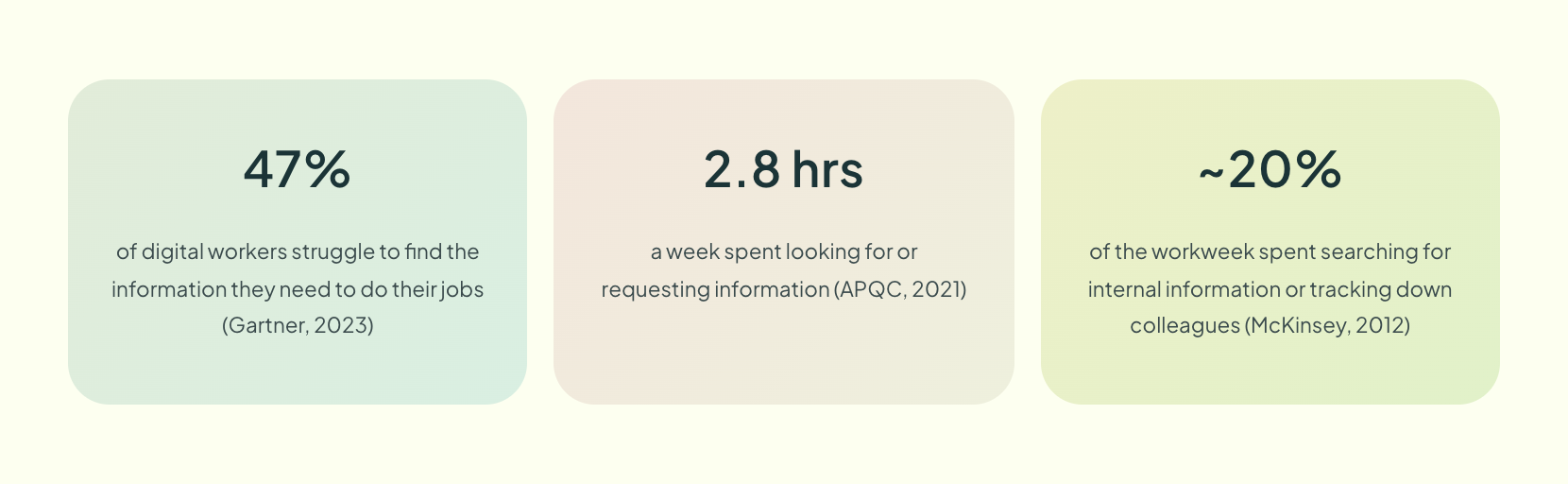
Those studies measure everyday friction, not departures. They matter here because every departure makes the friction worse: the person people used to ask is gone, so the search that took a minute becomes a hunt. A contact center feels the effect sooner than most functions, because the agent turnover rate decides how often the cycle repeats.
How organizations lose institutional knowledge
Knowledge rarely disappears in one dramatic moment. It leaks through a handful of ordinary events, and each one can be planned for.
- Resignations and retirements. The person who holds the history leaves, and the notice period is too short to transfer it.
- Restructuring and team moves. People change teams, and the unwritten handoffs and contacts they maintained go with them.
- System migrations. Old tickets, notes and shared drives are retired or archived, and the context stops being searchable even though the files still exist.
- Fast growth. New hires outnumber the people who know why things work as they do, so habits spread without their reasons.
- Vendor or outsourcing changes. A partner team that learned the process over years is replaced, and the learning leaves with them.
The pattern is the same each time: the knowledge was in people, the event moved the people, and nothing had captured it first. That is why the plan below starts before anyone resigns, not after.
Get the Beginner’s Guide to Knowledge Management
The plan: keep the knowledge worth keeping in 90 days
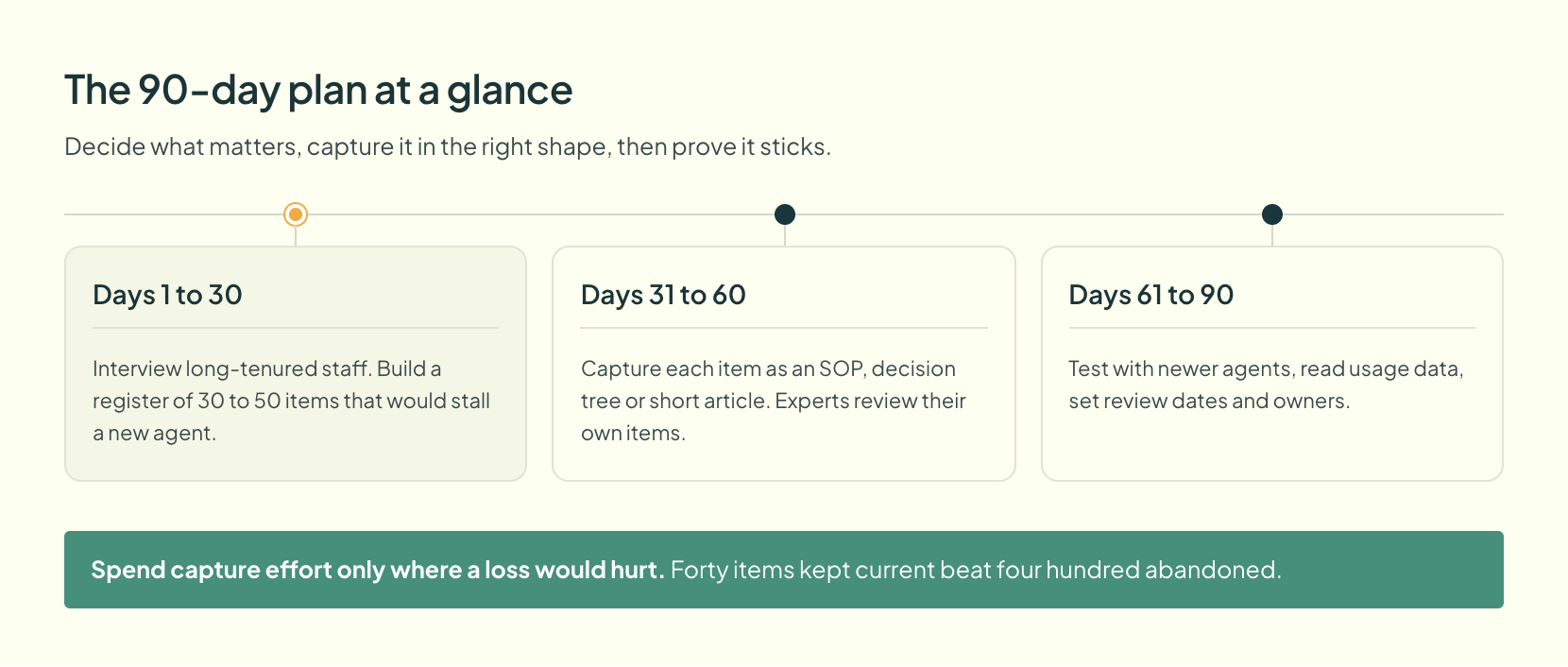
Capturing everything is neither possible nor wanted. The plan below is built around one idea: spend capture effort only where a loss would hurt, and let the rest go. It runs in three phases, each with an owner and a rough duration.
Phase one, days 1 to 30: decide what is worth keeping
Owner: the operations lead, with two team supervisors.
Start with people, not documents. List every agent, supervisor and specialist who has been with the operation long enough to carry history, and mark the ones whose departure would hurt most. Then ask a different question of each: what do you know that nobody else does? A short structured interview of 45 minutes per person is enough to surface it. Good prompts are concrete, for example “what do you do on a Monday that a new hire would get wrong?” or “which customer would you warn a colleague about?” Abstract questions get abstract answers. Specific ones, however, surface the workarounds that matter.
Sort the answers with one test. Would a new agent get a wrong answer or a stalled call without this? If yes, it goes on the register. If the answer is “it would be interesting to know,” it does not. A register of the 30 to 50 items that fail the test is more useful than a catalog of 500 that do not.
Phase two, days 31 to 60: capture it in the shape the work needs
Owner: a named subject matter expert per item, with an editor.
Each item on the register needs the right container, and the wrong one wastes the capture. A fixed sequence belongs in an SOP. A fact that depends on answers gathered during the call belongs in a branch of an interactive decision tree. Reasons and history suit a short article.
Use a worked example to see the difference. Take Dana’s callback rule, in a composite of what teams describe. As a sentence in a meeting it is “call the cancellation-risk customers back within the hour.” As captured knowledge it is a branch: is the account in the at-risk segment, has the customer mentioned cancelling, has an hour passed? If all three are true, route to a callback with the reason attached. The second version survives Dana’s resignation. The first leaves with her.
Start From a Free SOP Template
Two habits keep this phase honest. Capture the reason along with the rule, because a rule without its reason gets deleted the first time it looks inconvenient. And have the expert review the written version, since a draft written by someone else is often subtly wrong. Meanwhile, keep each item short enough to read mid-call; a captured item that needs five minutes of reading has only moved the problem.
Phase three, days 61 to 90: prove it sticks
Owner: the knowledge manager, or the operations lead where there is none.
Capture counts only if people use it. So check three things. Ask a newer agent to resolve a case from the register using the captured version alone, without asking anyone. Look at search and usage data to see which captured items agents actually open. And give every item a review date, so it does not decay into the stale pages that fill most knowledge bases.
This is where the operation shifts from a project to a process. The ongoing version is the same loop that sits inside any knowledge management process: capture, review, retire. Teams run phase one and two with energy and forget phase three, which is why the register goes stale within a year.
How to tell the plan is working
Four signals show it, none of them requiring a dashboard rebuild.
- New agents resolve register cases without asking anyone. Test it in week 10 with two recent hires.
- Escalations tied to a departed expert fall. Tag them for the first month so the count exists.
- Every register item has an owner and a review date. Without either, an item is already decaying, and nobody will notice until an agent quotes it.
- A resignation triggers a handover, not a scramble. The register tells the manager what to ask in the exit window.
Get the Knowledge Management Rollout Guide
What to do when it is not working
Most failures trace to one of three causes. Experts resist because they read capture as a prelude to replacing them; the fix is to frame the work as recognition and to credit each expert by name on what they wrote. The register grows past what anyone can maintain; the fix is to cut it, because 40 items kept current beat 400 abandoned. And the captured items sit in a drive nobody opens; the fix is to place them where the agent already works.
A concession belongs here. Writing things down cannot hold everything, and some of it should not try. The sense an experienced agent has that a call is turning toward cancellation comes from years of calls, and a page titled “Handling cancellation risk” lists the signs without conveying the feel. For that part, mentoring and shadowing do more than any capture exercise. They cost senior time, though, which most operations would rather spend on the queue. So plan for the person, not just the file. A share of what the veterans know will stay with them.
Where tooling earns its place
At small scale a shared folder and a calendar reminder will do. Past a few dozen agents the register, the owners and the review dates need software behind them, because nobody remembers to run phase three. Knowledge base software that records owners, review dates and usage turns the register from a spreadsheet into a living thing. Knowmax is built for that contact center case: articles, SOPs and decision trees sit in one governed library, and they surface inside the agent’s workflow. Other platforms do versions of the same job. The test is whether the review loop runs without anyone remembering to start it, because a loop that depends on memory stops the first week a product launch eats the owner’s calendar.
Ready to Keep What Your Experts Know?
Institutional knowledge and AI
AI assistants answer from the content they are given. If institutional knowledge lives only in people, an assistant cannot use it. If it has been captured but is out of date, the assistant repeats the old answer with confidence, which is why our guide to knowledge base content verification treats stale content as the main risk.
The practical answer is the same as for people: capture the reviewed items in articles, decision trees and SOPs with an owner and a review date, and let the AI answer only from that approved content. A knowledge management system that enforces owners and review dates keeps the human and the AI answers aligned.
Frequently asked questions
A senior agent knowing why a refund approval has two stages, and which customer segments need a callback within the hour, is institutional knowledge. It combines process history, customer context and reasons behind rules. Some of it may sit in policy documents, but much of it exists only in the heads of long-tenured staff.
The whole body of what an organization knows, including written policies, procedures and the history behind them, is institutional knowledge. Tacit knowledge is one part, the judgment people struggle to put into words. Policies and procedures capture the written part, while mentoring and shadowing carry the tacit part.
Identify who holds knowledge that would hurt to lose, interview them about what nobody else knows, and capture each item in a fitting format such as an SOP, decision tree or short article. Give every item an owner and review date, then test that newer staff can use it alone.
Consistency when people change depends on it. This knowledge shortens training, reduces escalations to a handful of experts, and preserves the reasons behind decisions so past mistakes are not repeated. When it sits only with individuals, every resignation becomes a service risk for customers.
Institutional memory, organizational memory and corporate memory all describe the same idea: the know-how, history and context an organization has accumulated. Organizational knowledge is a common plain-language alternative.
Tribal knowledge is the informal part, the unwritten know-how that passes between colleagues by word of mouth. Institutional knowledge is wider, because it includes that informal know-how plus the documented policies, procedures and the history behind them.


 Word Document)
 Excel File)


