 13 Min



KnowledgeOps starts with a scene that plays out in enterprise CX every quarter. A knowledge team presents results. Articles published: 340. Updated: 1,200. Style guide compliance: 94%. Portal sessions up 18%. Everyone nods, and the deck is genuinely good work.
Then, however, someone from the AI programme asks a different question. Of the top fifty reasons customers contacted us last month, how many have exactly one correct, current, machine readable answer?
Silence follows. Not because the team is bad, but because nobody ever asked knowledge to report like an operations function. For twenty years it reported like publishing: output, quality, engagement.
Meanwhile that mismatch is now among the most expensive things in the CX stack.
Table of contents
- Why the pre KnowledgeOps publishing model worked
- The failure pattern that made KnowledgeOps necessary
- What a KnowledgeOps discipline actually means
- Four KnowledgeOps metrics that replace article counts
- KnowledgeOps error budgets
- Three objections worth taking seriously
- A 90 day path to KnowledgeOps
- The point
- Frequently asked questions
Why the pre KnowledgeOps publishing model worked
Originally, the classic knowledge base assumed a forgiving reader. An agent opens an article, skims it, spots the stale date, patches it mentally, and handles the call. The article was never the answer. It fed a human who supplied the missing thirty percent.
Under those conditions, publishing metrics make sense. More coverage helps. Better writing helps. Engagement is a reasonable proxy for usefulness, because a human decides what to trust.
However, every assumption in that model breaks when the reader is a machine.
By contrast, an AI system does not skim. It has no idea the effective date is stale, nor any memory of the exception your risk team approved in March. Instead it reads what you published, treats it as true, and answers with equal confidence whether the source was verified last week or in 2023.
So here is the core inversion. Humans absorbed defects silently and privately. Machines amplify them consistently and publicly. Defect tolerance in your content dropped by an order of magnitude, and almost nobody adjusted the operating model.
The failure pattern that made KnowledgeOps necessary
The evidence sits in the failure pattern rather than the theory, and through 2026 that pattern has been remarkably consistent.
Adoption of AI agents runs close to universal in experimentation and far thinner in production. Salesforce reported adoption climbing from 39% to 66% between 2025 and 2026, which sounds decisive until you separate pilots from live deployments. Gartner, meanwhile, expects more than 40% of agentic AI projects to be cancelled before the end of 2027.
Notably, when teams publish what went wrong, the reasons rhyme. The intent was not covered. Or a retrieved article contradicted another system. Or a policy changed while the content did not. Sometimes a process branched in a way prose could not express, so the model guessed.
None of those are model problems. All of them are operational problems inside a system nobody was running as an operation.
Note what the market did in response. Gartner created a standalone Magic Quadrant for Customer Service Knowledge Management Systems in July 2026, and the Leader positions were credited to capabilities like content health analytics over time, gap and contradiction detection, continuous evaluation with guardrails, and auditable governance. Read that list again. Not one of those is a content quality attribute. Every one is a reliability attribute.
What a KnowledgeOps discipline actually means
Usefully, software operations solved a structurally identical problem twenty years ago. Systems many people depend on, changing constantly, failing invisibly until a customer is affected. The answers that emerged, namely named ownership, service levels, telemetry and error budgets, transfer to knowledge almost without translation.
Named ownership, not shared inboxes
In practice, every answer domain gets one accountable human. Billing disputes has an owner. SIM activation has an owner. Not a team alias. A name, in the object metadata, visible to anyone reading the article.
This is the highest leverage change and the one most often skipped, because it is organisational rather than technical. A shared queue makes every defect everyone’s problem, which reliably means nobody’s.
Service levels that expire
Certainly, most knowledge bases have review dates. Almost none have review dates that do anything. An operations model treats an expired review as an incident state. The answer gets flagged in search, downgraded for AI retrieval, and escalated to its owner. Freshness stops being a suggestion.
Importantly, set the service level by risk rather than uniformly. A regulated disclosure might carry a 30 day review while a product FAQ carries 180. Uniform cycles are how teams review 4,000 articles and look closely at none.
Telemetry on failure, not on usage
In short, publishing metrics measure what happened. Operations metrics measure what went wrong. Consequently the signals that matter are almost all negative:
- Searches returning zero usable results, grouped by intent
- AI answers the agent overrode or edited before sending
- Self service sessions that ended in a contact within the hour
- Intents where two published sources disagree
- Answers retrieved past their review date
Crucially, each of those is a defect with a location and an owner. That is what makes them actionable in a way that “portal sessions up 18%” never is.
Format as an engineering decision
A meaningful share of knowledge failures are format failures rather than accuracy failures. A process with nine conditional branches becomes a 1,400 word article, because articles are what the system produces. The information is all technically present. The agent still gets step six wrong, and an AI reading it must infer branch logic from paragraph order.
An operations mindset therefore asks a different question at authoring time. What shape is this answer? Linear reference goes in an article. Conditional process goes in a decision tree where every branch is explicit and every outcome is logged. Interface dependent steps go in a visual guide. Format is a reliability choice rather than a stylistic one.
Four KnowledgeOps metrics that replace article counts
| Metric | Definition | Why it matters |
|---|---|---|
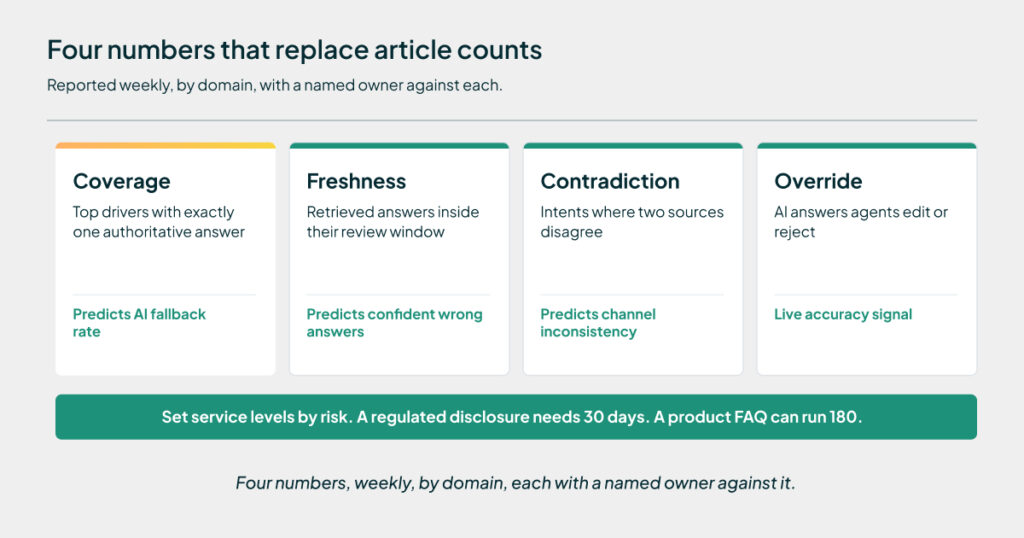
| Coverage | Share of top contact drivers with exactly one authoritative answer | Predicts deflection failure and AI fallback rate before launch |
| Freshness | Share of retrieved answers inside their review window | Predicts confidently wrong answers |
| Contradiction rate | Intents where two or more published sources disagree | Predicts inconsistency across channels and agents |
| Override rate | Share of AI suggested answers agents edit or reject | The closest thing to a live accuracy signal you own |
So: four numbers, reported weekly, by domain, with an owner’s name against each. That single change reframes knowledge from a cost centre producing content into a reliability function protecting outcomes. Incidentally, it is also how the work finally gets funded.
KnowledgeOps error budgets
Perhaps the most useful borrowing is the least obvious. Site reliability engineering never targets zero failures, because zero is infinitely expensive and stops all change. It sets an acceptable failure rate and spends it deliberately.
Similarly, knowledge needs a budget. You will not cover every long tail intent, and chasing it consumes a team that should be protecting the top fifty drivers. So decide explicitly. Ninety five percent coverage and freshness on tier one intents, seventy percent on the tail, and when you breach the budget, feature work stops until it recovers.
Consequently, a knowledge lead finally gets a defensible reason to say no. Currently most teams absorb every request from every product launch, with no mechanism to signal the foundation is degrading.
Three objections worth taking seriously
“This is just KCS with new vocabulary.” Partly fair. Knowledge Centred Service already established capture in the workflow, collective ownership and demand driven content, and those principles hold up well. The difference is the consumer. KCS optimises for a human reading in context. KnowledgeOps adds the requirements that appear when a machine reads without context: explicit branch logic, enforced expiry, contradiction detection and citation traceability. Think of it as KCS plus a reliability layer rather than a replacement.
“We do not have the headcount.” Probably true today. However, the capability already sits on your floor. Senior agents have reconciled contradictory sources for years, one call at a time, invisibly, instead of once at the source. Upskilling them into knowledge specialists is the most practical staffing route available.
“Our platform already does governance.” Most platforms provide the mechanisms: versioning, approvals, review dates, audit trails. Very few organisations operate them. The gap between “the system supports review dates” and “expired answers are suppressed from AI retrieval” is where nearly all real world failure lives. Tooling is necessary and nowhere near sufficient.
A 90 day path to KnowledgeOps
- Days 1 to 30. Measure honestly. Take your top fifty contact drivers. For each, record whether an authoritative answer exists, when it was last verified, whether another system contradicts it, and whether the process branches. Expect the result to be worse than anyone in the room predicts. That is normal, and it is the point.
- Days 31 to 60. Assign and consolidate. Put a name on every domain in the top fifty. Merge duplicates down to one authoritative answer per intent, then retire the losers rather than leaving them published. Convert branching processes into guided decision trees.
- Days 61 to 90. Instrument and report. Stand up the four metrics. Make expired reviews visibly degrade in search and AI retrieval. Publish the dashboard weekly to the same audience seeing your AI programme metrics, because both measure the same system from opposite ends.
The point
Regardless of labels, every organisation deploying AI in customer service runs a knowledge system in production. The only question is whether it gets run the way production systems are run, with owners, service levels, telemetry and a budget for failure, or the way a publishing calendar is run.
Ultimately, the teams reaching production are not the ones that picked a better model. They are the ones who noticed their content had become infrastructure and started operating it accordingly.
Frequently asked questions
Essentially, KnowledgeOps is the practice of running enterprise knowledge as an operations discipline rather than a publishing function. It applies named ownership, service levels, failure telemetry, contradiction detection and error budgets to the content that agents, self service portals and AI systems answer from.
Traditional contact center knowledge management optimises for output and quality: articles published, updated and read. KnowledgeOps optimises for reliability: coverage, enforced freshness, contradiction rate and override rate. AI systems drove the shift, because they read literally and cannot compensate for defects the way experienced agents do.
Not quite, although they are compatible. KCS establishes capture in the workflow, demand driven content and collective ownership, optimised for a human reader with context. KnowledgeOps adds the reliability requirements that machine readers introduce, including explicit branch logic, enforced expiry, contradiction detection and citation traceability.


 Word Document)
 Excel File)


