 10 Min



An AI agent customer service deployment usually gets judged on the wrong number. A customer contacts your support line. The bot replies in three seconds and offers a solution in forty-five. Dashboard turns green. Somebody screenshots it for the board deck.
Now follow that customer for another week. They never call back, but they never recommend you either. And the next caller, whose question sat just outside the bot’s training, landed with a human who had to rebuild the whole context from scratch.
That is the paradox. We optimised for the metric that was easiest to move.
Table of contents
- AI agent customer service and the trouble with speed
- Why “routine” is narrower than it sounds
- What AI agent customer service leaders actually measure
- The AI agent customer service arithmetic nobody models
- The containment trap in AI agent customer service
- What breaks at the handoff
- The question to ask a vendor
- Frequently asked questions
AI agent customer service and the trouble with speed
Speed is a wonderful proxy metric because it is cheap to measure and impossible to argue with. Response time either dropped or it did not. Naturally, that is why it ends up on the dashboard.
But speed only tells you how fast the answer arrived. It says nothing about whether the answer was right. And a fast wrong answer is not a small failure — it is a compounding one. The customer acts on it. They tell a colleague. They come back angrier, and now you are handling a complaint instead of a question.
Meanwhile the metric still looks good, because the interaction closed quickly. In effect, you have optimised the reporting rather than the service.
See Knowmax in Action
Why “routine” is narrower than it sounds
Most AI agent customer service business cases rest on the idea that routine contacts can be automated away. Fair enough. The problem is the definition.
In an AI agent customer service business case, a contact is genuinely routine only when the knowledge behind it is clean, current, and unambiguous. That is a statement about your documentation, not about the customer’s question. So the moment context matters — a prior case, a policy exception, an edge case nobody wrote down — the question stops being routine no matter how simple it sounds.
This is why automation rates plateau. Teams automate the contacts their knowledge supports, then discover the remainder are not harder questions. Instead, they are questions with worse documentation. Consequently, the next tranche of automation depends on writing, not modelling.
Take a concrete example. “How do I reset my password?” automates easily, because there is exactly one answer and somebody documented it years ago. Now try “why was I charged twice?” On paper it is a simpler sentence. In practice the answer depends on the payment method, whether a pre-authorisation is still pending, which of two billing systems holds the account, and whether your goodwill policy allows an immediate refund or requires a review. Four dependencies, probably documented in four places, at least one of which is out of date.
The second question is not more complex for a model to phrase. It is more complex for your organisation to answer consistently, and that was true before automation entered the picture.
What AI agent customer service leaders actually measure
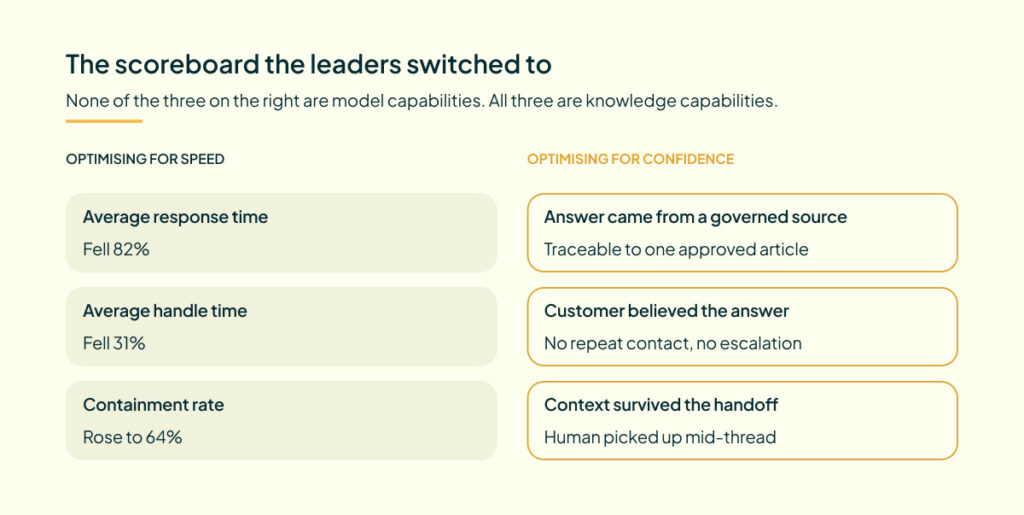
The contact centers doing well with AI agent customer service have quietly changed the scoreboard. Instead of speed, they track resolution with confidence, which comes down to three things.
The agent, human or machine, works from complete and current information. The customer leaves believing the answer rather than merely receiving it quickly. And when a handoff happens, context survives it.
None of those three are model capabilities. All three are knowledge capabilities. That distinction decides whether an AI agent customer service programme keeps compounding or stalls after the pilot.
The AI agent customer service arithmetic nobody models
There is a reason this keeps landing on the knowledge layer, and APQC research puts a number on it. Surveying 982 full-time knowledge workers, APQC found the average knowledge worker spends only 30 hours of a 40-hour week on productive work. Nearly three of those lost hours each week go to looking for or requesting information.
Notice what that means for an AI rollout. You are not automating a well-documented process. You are automating on top of a documentation problem your own people already route around.
Furthermore, an AI system pointed at fragmented knowledge does not fix the fragmentation. It industrialises it. Where one agent previously gave one wrong answer, a bot now gives the same wrong answer at machine scale, with the confident tone models are so good at.
The containment trap in AI agent customer service
Before speed, most teams reach for containment rate: the share of contacts the bot handled without escalating. It feels like the right measure. Naturally, it is the one most vendors report.
But containment counts absence of escalation, not presence of resolution. A customer who gives up and closes the window is contained. So is a customer who accepts a wrong answer and discovers the problem a week later. Both look identical to a customer who got exactly what they needed.
That is why containment and satisfaction so often move in opposite directions. Push containment hard enough and you eventually suppress escalation rather than reduce the need for it. The queue gets shorter because people stopped trying.
A more honest version pairs containment with what happened next. Did the same customer come back within seven days? Did they contact through another channel instead? Did the interaction end with a resolution the customer confirmed? None of those are hard to instrument. They are simply less flattering.
What breaks at the handoff
The other place an AI agent customer service deployment quietly leaks value is the escalation itself.
When a bot passes a conversation to a human, three things should travel with it: what the customer asked, what the bot already told them, and which knowledge source it drew that from. In most deployments only the first survives. Occasionally the second. Almost never the third.
So the human agent opens a transcript, reads what the customer was told, and has no way to know whether it was right. Their choices are to repeat the bot’s answer without being able to verify it, or to start again and implicitly tell the customer the last five minutes were wasted. Most agents choose the second, because it is safer. That is the moment the customer decides your support is disjointed.
Fixing it is not a routing problem. It requires the bot and the agent to be reading from the same governed source, with the retrieved article identifiable after the fact. Where both sides answer from one knowledge management platform, the handoff becomes a continuation rather than a restart.
The question to ask a vendor
If you are evaluating agentic AI for customer service, the demo will be fast. They all are. Fast is table stakes and tells you nothing.
Ask instead the questions that actually separate one AI agent customer service platform from another. What does it answer from? How current is that source? Who owns it? What happens when two documents disagree? Can you show me, after the fact, which article produced a given answer?
Vendors who have thought about contact center knowledge management will welcome those questions. The rest will steer you back to latency, or to a benchmark comparing their model against a competitor’s on a dataset neither resembles your contact drivers.
One further reason to ask now rather than later. Analyst attention has shifted the same way: in its 2026 Magic Quadrant for Customer Service Knowledge Management Systems, Gartner described the category moving beyond document search toward knowledge graphs and structured reasoning. In other words, the industry has concluded that AI agents need knowledge they can reason over rather than merely retrieve. Speed was never the bottleneck.
Ready to Build Your Own Customer Service Knowledge Base?
Frequently asked questions
In narrow, well-documented territory, often yes. AI handles high-volume repeatable requests quickly and consistently. It struggles with exceptions, history, and nuance. So the realistic model is hybrid: AI for routine contacts, humans for complex ones, both drawing on the same governed knowledge.
Handle time measures how long the interaction took. First-contact resolution measures whether the problem stayed solved. A two-minute call that ends the issue beats a thirty-second call that produces a callback. Optimising purely for speed tends to raise total handle time, because the second contact still has to happen.
Because the remaining contacts are rarely harder questions. They are questions with weaker documentation. Once you exhaust the well-documented topics, further automation requires knowledge work rather than model work.


 Word Document)
 Excel File)


