 23 Min


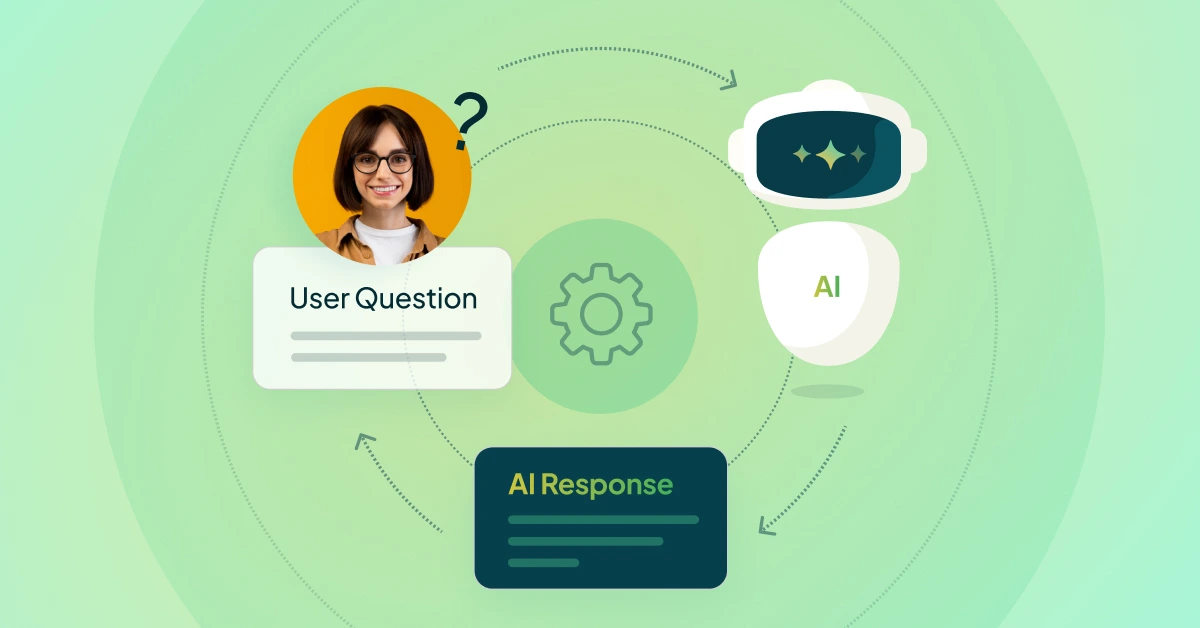
Last year, Air Canada was ordered by a civil resolution tribunal to honor a refund policy that never existed. The policy was invented by the airline’s AI chatbot. Klarna walked back its plan to replace human agents following complaints about chatbot hallucinations. The fix isn’t to stop using AI, it’s to ground AI in verified knowledge. That’s what Retrieval-Augmented Generation does.
This article explains how RAG customer service works, what makes a knowledge base RAG-ready, how it compares to fine-tuning and traditional chatbots, and what 2026 advances like GraphRAG and Agentic RAG mean for your contact center. Implementation challenges, compliance considerations, and a readiness assessment are all included.
Table of contents
- What Is RAG and How Does It Work?
- RAG vs. Fine-Tuning vs. Traditional Chatbot: Which Is Right for Customer Service?
- Why AI Chatbots Hallucinate in Customer Service
- How RAG Prevents Hallucinations: Four Mechanisms
- RAG in the Contact Center: What It Looks Like in Practice
- Common RAG Implementation Challenges (and How to Solve Them)
- What Makes RAG Work: The Knowledge Base Problem
- How to Evaluate if Your Organization Is RAG-Ready
- RAG Architecture Advances in 2026
- Conclusion
- Frequently Asked Questions on RAG Customer Service
What Is RAG and How Does It Work?
Retrieval-Augmented Generation is a machine learning architecture that combines information retrieval with generative AI. Instead of relying solely on patterns learned during training, RAG systems retrieve relevant documents or data from a knowledge base in real-time and use that grounded information to generate accurate, sourced responses. This fundamentally shifts the AI from hallucinating to citing.
RAG operates in three core steps: first, query understanding translates user questions into searchable queries that identify relevant intent and context. Second, retrieval searches the knowledge base to find the most relevant documents, articles, or data sources that contain the answer. Third, generation uses those retrieved sources as a foundation, embedding the citations into the response so the AI explains not just what it knows, but where it knows it from.
RAG vs. Fine-Tuning vs. Traditional Chatbot: Which Is Right for Customer Service?
This is the question most enterprise teams get wrong. Here’s how the three approaches compare:
| Dimension | Traditional Chatbot | Fine-Tuned LLM | RAG with Knowledge Base |
|---|---|---|---|
| How it works | Scripted rules & decision trees | Retrain model on company data | Retrieve docs → ground the generation |
| Handles new policies | Manual reprogramming | Full retraining cycle required | Update the knowledge base instantly |
| Hallucination risk | Low (but rigid) | Medium-High (still generates) | Very Low (grounded in source) |
| Handles complex queries | Breaks on variation | Better than a chatbot | Best, retrieves before generating |
| Cost to update | High | Very High | Low |
| Time to update | Days/weeks | Weeks/months | Minutes |
| Citations/attribution | None | None | Built-in source references |
| Best for | Simple FAQs, fixed flows | Domain-specific language patterns | Dynamic policies, regulated CX, scale |
Why AI Chatbots Hallucinate in Customer Service
Hallucinations aren’t bugs; they’re a structural feature of how large language models work. LLMs are trained to predict the most statistically plausible next token, not to retrieve verified facts. In customer service contexts, this produces four types of failure:
- Policy fabrication: The model invents terms and conditions that sound plausible but don’t exist in company policy. The Air Canada case is the canonical example.
- Confident inaccuracy: False information is expressed with the same certainty as true information. There is no built-in ‘I don’t know’ signal in a standard LLM.
- Stale knowledge: Training data has a cutoff date. Promotional pricing, updated return windows, and new product specifications are invisible to an untrained model.
- Cross-domain contamination: The model conflates your policies with competitor or industry-standard policies it encountered during training, producing answers that are ‘correct’ for another company but wrong for yours.
AI-enabled contact centers can reduce human-serviced interactions by 40–50%, but that efficiency disappears the moment hallucinations erode customer trust and trigger escalations, compensations, or regulatory review.
McKinsey research
In regulated industries, such as financial services, healthcare, and telecom, the risk is higher still. AI statements that contradict regulatory guidance can carry legal weight regardless of whether the platform intended them to be authoritative.
Leveraging existing organizational knowledge to power AI for CX success
How RAG Prevents Hallucinations: Four Mechanisms
1. Grounding in Source Documents
A RAG customer service system can only answer with information that exists in its knowledge base. If the information isn’t there, the system is designed to say so rather than fabricate. This is the most important distinction from a standard LLM: the generative step is constrained by the retrieval step.
2. Real-Time Knowledge Access
When a promotion ends, a return window changes, or a new product launches, updating the knowledge base immediately makes that information available to the RAG system. No retraining. No deployment cycle. The AI reflects your current reality within minutes of an update.
3. Built-In Citation and Attribution
Every RAG response references its source: “According to our billing policy (updated March 2026)…” This creates an auditable trail for compliance teams, gives customers a way to verify the answer, and makes it straightforward to identify and correct any inaccurate source documents.
4. Scope Limitation Prevents Cross-Contamination
Because the RAG system only retrieves from your curated knowledge base, it cannot accidentally reference competitor pricing, outdated industry standards, or training data from unrelated domains. A telecom company’s RAG chatbot won’t quote a banking refund policy.
RAG-enabled systems reduce average handle time by 40–60%, boost first-contact resolution by up to 30%, and deliver 5-year ROI exceeding 125% once adoption barriers are resolved.
WJARR
RAG in the Contact Center: What It Looks Like in Practice
RAG deployment in a contact center takes multiple forms, each addressing a different layer of the customer service stack:
1. Customer-Facing RAG Chatbots
RAG chatbots for customer service answer common questions, order status, return policies, billing disputes, and account management, with citations to actual company knowledge. Because the response is grounded, customers receive accurate, verifiable answers rather than plausible fabrications.
Real-world example: An e-commerce customer asks, “Can I return an item I bought 3 weeks ago?” A traditional LLM might guess. A RAG chatbot retrieves the return policy (30-day window), cross-references the order date, and responds: “Yes, you have 7 days remaining in your return window. Here’s how to initiate it.”
2. Agent Assist / AI Copilot
RAG-powered copilot tools retrieve relevant policies, customer interaction history, and product information in real time as the agent speaks with a customer. Agents make recommendations with confidence rather than holding the customer while they search for documentation.
McKinsey research on a gen AI deployment at a major telecommunications provider found a 65% reduction in average handle time specifically attributable to agents finding relevant knowledge faster via AI-assisted retrieval.
3. Email and Ticket Automation
RAG systems draft responses or suggest next steps for email and support ticket queues based on the AI knowledge management system, matching the incoming request to documented resolution paths and generating a grounded reply for agent review or autonomous sending.
4. Voice AI and IVR
Voice AI systems equipped with RAG handle more complex phone interactions by retrieving policy context in real time during the call. This enables intelligent IVR that can answer substantive questions rather than only routing.
Common RAG Implementation Challenges (and How to Solve Them)
RAG is a significant operational improvement over standard LLMs, but it is not plug-and-play. The following challenges are the most common points of failure in enterprise deployments:
Challenge 1: Knowledge Base Fragmentation
Most enterprises have knowledge scattered across wikis, SharePoint, shared drives, Confluence, email threads, and legacy ticketing systems. A RAG system retrieves from wherever you point it; if those sources contain contradictions, the AI will surface contradictions.
Solution: Establish a single source of truth before deploying RAG. Knowmax’s knowledge management platform is designed specifically to centralize, structure, and govern enterprise knowledge so that the RAG retrieval layer has a clean, authoritative corpus to work from.
Before Deploying RAG, Build the Right Knowledge Foundation
Challenge 2: Latency and Performance
The retrieval step adds latency. In high-volume contact centers with concurrent sessions, a poorly optimized RAG pipeline can create perceptible delays that damage the customer experience.
Solution: Use vector database indexing, caching for high-frequency queries, and architecture optimization to keep retrieval under 300ms. Cloud-based retrieval infrastructure scales elastically with demand without requiring dedicated hardware investment.
Challenge 3: Data Privacy and Compliance
In the US, financial services, healthcare, and telecom face sector-specific compliance requirements. RAG systems that retrieve customer data must comply with CCPA, meet data residency requirements, and implement access controls.
Solution: RAG knowledge bases can be entirely internal and private. The retrieval happens on your infrastructure; no external API needs access to knowledge base content or customer data. Role-based access controls on the knowledge base ensure that agents and AI retrieve only documents appropriate to their scope.
Challenge 4: Knowledge Governance Overhead
A RAG system is only as good as its knowledge base. Without formal governance, scheduled reviews, approval workflows, and content owners, outdated or contradictory documents accumulate, degrading response quality.
Solution: Implement a formal content lifecycle: each knowledge article has an owner, a review date, and a structured approval workflow. Knowmax includes governance tooling, content expiry flags, review queues, and audit trails, which make knowledge governance operationally sustainable rather than a manual burden.
What Makes RAG Work: The Knowledge Base Problem
RAG is only as good as the knowledge base it retrieves from. A poorly organized, outdated, or incomplete knowledge base will produce accurate-sounding but useless, or actively harmful, responses. Organizations that succeed with RAG meet five requirements:
| Requirement | What It Means | Failure Mode Without It |
|---|---|---|
| Single source of truth | All company knowledge lives in one authoritative, versioned location | RAG retrieves contradictions; AI gives conflicting answers to the same question |
| Structured content | Consistent metadata, clear hierarchies, and semantic tagging | Retrieval returns irrelevant documents; response accuracy falls |
| Formal governance | Scheduled reviews, approval workflows, and content ownership | Outdated policies stay active; compliance risk accumulates |
| Metadata & tagging | Scope tags (product, region, date range, customer segment) | AI applies a policy to the wrong customer segment or time period |
| Coverage completeness | Documented answers to all questions customers are likely to ask | RAG hallucinates to fill gaps, the exact problem you deployed RAG to solve |
How to Evaluate if Your Organization Is RAG-Ready
Before implementing RAG, assess your organization across these five dimensions. Use this table to identify gaps and prioritize remediation:
| Dimension | RAG-Ready | Not Yet Ready |
|---|---|---|
| Knowledge Base | Centralized, versioned, regularly audited | Scattered across systems, outdated or duplicate content |
| Content Structure | Structured, metadata-rich, semantic markup, consistent terminology | Unstructured documents, no taxonomy, inconsistent naming |
| Governance | Formal review cycles, approval workflows, and named content owners | Ad hoc updates, no expiry tracking, no control framework |
| Data Integration | Automated sync with core systems (CRM, ERP, ticketing) | Manual uploads, siloed data islands, no change alerting |
| AI Strategy | Clear roadmap for AI/copilot deployment, defined success metrics | Uncertain AI plans, no knowledge strategy, no measurement baseline |
RAG Architecture Advances in 2026
Standard RAG, retrieve-then-generate, is already transforming contact centers. But the architecture is evolving rapidly. These advances define the frontier for 2026 and beyond:
1. GraphRAG
Standard RAG retrieves individual document chunks. GraphRAG represents knowledge as an interconnected graph, policies link to products, products link to pricing tiers, and pricing tiers link to customer segments. This enables the system to understand relationships and causality, not just keyword proximity. Early implementations report significant precision improvements on complex multi-step queries.
2. Agentic RAG
Agentic RAG allows the AI to iteratively search the knowledge base, refine a query, retrieve a result, recognize a gap, search again, mirroring the way a skilled human researcher works. Instead of a single retrieval pass, the system builds a comprehensive answer from multiple sources and explicitly notes when information is unavailable.
McKinsey’s internal AI tool ‘Lilli’ operates on a RAG pipeline across 40+ curated knowledge sources containing more than 100,000 documents. The system recovers an estimated 50,000 labor hours monthly by enabling consultants to find relevant knowledge in minutes rather than hours.
Digital Defynd
3. Multimodal Retrieval
RAG systems can now retrieve across text, images, video, and audio, which is critical for organizations whose knowledge lives in diverse formats, such as installation videos, product images, scanned contracts, and recorded training materials.
4. Real-Time Knowledge Sync
Event-driven architectures automatically synchronize the RAG knowledge base with source systems (CRM, ERP, ticketing). When a policy changes in your system of record, the knowledge base updates immediately, eliminating the lag between policy change and AI awareness that creates a hallucination window.
Conclusion
If your AI is only as good as the knowledge behind it, the question isn’t whether to adopt RAG; it’s whether your knowledge base is ready. See how Knowmax helps enterprise contact centers build the structured, governed, AI knowledge management tools that make RAG work.
Ready to see it in action? Get a Knowmax demo to discover how a structured, AI-ready knowledge base can power more accurate answers, faster resolutions, and better agent performance with RAG customer service.
Frequently Asked Questions on RAG Customer Service
A standard LLM answer from training data, which may be months or years old, may include competitor data and cannot be updated without retraining the entire model. RAG answers from your knowledge base, which you control, update in real time, and scope to your specific products, policies, and procedures.
Yes. RAG knowledge bases can be entirely internal and private. The retrieval happens on your servers or infrastructure, and no external API sees the knowledge base content. This makes RAG ideal for handling confidential pricing, contracts, and customer data in regulated industries.
Well-designed RAG systems are programmed to decline confidently rather than hallucinate. The response will be something like “I don’t have information about that topic. Please contact our support team.” This is far better for customer trust than a fabricated answer.
Track metrics such as hallucination rate (false statements per 1000 interactions), retrieval precision (percentage of retrieved documents that are relevant), citation accuracy (citations match the content), and end-to-end success rate (customers accept the answer without escalation). Compare these against non-RAG baselines to quantify improvement.
Yes. RAG systems can maintain multilingual knowledge bases, use cross-lingual retrieval to find answers in any language, and then generate responses in the customer’s language. This is especially valuable for global contact centers.
RAG requires investment in knowledge base infrastructure, governance tools, and integration with source systems. However, the ROI is typically 6-12 months because RAG reduces hallucination costs (compensation claims, regulatory fines), decreases manual intervention, and increases first-contact resolution rates.


 Word Document)
 Excel File)


