 17 Min



Big data and knowledge management is the practice of using very large, fast-moving data sets to find, create and improve the knowledge an organization relies on. The data side supplies the signals: what customers ask, buy and complain about. The knowledge side then turns those signals into trusted, reusable answers that people and AI can act on.
Still, that definition hides a tension. Data teams measure success in volume and speed. Knowledge teams, by contrast, measure it in accuracy and reuse, and the two rarely sit in the same meeting. So most organizations end up with a data lake full of customer signals on one side and a knowledge base that never hears about them on the other. This explainer answers the questions that come up when teams finally combine the two: what each term means, how they differ, the role big data plays, what it looks like in retail, and where the combination stops paying off.
Table of contents
- What is big data and knowledge management?
- How do big data and knowledge management differ?
- What is the role of big data in knowledge management?
- What are the benefits of big data and knowledge management?
- How do big data and knowledge management work in retail?
- Where does big data fail without knowledge management?
- How should a support team start with big data and knowledge management?
- Frequently asked questions
What is big data and knowledge management?
In short, big data and knowledge management combines two disciplines. The first covers data sets too large or complex for ordinary processing tools, close to the definition in Wikipedia’s big data entry. The second covers how an organization captures, governs and reuses what it knows.
One common way to describe big data is through its Vs. Textbooks list three, and the longer lists add two more. These are the 5 V’s of big data:
- Volume: the sheer quantity of data generated and stored.
- Velocity: how fast it arrives, and how quickly systems must handle it.
- Variety: the mix of formats, from database rows to call transcripts.
- Veracity: how reliable and accurate the data is.
- Value: what the data is actually worth once analyzed.
Notice, however, that the last two are knowledge questions in disguise. Veracity asks whether anyone can trust the data. Value asks whether anyone can use it. Those are exactly the problems knowledge management exists to solve.
The relationship also maps onto the old ladder that runs from data and information up to knowledge. Raw data sits on the bottom rungs, while knowledge management works the top one. A data and knowledge management program is simply one that connects the rungs instead of treating them as separate departments.
How do big data and knowledge management differ?
They differ in what they handle, what they produce and how they fail. Analytics answers “what is happening, and how often?” A knowledge program, on the other hand, answers “what should we do about it?” Put side by side, the contrast is easier to see.
| Dimension | Big data | Knowledge management |
|---|---|---|
| Raw material | Transactions, logs, clicks, transcripts | Articles, procedures, expert judgment |
| Typical output | Patterns, forecasts, dashboards | Reusable answers and guidance |
| Owned by | Data engineering and analytics | Knowledge managers and subject experts |
| Fails when | The data has gaps or bias | The content goes stale or loses its owner |
Most of the confusion around big data vs knowledge management comes from the middle of the table. Insight comes out of analytics, and insight feels like knowledge. Yet a dashboard showing that refund questions jumped sharply last week is a finding. It does not answer anything. Somebody still has to decide what the refund policy is, write it down, win approval for it and put it where an agent can see it mid-call.
That handoff is also where most unstructured data lives. Chat logs, emails and call notes are messy for an analytics pipeline, which struggles with free text, yet they hold some of the most useful knowledge an organization has, because they record how agents actually solved real problems.
What is the role of big data in knowledge management?
The role of big data in knowledge management is to tell the knowledge team what to write, what to fix and what to retire. Without it, a knowledge base grows on guesswork, and teams end up writing articles because someone in a meeting asked for them rather than because customers ever needed them. Logs fix that.
Four links between big data and knowledge management
Each of the four practical links is easiest to see with an example.
- Finding gaps. Search logs show what people look for and fail to find. For example, “cancel order after shipping” searched hundreds of times with no match is the next article to write.
- Spotting stale content. Say 1,000 customers a month open a warranty article and 300 call back within a week. As a result, that 30% repeat rate flags the article faster than any annual audit.
- Capturing know-how. Transcripts of resolved cases show what top agents ask first, such as “Did you buy it online or in store?”, which becomes step one of a decision tree.
- Personalizing delivery. Customer data decides which version a person sees. For instance, a premium customer reads “Free pickup within 30 days” while others see the 14-day mail-in process.
In each case, data starts the work and knowledge management finishes it. The search log does not write the article. Likewise, the transcript does not approve the decision tree. That division of labor is what people usually mean by knowledge management and data analytics working together.
Knowledge management analytics measures the base itself
There is a smaller data set hiding inside every knowledge base. Article views, search success, feedback and reuse are all measurable, and knowledge management analytics is the name for tracking them. For many teams, this is the first data knowledge management project they ever run, because the data already exists and nobody has to build a pipeline to reach it.
Raise the Knowledge Standard Behind Your Customer Data
What are the benefits of big data and knowledge management?
The main benefits of big data and knowledge management are faster decisions, fewer knowledge gaps and better use of the expertise already inside the organization. McKinsey made the economic case early. Its 2011 McKinsey report estimated that a retailer using big data to the full could raise its operating margin by more than 60 percent.
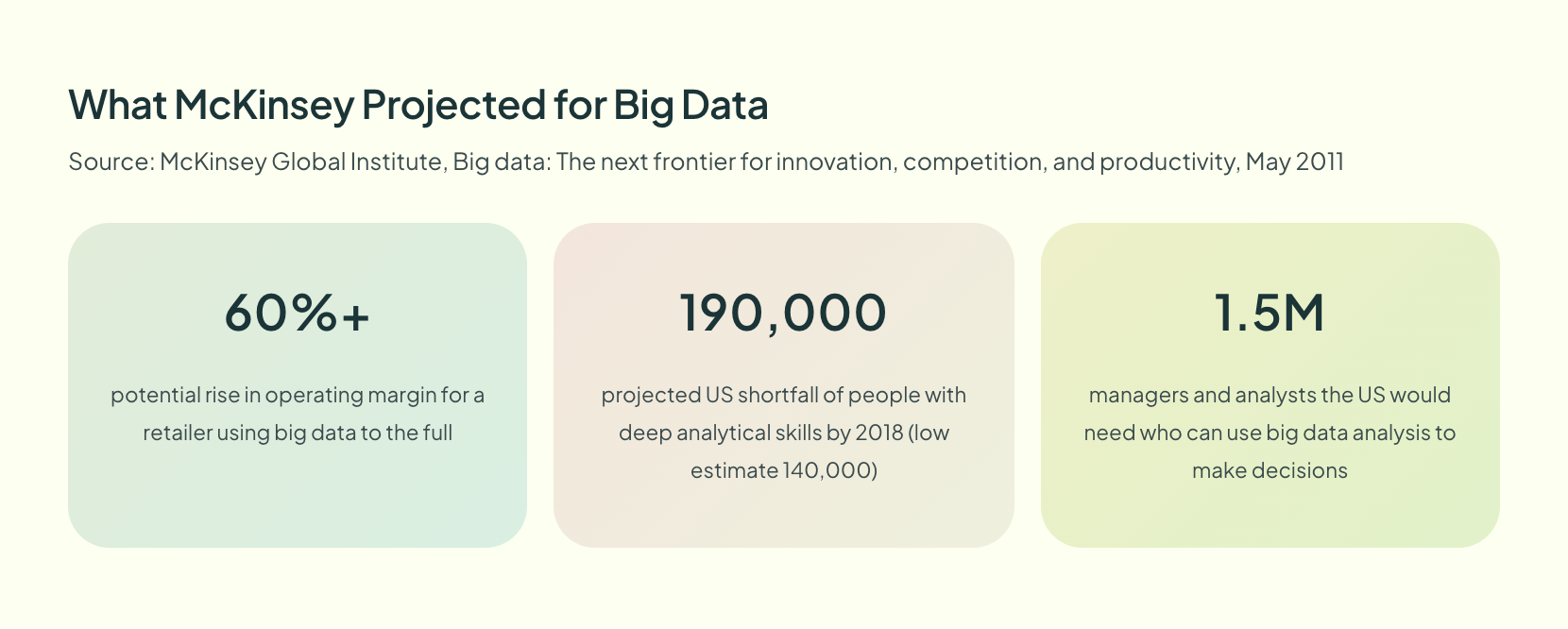
The same McKinsey study carried a warning that fewer people quote. It projected that the United States could face a shortfall of 140,000 to 190,000 people with deep analytical skills, and would also need 1.5 million managers and analysts who know how to use the analysis to make decisions. In fact, that second number is the knowledge management problem. After all, insight that only a data scientist can read does not change what the front line does.
Findability is the other half. A 2023 Gartner survey of 4,861 digital workers found that 47% struggle to find the information or data they need to do their jobs well. More data makes that worse unless something curates it. Done properly, big data knowledge management cuts the pile down to the answers people actually need, ranked by what the data says they need most.
How do big data and knowledge management work in retail?
Retail is where big data and knowledge management meet most visibly, because stores, sites and contact centers all generate customer signals at once. In most companies, big data in retail means demand forecasting, pricing and recommendations. The knowledge side gets less attention. Even so, it decides whether staff can explain any of it to a customer.
A worked example: big data and knowledge management in retail
Take a mid-size apparel retailer that changes its return policy for the holiday season. The data side sees the effects within days. Return searches on the help center climb. Chat transcripts fill with the phrase “gift receipt,” and store associates log more manager escalations.
On its own, none of that fixes anything. So the knowledge side has to act. Someone traces the spike to a single ambiguous line about gift returns and rewrites the article. They add a short decision tree for associates, then publish one version to the help center, the agent desktop and the store tablets. Finally, the data closes the loop: searches for the phrase drop, and escalations follow.
That loop, signal then answer then measurement, is the whole model in miniature. It is also why retail knowledge management tends to start in the contact center. Customers there ask the same seasonal questions in volume, so the payoff from one corrected answer shows up quickly.
Coursework on this topic often asks how a named department store uses these two disciplines. For most retailers, the honest answer is the pattern above. It simply repeats across returns, delivery, loyalty and pricing.
Put the Knowledge You Already Have Behind Your AI
Where does big data fail without knowledge management?
Raw analytics falls short whenever the answer depends on judgment, context or approval rather than on volume. A model can find a pattern. However, it cannot decide which policy is correct, and it cannot capture the implicit knowledge an experienced agent applies without thinking about it.
APQC makes a related point in a 2026 APQC note, arguing that volume alone creates no value and that AI tools can amplify any outdated, duplicated or unowned content they are pointed at. Its prescription is governance: named content owners, approval steps, review triggers and monitoring. Indeed, none of those come from a data pipeline.
The argument also owes a concession in the other direction, because big data is not always worth the trouble. A support team of 30 agents with a few hundred articles does not need a data lake. Its search logs and a monthly feedback review will reveal most of the gaps, while a big data project would cost more in engineering time, data contracts and maintenance than it could ever return to a team that size. In that situation, the knowledge-first answer is simply to fix the articles and skip the platform.
Privacy is the other limit. Transcripts and customer records carry personal data. Mining them for knowledge therefore needs consent, retention rules and redaction before anyone publishes anything, and teams that skip that step tend to discover the problem in an audit, which is the worst possible place to find it.
Plan a Knowledge Rollout That Starts With Your Data
How should a support team start with big data and knowledge management?
A support team should start with the data it already owns and one knowledge outcome it can measure. Ambitious data strategies tend to stall. Small, closed loops tend to spread. The order that usually works looks like this.
First, pick a single signal: failed searches, repeat contacts or escalation reasons. Next, assign an owner who can change the knowledge, because insight with no owner sits in a report. Then measure one result, such as fewer repeat contacts on the topics you fixed. Only after that loop runs reliably is it worth adding more sources.
Specifically, the platform matters at the second step. A knowledge management platform has to accept data signals, route them to an owner, and publish the corrected answer to every channel at once. Otherwise the loop breaks at the handoff. Knowmax follows that pattern: search and usage analytics feed review workflows, and one governed article or decision tree reaches agents, self-service and chatbots together. Its published case study covers a Fortune 500 retailer that runs store and service knowledge this way.
For teams adding generative models, the same logic applies with higher stakes. AI knowledge management tools retrieve and summarize far better than keyword search, but they answer from whatever the knowledge base holds. Usage data can also tell you which questions people put to the model most often. Whether those answers deserve repeating is a decision only knowledge management can make.
Ready to Turn Your Customer Data Into Answers Agents Trust?
Frequently asked questions
No, big data is an input to knowledge management rather than a part of it. Analysis reveals patterns, gaps and demand, while knowledge management decides what those findings mean, writes them into approved answers and keeps them current. Mature programs connect the two, using data to steer which knowledge the team creates, reviews or retires.
Knowmax, a platform for customer service, is one example; it combines a knowledge base, decision trees and AI search. A knowledge management system is software that stores, governs and delivers an organization’s know-how. Other common examples include internal wikis such as Confluence, help center tools, and document repositories with review workflows.
Data management keeps data accurate, secure and available, covering storage, quality, integration and access. Knowledge management works one level up, turning information and expertise into guidance people can act on. A data team makes sure the return figures are right; a knowledge team makes sure agents know the current return policy.
No, because AI answers from the content it receives. Generative models can draft articles, summarize transcripts and speed up search, but they cannot decide which policy is correct or who owns an answer. Without governance, an AI assistant repeats outdated or conflicting content with full confidence, and at much greater scale than any single agent could.


 Word Document)
 Excel File)


