 17 Min



Tacit knowledge is what a person knows from experience and cannot fully put into words; explicit knowledge is what has been written, recorded or diagrammed so someone else can use it. Tacit vs explicit knowledge differ mainly in how they travel: explicit knowledge can be copied and searched, while tacit knowledge moves through people, practice and coaching.
Two agents open the same article on a delayed shipment. The first follows it step by step and closes the call quickly. Meanwhile, the second reads the same page, hesitates at the line about exceptions, and asks a colleague. Both saw identical words. What differed was knowledge the page never held.
Tacit vs explicit knowledge is the split that explains that gap. Explicit knowledge is what someone has written, recorded or diagrammed so a stranger can act on it, and tacit knowledge is the judgment an experienced person carries and cannot fully state. This post sets the two side by side and shows what each looks like in a contact center. It then explains how knowledge converts between them and ends with a rule for deciding what deserves to be written down.
Table of contents
- What is the difference between tacit vs explicit knowledge?
- What is implicit knowledge, and how does it differ from tacit and explicit?
- What are examples of tacit and explicit knowledge in a contact center?
- Which matters more, tacit or explicit knowledge?
- How does tacit knowledge become explicit, and back again?
- Which format carries tacit vs explicit knowledge best?
- When does the tacit and explicit split stop helping?
- Frequently asked questions
What is the difference between tacit vs explicit knowledge?
Every tacit vs explicit knowledge discussion starts with the philosopher Michael Polanyi. Wikipedia’s tacit knowledge entry credits his 1966 book The Tacit Dimension with the line “we can know more than we can tell”. According to the entry, explicit knowledge passes on without its author. By contrast, the tacit kind needs close interaction, shared understanding and trust before it moves.
The same entry contrasts the two on how people acquire them, how they transfer, and whether anyone can store them centrally. Below, the table turns those contrasts into questions a support leader actually asks.
| Question | Explicit knowledge | Tacit knowledge | What it looks like on the floor |
|---|---|---|---|
| Where does it live? | Documents, systems, diagrams | A person’s habits and judgment | “Ask the senior agent” is the search method |
| How does it move? | Copy, search, link, translate | Shadowing, coaching, practice | New hires learn it by sitting beside someone |
| How do you check it? | Read it against reality | Watch someone do the work | Quality scores pass while escalations stay high |
| How does it fail? | It goes stale and nobody notices | It leaves when the person does | The queue spikes after a resignation |
So the difference between tacit and explicit knowledge is mostly a difference in how each one travels. Copying explicit knowledge costs almost nothing. Moving the tacit kind, however, takes people.
The entry adds one caution worth keeping: in practice the two are not discrete. Real knowledge usually has an explicit shell and a tacit core. The table therefore describes the ends of a scale, not two clean bins. That matters for any tacit vs explicit knowledge debate, because most arguments about which one wins treat the bins as real.
What is implicit knowledge, and how does it differ from tacit and explicit?
Implicit knowledge is the middle case. Writers use the term in two ways. Some treat it as a plain synonym for tacit knowledge. Others mean knowledge that could be written down but never has been, such as a rule of thumb every agent follows and nobody documented.
The difference matters because the two meanings call for different work. Knowledge that could be written down needs a facilitator and an hour, and it then becomes explicit knowledge. Knowledge that cannot be fully stated needs coaching and practice. So when someone asks about tacit vs implicit knowledge, or implicit vs explicit knowledge, first check which meaning is in use.
What are examples of tacit and explicit knowledge in a contact center?
Examples make the tacit vs explicit knowledge split concrete. The clearest tacit and explicit knowledge examples come in pairs, because almost every task uses both halves. The pairs below are illustrative composites of what support teams commonly describe.
- Refunds. The policy states who may approve what, and a customer’s tone tells an experienced agent to approve before the second ask.
- Outage calls. A troubleshooting guide covers the dropped connection, while the first two answers tell a veteran that this is the known carrier fault and not the guide’s scenario.
- Billing disputes. Written steps open the dispute, but experience says which disputes finance reverses anyway, so the agent skips a futile escalation.
- Cancellations. A list holds the retention offers, and a veteran senses a call turning toward cancellation and knows which one to lead with.
- Onboarding. Decks, quiz banks and recorded sessions carry the written half, and the real shortcuts and traps in the tools stay with whoever found them.
Notice the asymmetry. The written half of each pair fits on a line, but the unwritten half needs a sentence of explanation. That asymmetry is the finding. So cheap inventory makes teams count what they wrote, and the judgment stays uncounted.
Nearly every queue shows this pattern of tacit knowledge in customer service. The companion post on tacit knowledge treats it in depth.
More examples of explicit knowledge
Explicit knowledge is anything a colleague can open, read and follow without asking its author. In a contact center, common examples are:
- Step-by-step troubleshooting guides and SOPs.
- Knowledge base articles and FAQs.
- Policy documents, such as refund limits and escalation rules.
- Call scripts and email templates.
- Training videos and onboarding checklists.
More examples of tacit knowledge
Tacit knowledge shows up as judgment, and it usually has no document behind it. Common examples are:
- Knowing when to escalate a case before the customer asks.
- Reading a customer’s tone and changing approach mid-call.
- Recognizing a known fault from the first two answers.
- Knowing which workaround actually works for a given account.
- Pacing a difficult call so it stays calm.
Which matters more, tacit or explicit knowledge?
Neither wins, and the question hides a better one: which half is the operation underinvesting in? However, most teams underinvest in the tacit half for a plain reason. A dashboard can count what written knowledge leaves behind, such as articles published and pages viewed. Nothing countable comes from tacit knowledge until someone resigns.
Even the explicit half is hard to use. A 2023 Gartner survey of 4,861 digital workers found that 47% struggle to find the information they need to do their jobs, and the average worker now uses 11 applications, up from six in 2019.
An APQC survey of 982 full-time knowledge workers in 2021 put the weekly cost at 2.8 hours spent looking for or requesting information.
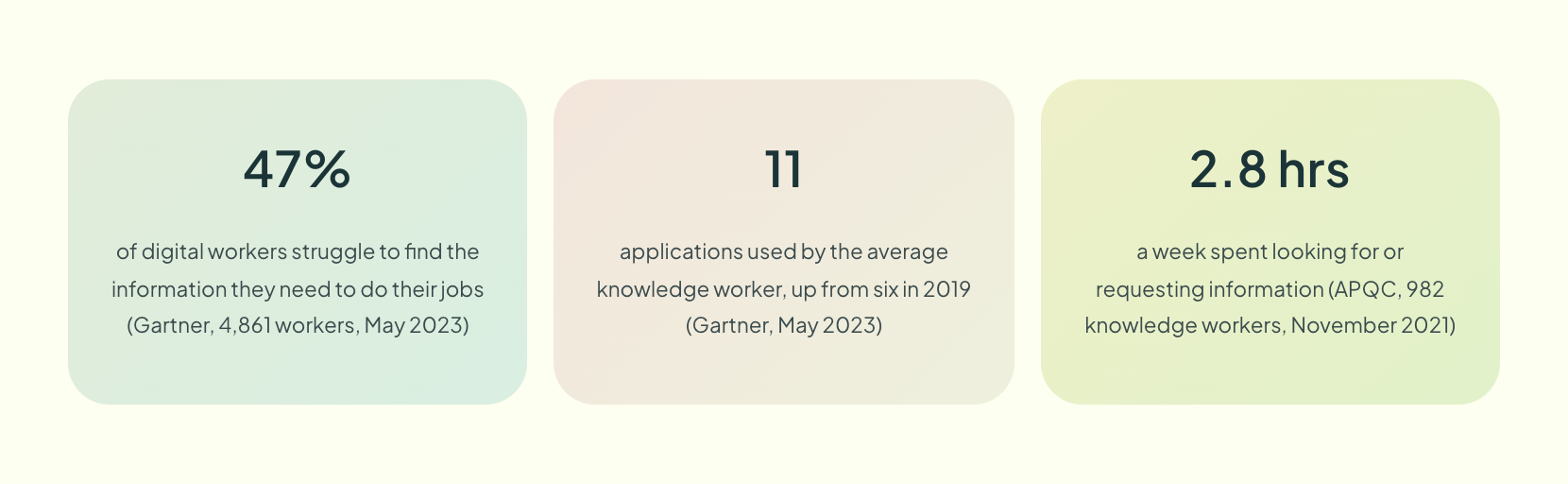
These figures measure how hard written knowledge is to find, but they say nothing about tacit loss. They do show a ceiling. More writing creates more places to look.
The position taken here: write down every fact a colleague could verify, then fund the tacit half deliberately through coaching and case review, because it will not fund itself. A sensible tacit vs explicit knowledge budget starts from that gap. Teams that count only the written half are usually surprised by how much leaves with a resignation, and the post on explicit knowledge covers how to choose a container for the written half.
Get the Beginner’s Guide to Knowledge Management
How does tacit knowledge become explicit, and back again?
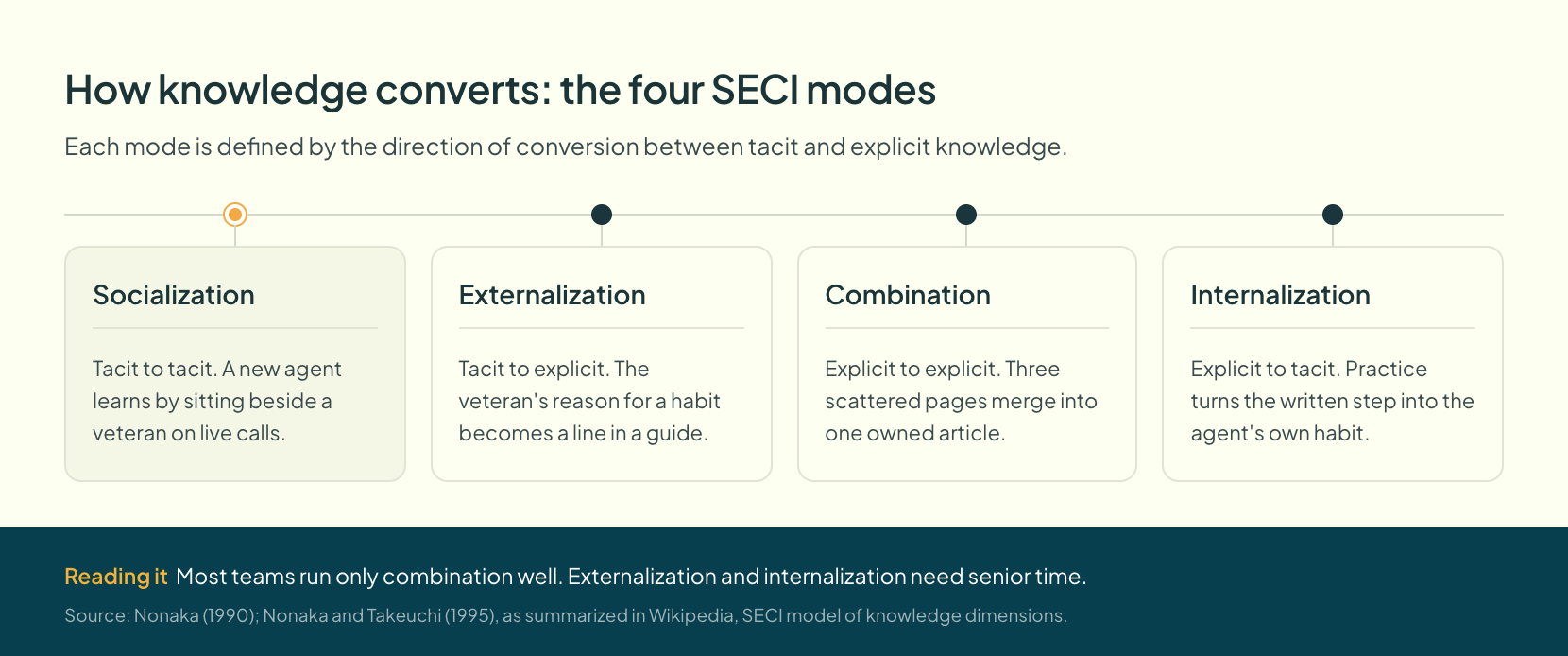
Conversion is where tacit vs explicit knowledge stops being a taxonomy and becomes work. Ikujiro Nonaka’s answer is the SECI model, which Wikipedia’s SECI model entry describes. He developed it in 1990, and his 1995 book with Takeuchi, The Knowledge Creating Company, made it the standard reference. Its central claim is that interaction between tacit and explicit knowledge creates knowledge, so conversion runs in both directions. The conversion of tacit knowledge is only one of four moves.
Each of the four modes below carries a worked example from a support floor. The examples are composites of what teams describe.
- Socialization (tacit to tacit). A new agent spends a week beside a veteran and notices that she always checks the account’s last three contacts before greeting. Nobody writes anything down, and the habit transfers.
- Externalization (tacit to explicit). A facilitator asks the veteran why. Her answer, “if the last call was a complaint I open with an apology, otherwise I lose the first two minutes”, becomes one line in the call opening guide.
- Combination (explicit to explicit). An editor merges three pages on greetings, complaints and account history into one article with a single owner. Nothing new is learned, yet the knowledge can finally be found.
- Internalization (explicit to tacit). A new agent practices the opening on twenty mock calls until she stops consulting the article. The step has become her own habit, so she can bend it when a call demands.
Why the middle modes cost the most
In fact, most organizations run only the third mode well. Combination is what document tools do, so it comes easily. Teams that run all four treat the gap between modes two and four as the real work. Externalization needs a person who asks good questions, and internalization needs practice time. Both cost senior attention, and both belong inside any working knowledge management process.
Start From a Free SOP Template
Which format carries tacit vs explicit knowledge best?
A tacit vs explicit knowledge decision starts with three tests. Write a fact down when a colleague could verify it, when it comes up often, and when its answer has a clear shape. Facts that fail the tests belong with people, through coaching and shadowing. The broader map of types of knowledge helps with the sorting, and the container then follows from what the reader is doing at the moment of need.
A fixed sequence belongs in an SOP. Cases that branch on the caller’s answers belong in an interactive decision tree, which asks one question per screen so a new agent never holds the whole procedure in memory.
For example, take the cancellation call again. The retention offers are explicit and belong in a table the agent can see. Which offer to lead with turns on three questions an agent can ask: how long the customer has stayed, whether the stated reason is price, and whether they have called before. Those questions are the externalized part of the veteran’s judgment, and they fit a branch. The tone-reading that tells her the customer half hopes to be talked out of leaving does not fit. Coaching on recorded calls handles that part, at the price of senior time.
The test also works in reverse. When agents keep asking the same colleague the same question, that fact has already passed all three tests without anyone noticing, and it is waiting to be written down. A tally of those repeat questions gives the externalization step a ready list.
Map One Veteran Judgment as a Decision Tree
When does the tacit and explicit split stop helping?
The split breaks down in two places. The first is conceptual: Wikipedia reports that Polanyi held all knowledge to be rooted in tacit knowing, so a goal of making everything explicit cannot succeed. In practice the problem is simpler. A page that tries to hold every condition and exception grows too long to read mid-call, and an agent who cannot read it goes back to asking a colleague.
The second is scale. A team of eight with a stable product may serve customers well on a dozen articles, a shared chat channel and regular call reviews, so heavy structure is a cost there and not a benefit. Equally, the tacit vs explicit knowledge split says nothing about who owns each item or when someone last checked it, and those two facts decide whether the written half stays true.
Where tooling earns its place
Past a few dozen agents, owners, review dates and usage data need software behind them, because nobody remembers to run a review loop by hand. Knowledge base software that records those three things shows which written items agents open and which sit unread. Knowmax serves this contact center case: it keeps articles, SOPs and decision trees in one governed library and surfaces them inside the agent’s workflow. It covers the explicit layer and the externalized fragments of judgment, but coaching still carries the part that depends on feel. Still, other platforms do versions of the same job. The test is whether the review loop runs without anyone remembering to start it.
Ready to Put Both Kinds of Knowledge to Work?
Frequently asked questions
Writing, recording or diagramming produces explicit knowledge, so others can use it. The tacit kind sits in a person and is hard to state. Writers use implicit knowledge in two ways, either as a synonym for tacit or for knowledge that could be written but never was, so check which sense a source means.
A how-to video is explicit knowledge, because it records a method others can replay without the author. What it rarely captures is the tacit layer: why the presenter chose that order, and what they would do if the screen looked different.
Test it on a real case. Ask a newer agent to resolve a past case using only the captured material and no colleague. If the outcome matches an experienced agent’s, the transfer worked. If not, the missing steps show where tacit knowledge remains.
A knowledge base holds the explicit half. Judgment about when to apply a rule, bend it or escalate is tacit and develops through practice on live calls, so coaching and case review remain necessary however complete the written library is.


 Word Document)
 Excel File)


