 18 Min


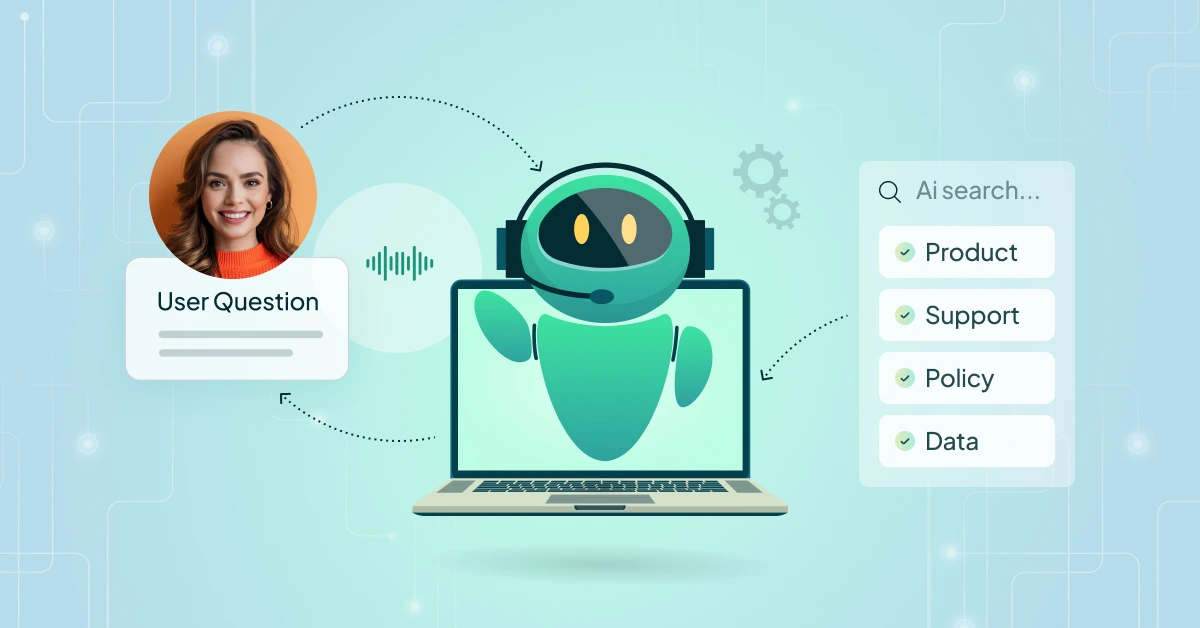
A frustrated customer contacts your support team at 2 PM on a Tuesday. They ask a simple question: “What’s your return policy for orders placed on weekends?”
Your new AI chatbot confidently responds: “Sure! You have 90 days to return any item. Oh, and we accept returns via cryptocurrency.”
The return policy is partially correct. The cryptocurrency acceptance? That was a hallucination; your company doesn’t even offer that. But why did it happen?
The bot was trained on sprawling, unstructured data: scattered emails, outdated PDFs, conflicting blog posts, and support tickets. It stitched together fragments without understanding relationships between concepts, dates, or dependencies. No wonder it invented “facts” that sounded plausible.
Now imagine a different scenario. The same customer asks the same question. But this time, your AI agent pulls from a structured knowledge graph, a network of interconnected, validated facts. The graph shows that return policies depend on order placement time, customer tier, and product category. It knows these relationships, sources, and approval dates. The answer comes back instantly and accurately: “Returns are accepted within 30 days for standard customers, 60 days for loyalty members, regardless of when you placed the order.”
This is the future of AI agents. And it all starts with a knowledge structure.
Table of contents
- What Is a Knowledge Graph (And Why It’s Not Just a Bigger Database)
- Why Enterprises Are Betting on Knowledge Graphs
- How Knowledge Graphs Prevent AI Hallucinations
- Building Blocks of an Enterprise Knowledge Graph
- The Role of Decision Trees and Guided Workflows
- The Future of Knowledge-Powered AI Agents
- Ready to Power Your AI Agents with Structured Knowledge?
- Frequently Asked Questions
What Is a Knowledge Graph (And Why It’s Not Just a Bigger Database)
A knowledge graph is fundamentally different from a flat knowledge base. Let’s break it down:
Flat Knowledge Base
- Documents, articles, and FAQs are stored as isolated files
- Search works by keyword matching
- No inherent relationships between concepts
- Difficult to update without cascading errors
Knowledge Graph
- Data organized as interconnected nodes and relationships
- Entities (products, policies, customers) are explicitly linked
- Context is embedded: A product “contains” features, “has” a price, “belongs to” a category
- Easy to propagate updates across connected knowledge
Think of it this way: A flat knowledge base is like a filing cabinet. A knowledge graph is like a well-organized mind, where pulling one thread of thought naturally leads to related ideas.
Learn more about structuring knowledge for AI on our blog.
Design FAQs That AI Can Actually Understand
Why Enterprises Are Betting on Knowledge Graphs
- 5X to 6X Performance Gains: eGain reports enterprises achieve 5X acceleration in knowledge creation and 6X improvement in search success by combining GenAI with trusted knowledge management. Structured knowledge paired with AI isn’t just incremental, it’s transformational.
- 80% Autonomous Resolution by 2029: Gartner predicts that agentic AI will autonomously resolve 80% of common customer service issues by 2029, but only if those agents have access to reliable, structured knowledge sources.
- The Unstructured Knowledge Penalty: Only 14% of self-service interactions fully resolve without structured knowledge. This is the real cost of relying on unstructured data: customer effort, repeat contacts, and erosion of trust.
- A Booming Market: The global KM software market is projected to reach $26.4 billion in 2026, as enterprises increasingly recognize that knowledge infrastructure is as critical as data infrastructure.
- The CX Perception Gap: 80% of organizations believe they deliver superior CX, yet only 8% of customers agree. Knowledge gaps, where agents can’t find the right information, are a leading cause of this disconnect.
How Knowledge Graphs Prevent AI Hallucinations
AI hallucinations occur when language models generate plausible-sounding but false information. They happen because the model relies on pattern-matching rather than grounding in verified facts.
The Hallucination Problem
When an AI agent relies on its training data alone, it fills gaps with patterns that seem logical but may be completely invented.
The Knowledge Graph Solution
A knowledge graph acts as a guardrail by:
- Grounding responses in verified facts: Every answer is traceable to an approved source with metadata (date, owner, version)
- Explicit relationships: The graph encodes “return policy applies to product type X, not Y,” preventing contradictions
- Constraint checking: Rules embedded in the graph prevent logically impossible responses
- Source transparency: Customers can see where information came from, building trust
- Easy updates: When policy changes, one update propagates everywhere the policy is referenced
Explore how AI agents reduce hallucinations through knowledge governance in our latest research.
Building Blocks of an Enterprise Knowledge Graph
1. Entities
The “nouns” of your knowledge system: Products, Policies, Customers, Teams, Locations, Outcomes. Each entity has properties (a product has a SKU, price, and warranty period) and is a node in the graph.
2. Relationships
The connections between entities. “Product X has Feature Y,” “Policy A applies to Customer Tier B,” “Resolution Type C is owned by Team D.” These relationships encode the logic your AI agents need.
3. Attributes & Metadata
Timestamps, authors, approval status, confidence scores. Metadata tells your AI agent why information should be trusted and when it was last validated.
4. Taxonomies & Hierarchies
Categories that organize knowledge: Product families, issue types, and resolution categories. These hierarchies help agents navigate complexity and quickly find the most relevant information.
5. Decision Logic & Rules
Conditional rules that guide decisions: “If issue type is ‘billing’ and customer tier is ‘platinum,’ escalate to the finance team,” or “If the return window has expired, suggest store credit instead.” Rules encode business logic that agents can execute with confidence.
The Role of Decision Trees and Guided Workflows
Knowledge graphs don’t just store facts; they encode decision pathways. This is where structured knowledge becomes truly powerful for customer service.
Decision Trees in Action
A well-designed knowledge graph includes decision trees that guide agents through complex scenarios:
Customer reports slow product → Is it a known issue (node in graph)? → Yes → Link to workaround documentation → Apply troubleshooting steps in sequence → Monitor for resolution. If not resolved → Escalate to engineering team.
Without this structure, an AI agent might offer conflicting troubleshooting steps or miss the fact that a known bug fix exists.
Guided Workflows
Knowledge graphs power workflow orchestration. When a customer contacts support, the agent (human or AI) isn’t navigating a search interface; they’re following a guided pathway:
- What is the issue category? (Product, billing, account, technical)
- What is the customer’s tier? (Changes available options)
- Has this issue been resolved before? (Link to past cases)
- What’s the fastest resolution path? (Graph knows dependencies and prerequisites)
- When should this escalate? (Thresholds are explicit in the graph)
Start Building Your Knowledge Graph the Right Way
The Future of Knowledge-Powered AI Agents
As AI capability accelerates, the differentiator isn’t raw model power; it’s knowledge quality and structure.
What’s Coming
- Real-time knowledge updates: Agents learn about new products, policies, and issues within minutes, not weeks
- Personalized reasoning: Knowledge graphs will encode customer-specific context (history, preferences, agreements), enabling hyper-relevant recommendations
- Multi-agent orchestration: Teams of specialized AI agents (product expert, policy specialist, tone matcher) will coordinate through shared knowledge graphs
- Proactive problem-solving: Graphs will enable agents to predict issues before customers report them
- Continuous knowledge quality: Feedback loops will automatically flag outdated or conflicting information for human review
- Cross-domain reasoning: Agents will connect product knowledge, customer history, company policies, and external market data to provide truly contextual support
The enterprises that win in 2026 and beyond won’t just have better AI models; they’ll have better knowledge.
Ready to Power Your AI Agents with Structured Knowledge?
Knowmax helps enterprises build and maintain knowledge graphs that turn unstructured information into intelligent, trustworthy AI agents. Whether you’re deploying your first knowledge-powered agent or scaling across your contact center, we have the platform and expertise to help.
See How Knowmax Powers Smarter AI Agents with Structured Knowledge
Frequently Asked Questions
A vector database stores embeddings (numerical representations) optimized for similarity search, while a knowledge graph stores explicit relationships and logic. Together, they’re powerful: vectors find relevant documents, graphs provide structured reasoning on top. Vector databases are about similarity; knowledge graphs are about relationships and rules.
Initial deployment for a single line of business typically takes 6-12 weeks, including knowledge extraction, taxonomy design, and validation. However, enterprise-wide graphs with multiple departments and complex relationships can take 6-18 months. The key is to start with a high-value domain and expand iteratively. Early wins build momentum and ROI
Yes, but with caveats. AI can extract entities and relationships from documents, but the result always requires human curation to ensure accuracy and consistency. The process involves:
(1) Automated extraction
(2) Manual review and conflict resolution
(3) Taxonomy alignment
(4) Approval workflow
A mix of automation and human expertise is most effective.
A small core team of 2-4 people can maintain a knowledge graph: A knowledge architect (owns structure and relationships), domain experts (validate accuracy), a data steward (ensures updates and quality), and technical support (integrations with AI agents). This team should report to a business leader, not IT, because knowledge is a competitive asset.
Build update workflows into your business processes. When a policy changes, a new product launches, or a bug is discovered, the responsible team updates the graph immediately as part of their job. Add governance: version control, change approval workflows, and periodic audits. Finally, surface outdated information to stakeholders, make it visible that something needs updating, rather than hiding it.


 Word Document)
 Excel File)


